Mandya Pre-Monsoon Rains Boost Agriculture and Crop Planning
Source:The Hindu ↗
Why It Matters
Provides a practical case study of agricultural planning at the district level, demonstrating the real-world linkages between monsoon dependency, cropping patterns, institutional support (FPOs/PACS), and risk mitigation schemes (PMFBY).
Summary
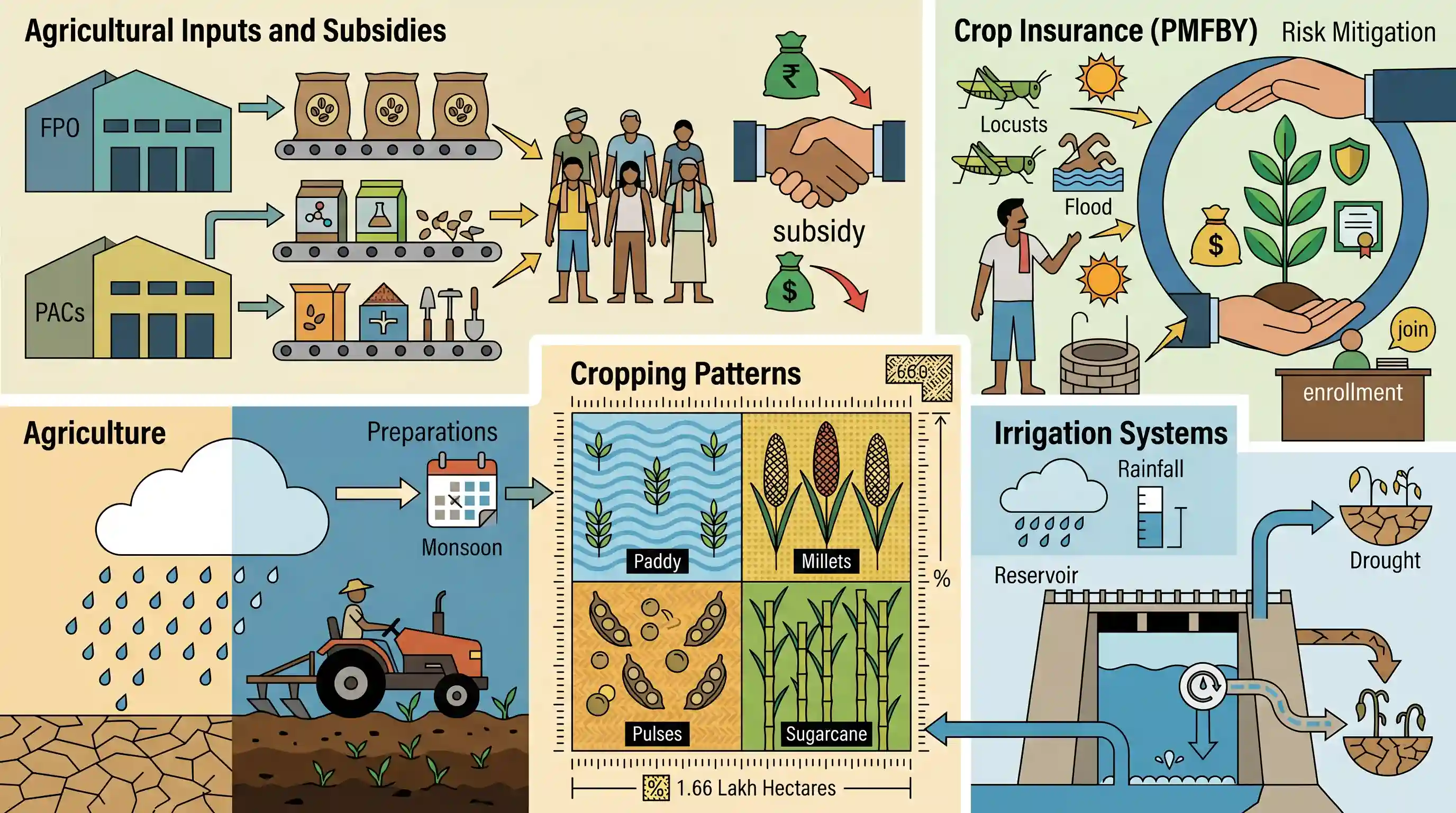
Pre-monsoon showers in Karnataka's Mandya district have revitalized agricultural activities, prompting early preparations for cultivating crops such as paddy, millets, pulses, and sugarcane. The state agriculture department aims to cover 1.66 lakh hectares during the monsoon, though ultimate success relies on sufficient rainfall and water levels in the Krishnaraja Sagar (KRS) reservoir. To support farmers, essential inputs including seeds and fertilizers are being distributed via Farmer Producer Organisations (FPOs) and Primary Agricultural Cooperative Societies (PACS), while enrollment in the Pradhan Mantri Fasal Bima Yojana (PMFBY) is being strongly encouraged for risk mitigation.
Key Points
- Pre-monsoon rains in Mandya district have spurred agricultural preparations, raising hopes for a good yield of summer and pre-monsoon crops like paddy, millets, pulses, and sugarcane.
- The Agriculture Department has set a cultivation target of 1.66 lakh hectares for the monsoon, aiming for a total of 1.92 lakh hectares including pre-monsoon cultivation.
- Agricultural success remains dependent on optimal water levels in the Krishnaraja Sagar (KRS) reservoir and rainfall across the Cauvery catchment area.
- Essential inputs like seeds and fertilizers are actively being distributed through Raitha Samparka Kendras, FPOs, and PACS to meet farmer demand.
- Farmers are being urged to enroll in the Pradhan Mantri Fasal Bima Yojana (PMFBY) to mitigate risks of crop failure.
Important Terms
Pradhan Mantri Fasal Bima Yojana (PMFBY)

Flagship crop insurance scheme providing financial support for crop loss due to natural calamities, pests, or diseases. It features low, capped premiums for farmers and leverages technology for damage assessment.
UPSC context
GS Paper III: Agriculture and Risk Management; tests understanding of government welfare schemes and sustainable farming incentives.
Farmer Producer Organisations (FPOs)
Collectives of small and marginal farmers formed to improve bargaining power in input procurement and marketing. They operate as hybrids between cooperatives and private companies to ensure better price realization.
UPSC context
GS Paper III: Agricultural Marketing and Empowerment; critical for topics on doubling farmers' income and supply chain management.
Primary Agricultural Cooperative Societies (PACS)
The grassroots level of India's short-term cooperative credit structure. They provide agricultural loans, distribute inputs like seeds and fertilizers, and offer marketing facilities directly to rural members at the village level.
UPSC context
GS Paper III: Institutional Credit; vital for rural development, financial inclusion, and the cooperative movement in India.
Raitha Samparka Kendras (RSK)
Karnataka-specific agricultural extension centers established at the hobli (sub-block) level to provide farmers with technical advisory services, quality seeds, and information on new agricultural technologies.
UPSC context
GS Paper III: Extension Systems; represents localized decentralized extension models that bridge the gap between lab research and farm practice.
Krishna Raja Sagara (KRS) Dam
A major gravity dam on the Kaveri River in Mandya, Karnataka, designed by Sir M. Visvesvaraya. It is the primary source of irrigation for the region and drinking water for Bengaluru.
UPSC context
GS Paper I & III: Geography/Water Resources; tests knowledge of river systems, inter-state water disputes (Cauvery), and iconic infrastructure.
Prelims Trap
Enrolment in the Pradhan Mantri Fasal Bima Yojana (PMFBY) is mandatory for loanee farmers.
PMFBY was revamped in Kharif 2020, making enrolment 100% voluntary for all farmers, including those availing institutional credit (loanee farmers).
Static Concepts Connected
What are the major pre-monsoon showers in India and their local significance?
- Mango Showers: Occur primarily in Kerala and Karnataka towards the end of summer; they are essential for the early ripening of mangoes.
- Blossom Showers: Also known as Coffee Showers; these pre-monsoon rains are vital for coffee flowers to blossom in Karnataka and Kerala.
- Kalbaisakhi: Violent thunderstorms in Bengal and Assam (Nor'westers) that, while sometimes destructive, provide moisture for tea, jute, and rice cultivation.
What is the premium and coverage structure under the PMFBY?
- Stated Premiums: Farmers pay a highly subsidized, uniform premium of 2% for Kharif crops and 1.5% for Rabi crops.
- Commercial Crops: Annual commercial and horticultural crops carry a maximum farmer premium of 5% of the sum insured.
- Coverage Scope: It provides comprehensive insurance against non-preventable natural risks from pre-sowing to post-harvest stages.
Cross-Topic Patterns
PACS and FPOs in Input Distribution
PACS are evolving beyond rural credit mechanisms into multi-service centers (distributing seeds and fertilizers), mapping directly to the Ministry of Cooperation's 'Sahkar se Samriddhi' mandate.
Reservoirs and Tributary Confluences
The Krishnaraja Sagar (KRS) Dam sits at the confluence of the Cauvery, Hemavathi, and Lakshmana Theertha, highlighting a recurring UPSC trend of matching dams with their precise tributary nodes.

Expect a 2026 Prelims map question pairing South Indian reservoirs (like KRS) with their specific tributary confluences and catchment crops.
Linked PYQs · 4
Linked PYQs · 4
- 2016PrelimsGS1
With reference to 'Pradhan Mantri Fasal Bima Yojana', consider the following statements: 1. Under this scheme, farmers will have to pay a uniform premium of two percent for any crop they cultivate in any season of the year. 2. This scheme covers post-harvest losses arising out of cyclones and unseasonal rains. Which of the statements given above is/are correct?
- 2016MainsGS3
Given the vulnerability of Indian agriculture to vagaries of nature, discuss the need for crop insurance and bring out the salient features of the Pradhan Mantri Fasal Bima Yojana (PMFBY).
- 2023MainsGS3
Explain the changes in cropping pattern in India in the context of changes in consumption pattern and marketing conditions.
- 2014MainsGS3
In the villages itself no form of credit organization will be suitable except the cooperative society. -All India Rural Credit Survey. Discuss this statement in the background of agricultural finance in India. What constraints and challenges do financial institutions supplying agricultural finance face? How can technology be used to better reach and serve rural clients?
