India US Strategic Partnership and Strategic Autonomy Concerns
Source:Indian Express ↗
Why It Matters
Provides a critical counter-perspective on the much-celebrated India-US strategic partnership, essential for UPSC aspirants to present a balanced view in GS2 International Relations answers. It highlights the tension between deepening alliances and maintaining strategic autonomy.
Summary
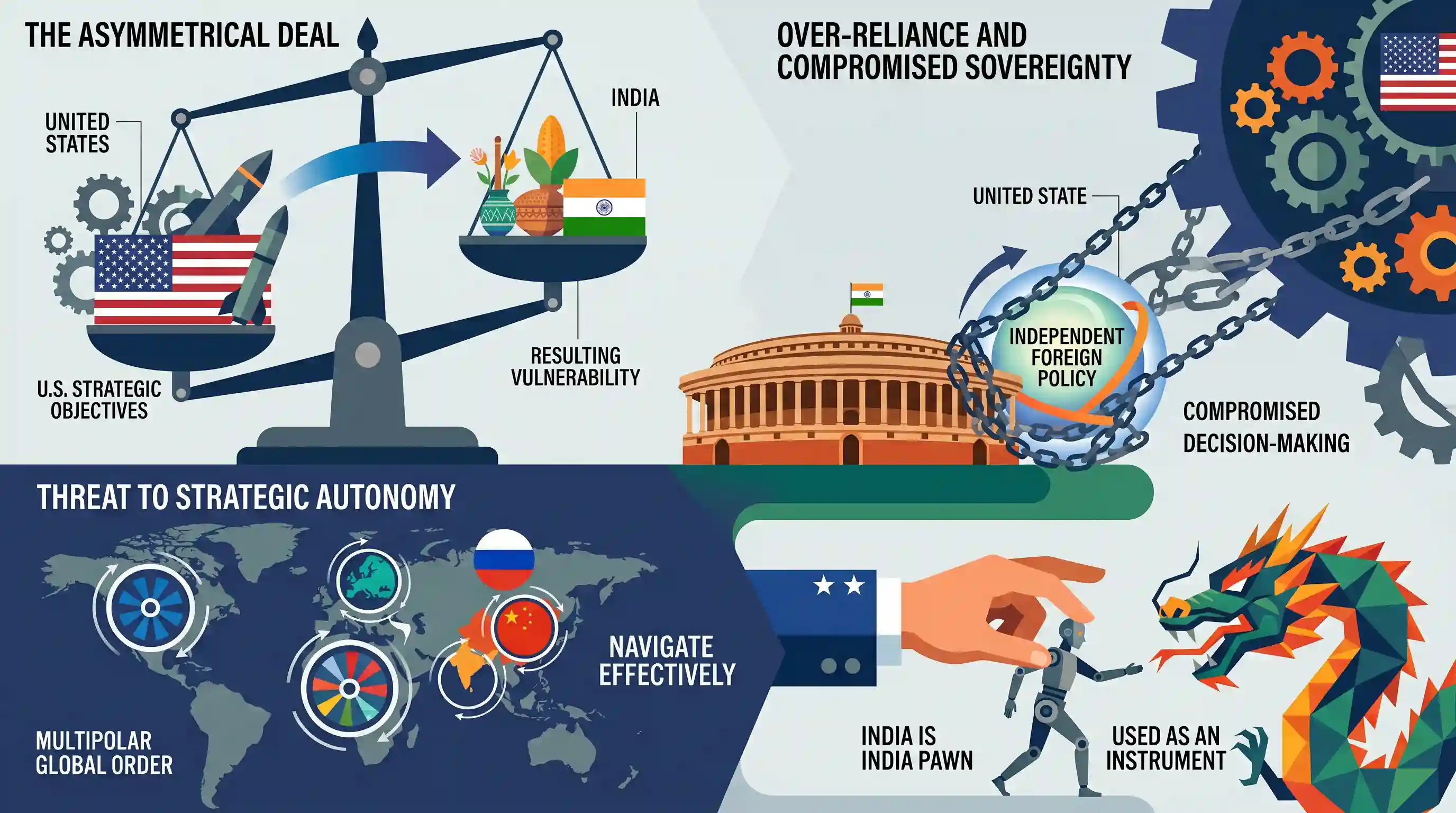
In an analytical critique, Pratap Bhanu Mehta asserts that a recent India-US deal is fundamentally asymmetric, prioritizing American strategic objectives over Indian interests. The article warns that engaging in one-sided agreements generates long-term vulnerabilities for New Delhi, threatening its strategic autonomy and independent foreign policy. By over-relying on the US, India risks compromising its sovereign decision-making power and its ability to navigate a multipolar global order effectively.
Key Points
- Pratap Bhanu Mehta argues that recent India-US agreements (likely in defense, technology, or trade) are inherently one-sided, disproportionately favoring American strategic and economic interests.
- Such deals compromise India's long-standing doctrine of strategic autonomy, binding it closer to US-led geopolitical frameworks and reducing its diplomatic maneuverability.
- Deepening structural reliance on the US creates long-term vulnerabilities, potentially exposing India to future technology denial regimes, supply chain leverage, or pressure to align with US foreign policy objectives.
- The author advocates for a recalibration of bilateral ties to ensure that partnerships preserve India's sovereign decision-making and accommodate its national self-esteem.
Important Terms
Strategic Autonomy

The ability of a nation to pursue independent foreign and security policies based on national interests without permanent alignment with major power blocs or external pressure.
UPSC context
Core concept for GS Paper II (International Relations); tests India's ability to balance major power rivalries (US-China-Russia).
Multi-alignment
India's pragmatic policy of engaging multiple, often competing, global powers simultaneously through issue-based coalitions (e.g., Quad and SCO) to maximize strategic leverage.
UPSC context
Evolution of Non-Alignment; critical for understanding modern Indian diplomacy in a multipolar world (GS II).
iCET (Initiative on Critical and Emerging Technology)
A 2022 bilateral framework between India and the U.S. to expand cooperation in high-tech areas like AI, quantum computing, semiconductors, and space exploration.
UPSC context
Signifies the shift from a buyer-seller relationship to a co-production and technology-transfer partnership (GS II/GS III).
Asymmetric Agreement
An international pact where benefits or obligations are skewed toward one party, potentially creating long-term strategic dependencies or compromising the sovereign decision-making of the weaker partner.
UPSC context
Analytical term for critiques of trade/defense deals; tests ability to evaluate "national interest" versus "strategic costs."
GE F414 Jet Engine Deal
A 2023 agreement for General Electric to transfer technology and coproduce fighter jet engines in India, serving as a milestone for defense industrial cooperation.
UPSC context
Key example of "Aatmanirbhar Bharat" in defense and high-end technology transfer (GS II/GS III).
Global Strategic Partnership
The institutional framework of India-US relations founded on shared democratic values and deep cooperation across defense, trade, and regional security in the Indo-Pacific.
UPSC context
Standard framing for India-US bilateral ties; essential for mapping the "defining relationship of the 21st century."
Prelims Trap
Foundational agreements like LEMOA and COMCASA establish a formal mutual defense alliance between India and the US.
Foundational agreements facilitate military interoperability, logistics sharing, and secure communications. They do not constitute a mutual defense treaty (like NATO) or mandate joint operations.
Static Concepts Connected
What are the four US foundational defense agreements signed by India?
- GSOMIA: Allows the sharing and protection of classified military information between the two nations (signed in 2002).
- LEMOA: Facilitates mutual logistics support, refueling, and berthing, but explicitly does not grant basing rights to the US (2016).
- COMCASA: Enables secure communication networks and data link interoperability for advanced defense platforms (2018).
- BECA: Allows sharing of classified geospatial intelligence, military maps, and satellite data for precision targeting (2020).
How does India's 'Strategic Autonomy' differ from Cold War-era 'Non-Alignment'?
- Non-Alignment: Focused defensively on maintaining equidistance from superpower blocs to avoid being drawn into the Cold War bipolar rivalry.
- Strategic Autonomy: Focuses proactively on multi-alignment, building issue-based, concurrent partnerships with competing powers (e.g., Quad and SCO) to maximize national interests.
Cross-Topic Patterns
Tech denial & Atmanirbhar Bharat
Reliance on US tech like GE F414 engines highlights how geopolitical shifts can weaponize supply chains, forcing accelerated indigenization in defense under Atmanirbhar Bharat.
Balancing US alignment and Eurasian partners
Over-integration with the US complicates India's balancing act with Russia (energy) and Iran (Chabahar port), directly testing the limits of its multi-alignment strategy.

Expect a 2026 Mains question on the paradox of India asserting 'Strategic Autonomy' while deepening asymmetric tech dependence on the US.
Linked PYQs · 3
Linked PYQs · 3
- 2020MainsGS2
What is the significance of Indo-US defence deals over Indo-Russian defence deals? Discuss with reference to stability in the Indo-Pacific region.
- 2019MainsGS2
‘What introduces friction into the ties between India and the United States is that Washington is still unable to find for India a position in its global strategy, which would satisfy India's national self-esteem and ambitions.’ Explain with suitable examples.
- 2025MainsGS2
"With the waning of globalization, post-Cold War world is becoming a site of sovereign nationalism.” Elucidate.
