Technological Sovereignty and Strategic Autonomy in Global Power
Source:Indian Express ↗
Why It Matters
The intersection of technology and international relations (geo-tech) is highly relevant for both GS2 (Global politics, foreign policy) and GS3 (Science & Tech, indigenization). This conceptual framework helps candidates argue why technological sovereignty is a prerequisite for strategic autonomy in a multipolar world.
Summary
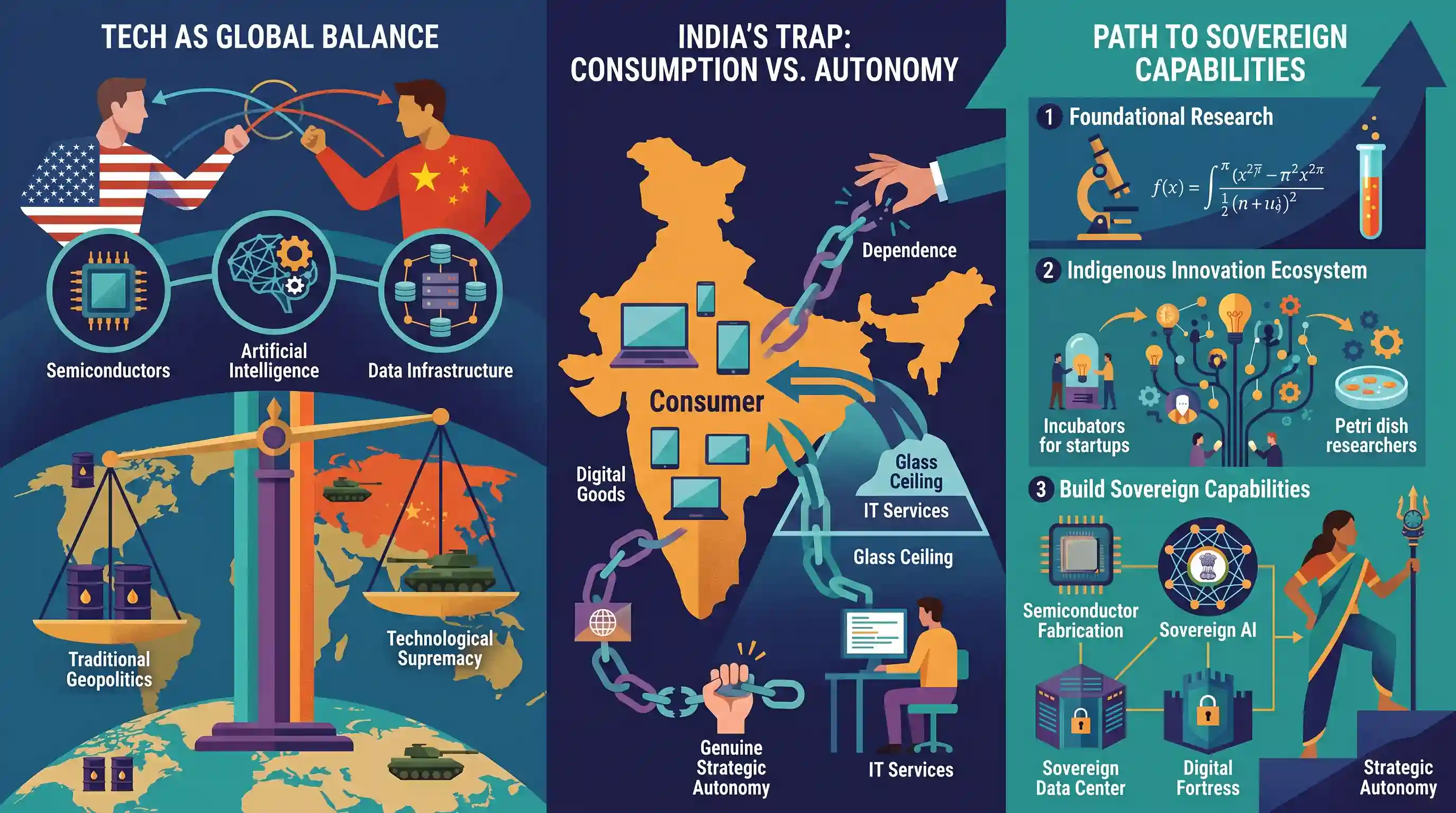
In this column, Pratap Bhanu Mehta explores how technological supremacy has become the primary metric defining the global balance of power, effectively superseding traditional geopolitical calculations. Driven heavily by the intensifying tech rivalry between the United States and China, the control over critical nodes like semiconductors, artificial intelligence, and data infrastructure is dictating international leverage. For India, the key lesson is that genuine strategic autonomy cannot be achieved simply by being a massive consumer of digital goods or a provider of IT services. Instead, India must rapidly scale up its foundational research, foster an indigenous innovation ecosystem, and build sovereign capabilities in critical technologies to secure its place in the emerging global order.
Key Points
- The traditional geopolitical concept of 'balance of power' is now fundamentally driven by mastery over critical and emerging technologies (such as AI, quantum computing, and semiconductors), rather than just conventional military might.
- The intensifying technological rivalry between the US and China is leading to supply chain decoupling, creating a fragmented global tech order that forces other nations to navigate complex strategic choices.
- For India to maintain genuine strategic autonomy, relying on technology imports or digital service provision is inadequate.
- India must aggressively pivot towards foundational research and development (R&D), building indigenous intellectual property, and establishing robust manufacturing ecosystems in strategic sectors.
Prelims Trap
"The private sector contributes the majority of India's Gross Expenditure on R&D (GERD)."
Unlike advanced economies, India's GERD (around 0.7% of GDP) is predominantly funded by the government, not the private sector.
Static Concepts Connected
What characterizes India's Gross Expenditure on R&D (GERD)?
- Low GDP Share: It has remained stagnant at around 0.65-0.7% of GDP for the past decade, significantly lower than the global average.
- Public Sector Dominance: The government and higher education sectors drive the majority of funding, unlike the private-led models of the US and China.
- NRF Intervention: The newly established Anusandhan National Research Foundation (NRF) aims to rectify this by crowding-in private R&D investments.
What is the India-US iCET?
- Bilateral Initiative: The Initiative on Critical and Emerging Technology (iCET) was launched by the US and India to elevate strategic tech partnerships.
- Core Domains: It targets collaboration in AI, quantum tech, space, 6G, advanced materials, and semiconductor supply chains.
- Strategic Objective: It aims to bypass traditional bureaucratic hurdles to foster co-development and co-production in defense and deep-tech.
Cross-Topic Patterns
Weaponized Interdependence & Tech Supply Chains
The US-China chip wars demonstrate 'weaponized interdependence', shifting geopolitical focus from maritime chokepoints to technology supply chains and export controls.
Sovereign AI and Data Localization
India's pursuit of 'technological sovereignty' directly ties into its data localization mandates and the push to build Sovereign AI stacks, linking IR to internal digital laws.
R&D Funding & IP Creation Deficit
India's struggle with low R&D connects directly to the Anusandhan National Research Foundation's mandate to crowd-in private funding and boost IP generation.

Expect a Mains question linking "technological sovereignty" with "strategic autonomy," examining how low private R&D limits India's IR choices.
Linked PYQs · 2
Linked PYQs · 2
- 2011MainsGS2
Is there still a role for the concept of balance of power in contemporary international politics? Discuss.
- 2014MainsGS2
The aim of Information Technology Agreements (ITAs) is to lower all taxes and tariffs on information technology products by signatories to zero. What impact would such agreements have on India's interests?
