Strategic Dilemma of Managing a Weak Versus Strong Pakistan
Source:Indian Express ↗
Why It Matters
The 'weak vs. strong Pakistan' debate is a foundational concept in India's foreign policy and security calculus. For UPSC aspirants, understanding this dynamic is essential for answering questions in GS-2 (International Relations) and GS-3 (Internal Security) regarding state sponsorship of terrorism, border management, and the implications of neighborhood instability on India's strategic goals.
Summary
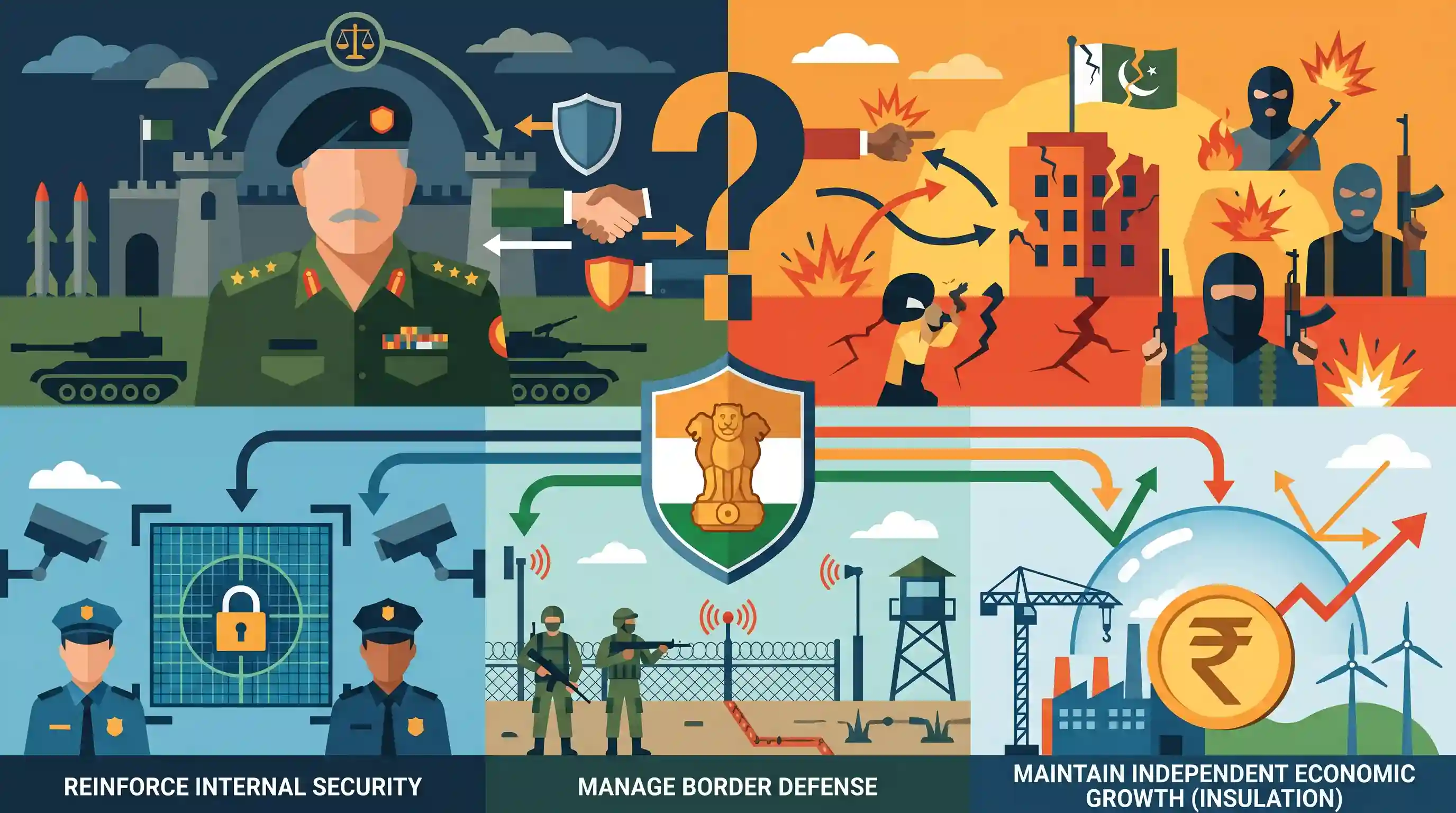
In his column, Pratap Bhanu Mehta analyzes the complex strategic dilemma India faces regarding its neighboring country, Pakistan: whether India is better off dealing with a strong or a weak Pakistan. While a strong Pakistan typically implies an empowered military establishment inherently hostile to India, it also offers a cohesive entity that can be deterred or engaged diplomatically. On the other hand, a weak, economically strained, and politically unstable Pakistan presents the dangerous nightmare of state collapse, proliferation of autonomous non-state actors, and radicalization, often leading to unpredictable cross-border terrorism as domestic diversion. The article argues that since India has minimal ability to influence Pakistan's internal trajectory, New Delhi must prioritize reinforcing its own internal security, managing border defense, and maintaining a focus on its independent economic growth to insulate itself from the spillover effects of Pakistan's instability.
Key Points
- The primary strategic dilemma for India involves evaluating whether a stable, strong Pakistan or an unstable, weak Pakistan aligns better with India's long-term security interests.
- A strong Pakistani state, typically dominated by its military establishment, inherently sustains structural animosity towards India but provides a centralized authority for deterrence and diplomatic engagement.
- Conversely, a weak Pakistan—characterized by economic turmoil and political fragmentation—increases the risk of state failure, loose control over radical non-state actors, and unpredictable cross-border provocations used as a diversion from domestic crises.
- India’s optimal approach is to accept its limited leverage over Pakistan's internal trajectory and focus on building robust internal security mechanisms, securing the Line of Control against trans-border terrorism, and widening the economic asymmetry between the two nations.
- Pakistan's internal instability continues to act as a significant impediment to regional cooperation frameworks like SAARC and overall South Asian stability.
Important Terms
Neighborhood First Policy

India's diplomatic strategy prioritizing immediate South Asian neighbors through connectivity, economic cooperation, and development aid to ensure regional stability and counter external influence.
UPSC context
GS Paper II (International Relations). Tests understanding of India’s regional engagement strategies and the prioritization of South Asian stability.
Cross-border Terrorism
Terrorist activities originating from one country’s territory (notably Pakistan) directed against another (India), often serving as a low-cost, asymmetric "grey zone" conflict.
UPSC context
GS Paper III (Internal Security). Tests knowledge of external security threats and the management of porous borders.
Non-state Actors
Groups or individuals, such as terrorist outfits or insurgent groups, that exert significant influence on security and politics without formal state affiliation.
UPSC context
GS Paper III (Security). Analyzes how external entities create internal security challenges through terrorism and radicalization.
Strategic Autonomy
The ability of a sovereign state to formulate and execute its foreign policy based purely on national interest without being constrained by external powers or alliances.
UPSC context
GS Paper II (Foreign Policy). Tests the evolution of India’s independent foreign policy and its modern global positioning.
Deep State
A secretive, unofficial power structure—typically the military and intelligence services (ISI) in Pakistan—that exercises significant control over state policy independently of the civilian government.
UPSC context
GS Paper II (International Relations). Tests analysis of the internal power dynamics of neighbors and their impact on bilateral ties.
SAARC
An intergovernmental organization of eight South Asian nations established in 1985 to promote regional cooperation; it remains largely ineffective due to persistent India-Pakistan hostilities.
UPSC context
GS Paper II (Regional Groupings). Foundation of South Asian regionalism; tests knowledge of multilateral forum challenges.
Proxy War
A conflict in which a state uses third parties—such as insurgents or non-state actors—as substitutes to fight an adversary, avoiding direct military confrontation.
UPSC context
GS Paper III (Security). Analyzes the asymmetric methods used by neighboring states to destabilize India.
Prelims Trap
"India's strategic doctrine officially aims for the political and economic collapse of Pakistan to neutralize border threats."
India actively avoids a complete state collapse in Pakistan. A failing nuclear-armed state controlled by radical non-state actors poses a far greater, unpredictable security nightmare.
Static Concepts Connected
How do hostile states utilize non-state actors for sub-conventional warfare against India?
- Plausible Deniability: Proxy groups allow the sponsor state to execute attacks, evade direct military retaliation, and avoid international diplomatic sanctions.
- Asymmetric Warfare: State sponsors use low-cost, high-impact terrorist strikes to bleed a conventionally stronger adversary without crossing the threshold of full-scale war.
- Domestic Diversion: Regimes facing severe economic or political turmoil use cross-border provocations to unite domestic populations and distract from internal crises.
What are the primary mechanisms used to secure India's Line of Control (LoC)?
- Physical Fencing: The Anti-Infiltration Obstacle System (AIOS) consists of multi-tier concertina wire fencing equipped with alarm systems to delay intruders.
- CIBMS Deployment: The Comprehensive Integrated Border Management System uses thermal imagers, radar, and underground sensors to create an electronic wall.
- Ceasefire Pacts: Bilateral military agreements, notably the 2003 pact and its 2021 reiteration, aim to reduce artillery exchanges and stabilize the frontier.
Cross-Topic Patterns
SAARC Dormancy & the BIMSTEC Pivot
Pakistan's internal instability and state-sponsored terrorism have stalled SAARC mechanisms since 2016, driving India's strategic shift toward BIMSTEC to ensure regional connectivity without obstruction.
Nuclear Security & State Collapse
A politically fragmented Pakistan severely heightens global non-proliferation anxieties, specifically the risk of tactical nuclear assets being acquired by autonomous radical non-state actors during a domestic collapse.

Expect a GS3 Mains 2026 question linking a neighbor's economic collapse to India's border management and non-state actor threats.
Linked PYQs · 4
Linked PYQs · 4
- 2015MainsGS2
Terrorist activities and mutual distrust have clouded India-Pakistan relations. To what extent the use of soft power like sports and cultural exchanges could help generate goodwill between the two countries? Discuss with suitable examples.
- 2016MainsGS2
Increasing cross-border terrorist attacks in India and growing interference in the internal affairs of several member-states by Pakistan are not conducive for the future of SAARC (South Asian Association for Regional Cooperation)." Explain with suitable examples.
- 2021MainsGS3
Analyse the multidimensional challenges posed by external state and non-state actors, to the internal security of India. Also discuss measures required to be taken to combat these threats.
- 2020MainsGS3
Analyze internal security threats and transborder crimes along Myanmar, Bangladesh and Pakistan borders including Line of Control (LoC). Also discuss the role played by various security forces in this regard.
