Global Governance Implications of the Israel Gaza Conflict
Source:Indian Express ↗
Why It Matters
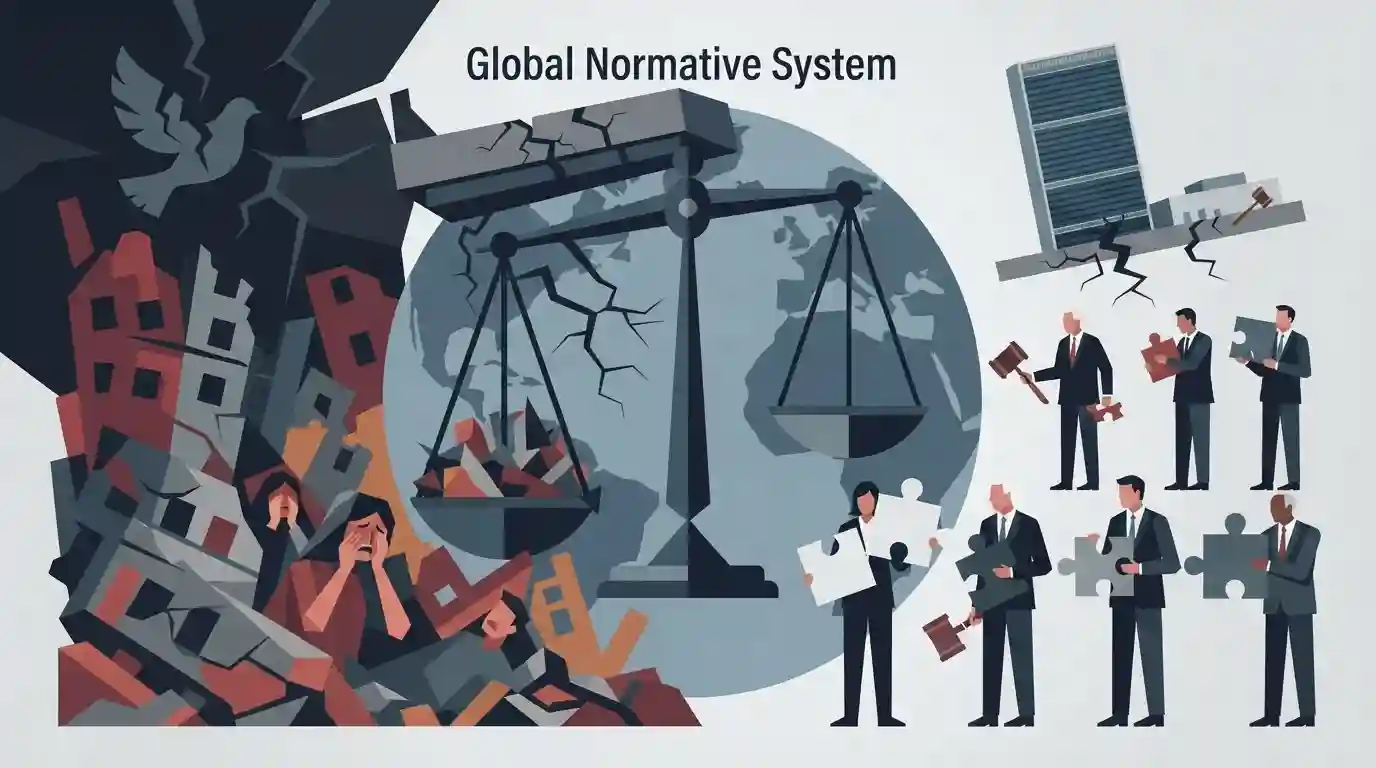
The article offers a profound analytical lens on how the Israel-Gaza conflict is not just a regional crisis but a systemic shock to global governance and international law. It provides critical arguments for GS2 (failure of the UN and rules-based order) and GS4 (ethics and moral duty in international relations).
Summary
In this commentary, Pratap Bhanu Mehta critiques the global response to the Israel-Gaza war, asserting that the staggering human suffering in Gaza exposes the failure and hypocrisy of the global normative system. He argues that the international community's complicity or inaction amidst profound devastation will inevitably erode the legitimacy of the rules-based global order, creating long-term geopolitical and ethical repercussions.
Key Points
- The unprecedented scale of civilian casualties and destruction in Gaza represents a severe humanitarian catastrophe that tests the conscience of the world.
- Global institutions, especially the United Nations, have been rendered largely impotent in halting the violence or enforcing international humanitarian law due to geopolitical gridlocks.
- The unequivocal support or muted criticism from prominent Western nations exposes deep hypocrisies, severely damaging the credibility of the so-called 'rules-based international order'.
- The failure to prioritize moral duty and basic human rights over strategic interests reflects a profound ethical vacuum in contemporary international relations.
- Turning a blind eye to the suffering in Gaza will have long-term consequences, eroding the normative foundation of the global system and breeding future instability and resentment.
Important Terms
International Law

A body of rules and principles that govern relations between sovereign states and international organizations. In the context of the Gaza conflict, it tests the limits of enforcement when powerful states bypass its frameworks.
UPSC context
Crucial for GS Paper II (International Relations). Tests knowledge of global governance, sovereignty, and the limits of international systems.
International Humanitarian Law
Also known as the law of armed conflict. A set of rules aiming to limit the effects of war by protecting non-combatants and restricting warfare methods, such as in the Israel-Gaza war.
UPSC context
Essential for GS Paper II. Evaluates understanding of human rights, war crimes, and ethics in international conflict.
United Nations (UN)
An intergovernmental organization founded in 1945 to maintain international peace, security, and cooperation. Its effectiveness and structural limitations, especially the Security Council's role, are heavily scrutinized during global crises.
UPSC context
Core to GS Paper II. Tests knowledge of international organizations, global governance, and reforms in the global order.
Prelims Trap
"UN General Assembly resolutions demanding a ceasefire are legally binding under international law."
Only UN Security Council resolutions are legally binding. UNGA resolutions carry moral and political weight but lack binding legal enforcement mechanisms.
Static Concepts Connected
What distinguishes International Humanitarian Law (IHL) from Human Rights Law (IHRL)?
- Context of Application: IHL applies exclusively during armed conflicts (jus in bello), whereas IHRL applies at all times, including peacetime.
- Derogation limits: IHRL allows states to suspend certain rights during public emergencies. IHL cannot be derogated from, as it is designed specifically for war.
- Core Frameworks: IHL is primarily rooted in the Geneva Conventions, while IHRL stems from the Universal Declaration of Human Rights and subsequent covenants.
What are the core dilemmas studied under Ethics in International Relations?
- Realism vs. Morality: The persistent tension between pursuing hard strategic national interests (realism) and upholding universal moral duties or human rights (idealism).
- Selective Interventionism: The hypocrisy of powerful states enforcing normative rules or staging humanitarian interventions selectively based on geopolitical alliances rather than universal justice.
- Institutional Inequality: The unequal power dynamics within global institutions (like the UN veto system) that prioritize the strategic needs of a few over global equity.
Cross-Topic Patterns
UN Paralysis and UNSC Reform demands
The P5 veto gridlock over the Gaza conflict directly strengthens India's and the broader Global South's persistent demand for expanding and democratizing the UN Security Council.
Ukraine vs. Gaza: Geopolitical Realpolitik
Western rhetoric on Ukraine emphasizing sovereignty sharply contrasts with its stance on Gaza, a contradiction routinely leveraged by China to court developing nations.

2026 Mains will likely fuse GS2 and GS4, asking how the selective application of human rights norms undermines the rules-based global order.
Linked PYQs · 2
Linked PYQs · 2
- 2025MainsGS2
"The reform process in the United Nations remains unresolved, because of the delicate imbalance of East and West and entanglement of the USA vs. Russo-Chinese alliance.” Examine and critically evaluate the East-West policy confrontations in this regard.
- 2020MainsGS4
‘The will to power exists, but it can be tamed and be guided by rationality and principles of moral duty.’ Examine this statement in the context of international relations.
