Limits of India Global Mediation and Realist Foreign Policy
Source:Indian Express ↗
Why It Matters
Offers a critical evaluation of India's 'multi-alignment' strategy and highlights the tension between pragmatism (realism) and principles (morality/international law) in foreign policy. Highly relevant for evaluating India's emerging role as a 'Vishwa Mitra' and for addressing GS4 questions on ethics in international relations.
Summary
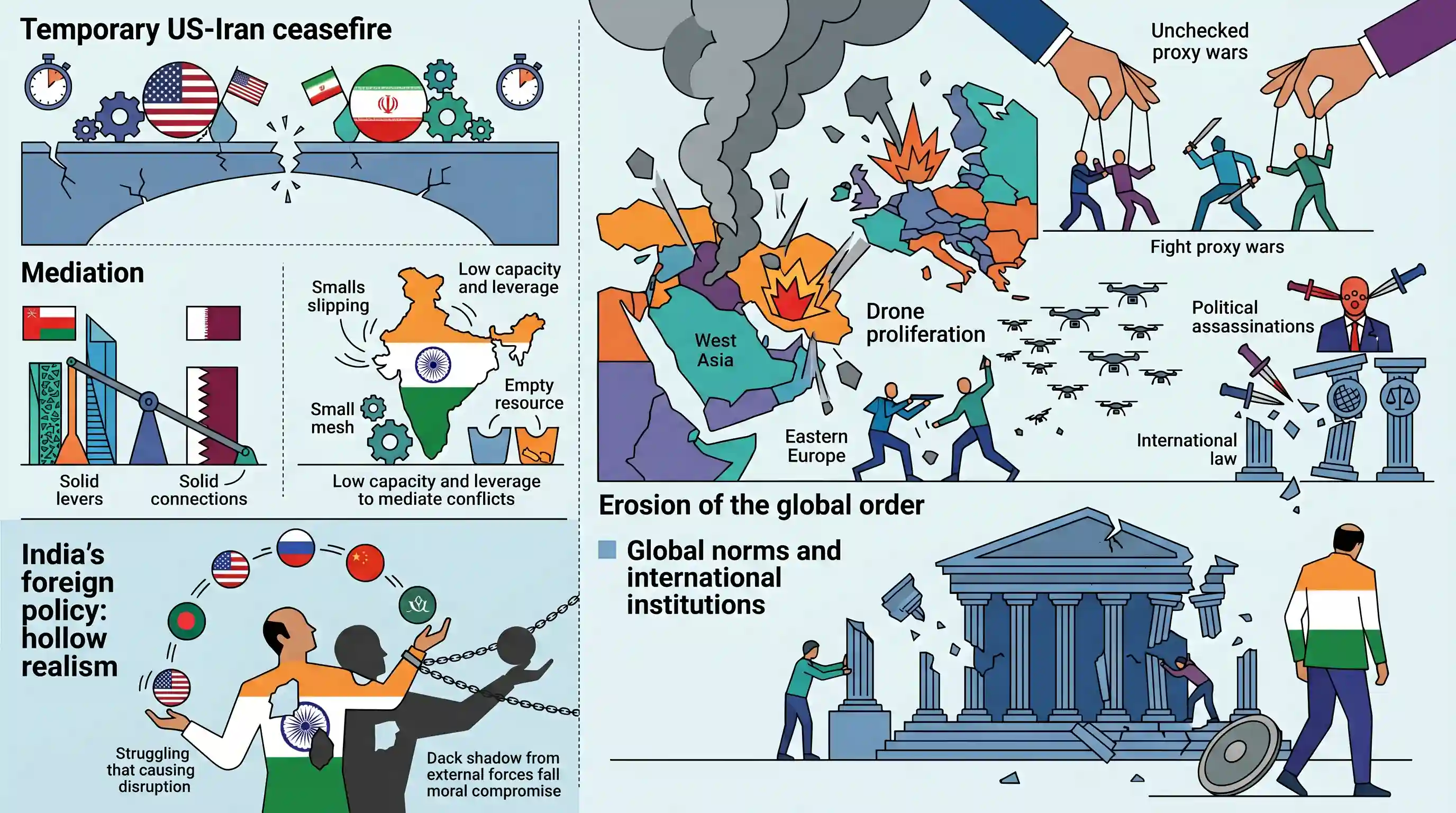
Pratap Bhanu Mehta examines the recent US-Iran ceasefire, arguing it represents a fragile tactical pause rather than a lasting geopolitical settlement. The piece critiques the notion of India acting as a mediator in global conflicts, highlighting New Delhi's lack of substantive leverage, diplomatic capacity, and principled alliances compared to successful facilitators like Oman and Qatar. Furthermore, the article observes a dangerous erosion of the global order, characterized by unchecked proxy wars, drone proliferation, and political assassinations in regions like West Asia and Eastern Europe. Mehta asserts that India's current foreign policy—styled as "multi-alignment" or "realism"—is practically hollow and morally compromised, as it aligns with powers undermining international law. He concludes that true diplomatic relevance lies in defending global norms and the international institutional order, a role India has largely abdicated.
Key Points
- The Iran-US ceasefire, brokered via Oman and Qatar, is viewed as a tactical postponement driven by political incentives rather than a durable peace settlement.
- India's aspirations to act as a global mediator are misplaced due to its current lack of diplomatic leverage, institutional capacity, and principled alliances in conflict zones.
- Contemporary conflicts in West Asia, Ukraine, and Africa underscore a broader collapse of international norms, sovereignty, and international law.
- The global security landscape is increasingly defined by proxy warfare, political assassinations, and unregulated drone violence.
- India's foreign policy, often framed as 'multi-alignment' or realism, is criticized for being morally hollow and aligning with actors that actively undermine the rules-based international order.
Important Terms
Multi-alignment

A foreign policy strategy where a country engages multiple global power centers simultaneously to maximize national interests and maintain strategic autonomy without joining formal alliances.
UPSC context
GS2 (International Relations); tests understanding of India's strategic autonomy and evolving role in a multipolar world.
Realism (International Relations)
An international relations theory emphasizing that states act primarily based on power and national interest in an anarchic system, often prioritizing security over moral ideals.
UPSC context
GS2/PSIR; evaluates the theoretical framework behind India’s pragmatic \"national interest-first\" approach to global diplomacy.
Rules-based International Order
A framework of international laws, treaties, and institutions (e.g., UN, UNCLOS) designed to govern state behavior and ensure global peace and stability.
UPSC context
GS2; crucial for analyzing challenges to global governance and India's commitment to defending international norms.
Proxy War
A conflict where opposing major powers use third parties—states or non-state actors—as substitutes to fight each other, avoiding direct military confrontation between themselves.
UPSC context
GS2; vital for understanding regional instability in West Asia and Eastern Europe and its impact on Indian interests.
Mediation
A diplomatic process where a neutral third party assists conflicting states to reach a mutually acceptable agreement, requiring substantive leverage and trust from all sides.
UPSC context
GS2; evaluates India's capacity and diplomatic leverage to act as a global peacemaker or \"Vishwa Mitra.\"
Tactical Ceasefire
A temporary and fragile suspension of hostilities intended for specific short-term objectives (like humanitarian aid) rather than a comprehensive or lasting geopolitical settlement.
UPSC context
GS2; helps analyze the fragility of conflict resolution efforts in modern geopolitics.
International Law
The body of rules, norms, and standards generally accepted in relations between nations, providing a legal framework for state conduct and international cooperation.
UPSC context
GS2/GS4; tests the ethical dimension of foreign policy and adherence to global standards of conduct.
Prelims Trap
"India's multi-alignment policy successfully brokered the US-Iran ceasefire."
UPSC often preys on India's "Vishwa Mitra" (Global Friend) branding. Despite multi-alignment, India did not broker the US-Iran ceasefire; Oman and Qatar did.
Static Concepts Connected
How does Multi-alignment differ from the Non-Aligned Movement (NAM)?
- Ideological Basis: NAM was historically rooted in anti-imperialism and maintaining strict distance from Cold War blocs.
- Engagement Strategy: NAM often meant non-participation; multi-alignment involves active, simultaneous engagement with competing global blocs (e.g., being in both Quad and SCO).
- Core Objective: Multi-alignment seeks pragmatic, issue-based partnerships to maximize national interests, dropping the moralizing tone of early NAM.
Why do small states like Oman and Qatar succeed in mediation?
- Strategic Neutrality: They maintain working diplomatic and economic relationships with adversarial factions (e.g., Qatar hosting US bases, Hamas, and Taliban offices).
- Backchannel Access: They provide discreet, structured backchannels without the strategic baggage and threat-perception associated with major global powers.
- Survival Strategy: Small states utilize mediation as a core foreign policy tool to ensure their own geopolitical relevance and secure protection guarantees.
Cross-Topic Patterns
Multi-alignment vs Moral Credibility (GS4)
India's shift toward extreme realism and transactional multi-alignment is heavily relevant for GS4 (Ethics in IR), where the balance between national interest and defending global norms is routinely tested.
Rise of Middle-Power Diplomacy
The success of Oman and Qatar in the US-Iran ceasefire highlights a broader shift in West Asia: regional middle-powers are replacing US-hegemonic frameworks in conflict resolution.

Mains GS2 will likely ask to critically evaluate India’s ‘Vishwa Mitra’ (global friend) aspirations vs its actual mediation leverage.
Linked PYQs · 4
Linked PYQs · 4
- 2025MainsGS2
"With the waning of globalization, post-Cold War world is becoming a site of sovereign nationalism.” Elucidate.
- 2024MainsGS2
‘Terrorism has become a significant threat to global peace and security.’ Evaluate the effectiveness of the United Nations Security Council's Counter Terrorism Committee (CTC) and its associated bodies in addressing and mitigating this threat at the international level.
- 2020MainsGS4
‘The will to power exists, but it can be tamed and be guided by rationality and principles of moral duty.’ Examine this statement in the context of international relations.
- 2015MainsGS4
At the international level, the bilateral relations between most nations are governed on the policy of promoting one's own national interest without any regard for the interest of other nations. This leads to conflicts and tensions between the nations. How can ethical consideration help resolve such tensions? Discuss with specific examples.
