Grassroots campaign strategies of new political platforms in Bihar
Source:Indian Express ↗
Why It Matters
Understanding the emergence of new political organizations and their campaign strategies provides insight into the evolving nature of democracy and regional politics in India. It illustrates how alternative platforms are attempting to disrupt established caste and party dynamics through systematic grassroots mobilization.
Summary
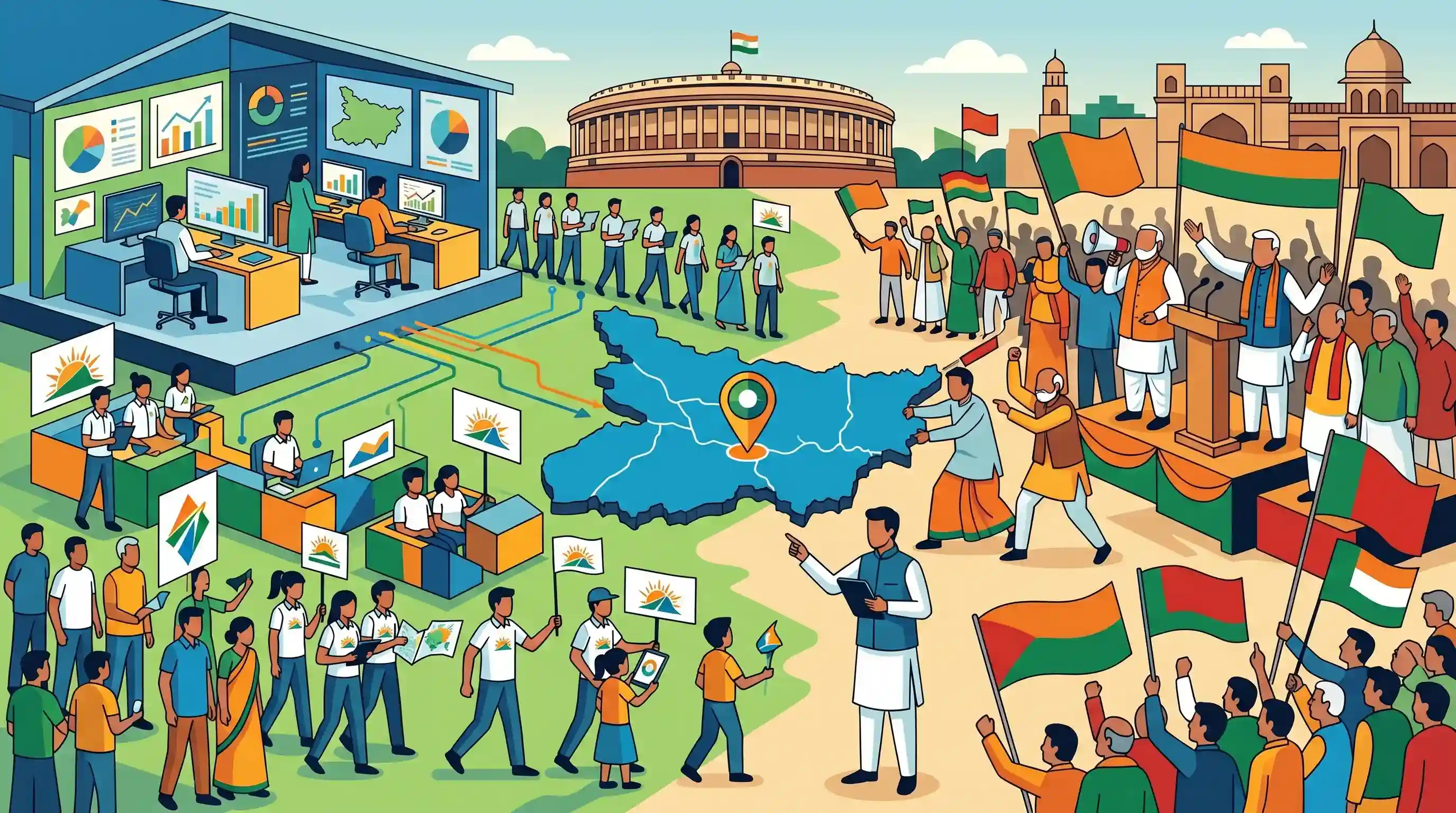
The article analyzes the electoral strategy and grassroots mobilization efforts of Prashant Kishor's newly launched Jan Suraaj party in Bihar's Tarapur constituency. It highlights how the party is deploying its organizational machinery to mount a structured campaign against established leaders like BJP's Samrat Choudhary. The emergence of Jan Suraaj signifies an attempt to introduce data-driven, alternative political campaigning in regional politics, aiming to challenge traditional electoral dynamics dominated by established parties.
Key Points
- Prashant Kishor's Jan Suraaj party is actively mobilizing its grassroots machinery to contest elections in Bihar.
- The campaign in Tarapur showcases the party's organized strategy to challenge established political leaders like BJP's Samrat Choudhary.
- Jan Suraaj aims to disrupt traditional state politics by focusing on micro-level campaigning and alternative political narratives, moving beyond conventional caste arithmetic.
- The developments reflect shifting dynamics in regional politics, highlighting the increasing role of structured, data-driven political management in Indian elections.
Important Terms
Jan Suraaj Party

A political platform launched by strategist Prashant Kishor in Bihar, emphasizing "Suraaj" (good governance) and data-driven grassroots mobilization over traditional caste-based identity politics.
UPSC context
Relevant for GS Paper II (Polity) regarding the emergence of new political parties and alternative governance models.
Alternative Politics
A term referring to political movements that challenge established party structures, focusing on systemic reform, decentralization, and non-traditional issues like sustainable development or direct democracy.
UPSC context
Tests understanding of political theory and evolving electoral dynamics under GS Paper II.
Samrat Choudhary
A key BJP leader in Bihar, currently serving as Deputy Chief Minister and representing the influential Kushwaha (OBC) community, central to the state's caste-based electoral arithmetic.
UPSC context
Significant for Bihar-specific regional politics and the study of caste demographics in elections (GS Paper II).
Data-Driven Campaigning
The use of big data, voter analytics, and professional management to design electoral strategies, micro-target voters, and optimize resource allocation during political campaigns.
UPSC context
Relevant to electoral reforms and the modernization of political processes in India (GS Paper II).
Padyatra
A traditional Indian political tool involving a long-distance foot march to establish direct contact with the masses, recently modernized as a means of large-scale grassroots mobilization.
UPSC context
Important for understanding political communication and mass outreach strategies in Indian democracy.
Political Strategist
A professional who advises political parties on campaign strategy, voter sentiment analysis, and image building, reflecting the professionalization of Indian elections.
UPSC context
Tests awareness of changing electoral management trends and the influence of non-elected actors in governance.
Prelims Trap
Newly formed political parties are recognized as State Parties by the ECI based on grassroots mobilization or prominent leadership.
New entrants are merely 'Registered Unrecognized Political Parties'. Recognition as a State/National party strictly depends on electoral performance (specific vote/seat percentages) under the Election Symbols Order, 1968.
Static Concepts Connected
What are the conditions for a registered party to become a recognized State Party?
- Assembly seats: Win at least 3% of the total number of seats in the Legislative Assembly of the state, or 3 seats, whichever is higher.
- Vote share: Secure at least 6% of valid votes polled in Assembly/Lok Sabha elections from the state, plus win 2 Assembly or 1 Lok Sabha seat.
- Flat vote share: Secure at least 8% of the total valid votes polled in the state during Assembly or Lok Sabha elections, regardless of seats won.
How are new political parties legally registered in India?
- Section 29A: Registration is governed by Section 29A of the Representation of the People Act, 1951. Applications must be filed with the Election Commission within 30 days of formation.
- Constitutional allegiance: The party's memorandum must explicitly declare true faith and allegiance to the Constitution, socialism, secularism, democracy, and the sovereignty and integrity of India.
Cross-Topic Patterns
Civil society to institutional politics
Jan Suraaj follows a historical pattern (like the JP movement or India Against Corruption) where grassroots socio-political movements formalize into registered political parties to execute governance reforms.
Micro-targeting vs. Data Privacy
The growing use of data-driven political management and booth-level voter profiling links modern electoral strategies directly to concerns over digital privacy, voter manipulation, and the DPDP Act.

Expect 2026 mains questions on how data-driven micro-targeting and the 'corporatization of elections' impact voter autonomy.
Linked PYQs · 2
Linked PYQs · 2
- 2022MainsGS2
“While the national political parties in India favour centralisation, the regional parties are in favour of State autonomy.” Comment.
- 2024MainsGS2
Examine the need for electoral reforms as suggested by various committees with particular reference to "one nation one election" principle.
