Prambanan Temple and Historical Spread of Hinduism in Indonesia
Source:The Hindu ↗
Why It Matters
This topic bridges historical maritime linkages, ancient temple architecture, and contemporary soft power diplomacy. UPSC frequently tests India-Southeast Asia historical interactions (such as Chola maritime expeditions to Srivijaya) in Prelims, while cultural diplomacy and the Act East Policy are central to Mains GS2 and GS1 Art & Culture.
Summary
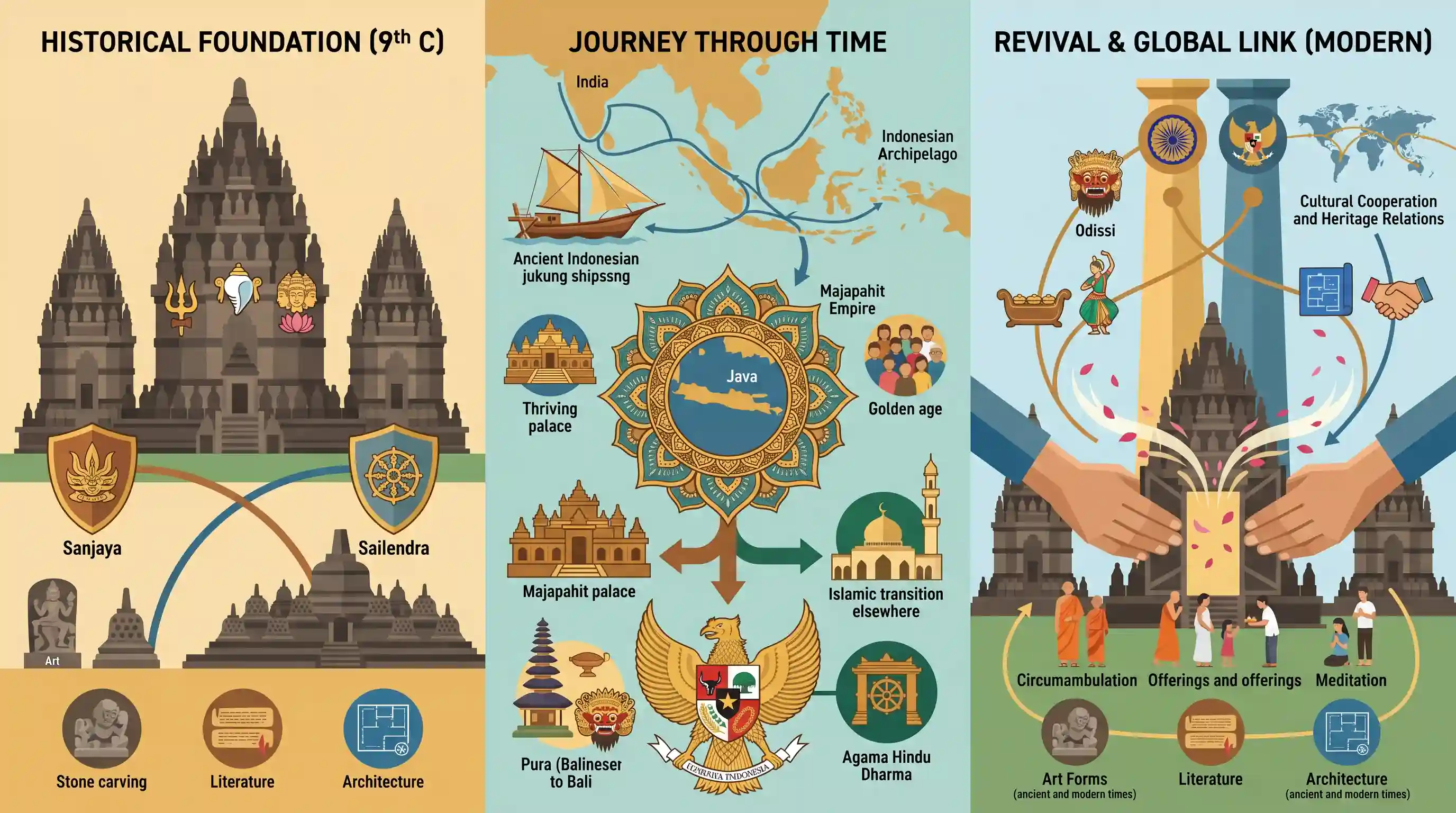
This article explores the historical significance of the Prambanan temple compound in Central Java, Indonesia, and traces the broader historical journey of Hinduism in the Indonesian archipelago. Built in the 9th century by the Sanjaya Dynasty to honor the Trimurti, Prambanan is a testament to the classical Hindu-Javanese architecture and its interplay with Buddhist dynasties (such as the Sailendras of Borobudur). It chronicles how Hinduism spread via ancient maritime trade routes, flourished during the Majapahit golden age, shifted to Bali during the Islamic transition, and adapted to modern Indonesia’s Pancasila state philosophy as Agama Hindu Dharma. The article concludes with the recent spiritual revival at Prambanan, where a 2022 policy shift allowing religious worship has transformed the heritage site into an active center of global pilgrimage and a key pillar of India-Indonesia cultural relations.
Key Points
- Prambanan’s Architecture and Origin: Built in the mid-9th century (around 850 CE) by King Rakai Pikatan of the Sanjaya Dynasty, Prambanan is the largest Hindu temple compound in Indonesia and a UNESCO World Heritage site. It is dedicated to the Trimurti (Shiva, Vishnu, and Brahma), with the central 47-meter-tall tower dedicated to Lord Shiva.
- Socio-Political Context: Prambanan was constructed as a grand response to the nearby Buddhist Borobudur temple built by the rival Sailendra Dynasty, showcasing both political rivalry and peaceful religious coexistence in ancient Java.
- Historical Diffusion of Hinduism: Hinduism reached the Indonesian archipelago around the 1st–2nd centuries CE via maritime trade routes linking East and South India (e.g., Kalinga, Pallava, and Chola kingdoms) with Southeast Asia, leaving early footprints like the 4th-century Sanskrit Yupa inscriptions in Kutai.
- The Balinese Migration: Under the Majapahit Empire (13th–16th century), Hindu-Javanese culture reached its peak. Following the rise of Islamic sultanates, the Javanese Hindu royal court migrated to Bali, making it the modern stronghold of Hinduism in the country.
- Modern Adaptation (Agama Hindu Dharma): To align with Indonesia's state philosophy of Pancasila (which mandates monotheism), modern Indonesian Hinduism adapted by recognizing Sang Hyang Widhi Wasa (Acintya) as the supreme deity, blending ancient Vedic concepts with local Javanese and Balinese customs.
- Living Heritage Revival: In 2022, the Indonesian government signed a landmark agreement allowing the active use of Prambanan and Borobudur for Hindu and Buddhist religious ceremonies, transitioning them from passive archaeological sites to living spiritual centers, which has greatly boosted India-Indonesia cultural diplomacy.
Important Terms
Sanjaya Dynasty

A medieval Javanese Hindu dynasty that ruled the Mataram Kingdom (8th-10th centuries), famous for building the Shiva-dedicated Prambanan temple complex in Central Java.
UPSC context
GS Paper I: Salient features of ancient temple architecture and the spread of Indian culture to Southeast Asia.
Sailendra Dynasty
A powerful Buddhist dynasty of Central Java (8th-9th centuries) that built the monumental Borobudur temple and promoted Mahayana Buddhism alongside Javanese Hindu neighbors.
UPSC context
GS Paper I: Spread of Buddhism, ancient art forms, and architectural interactions in Southeast Asia.
Majapahit Empire
The last major Hindu-Buddhist thalassocratic empire of Southeast Asia, based in East Java (13th-16th centuries), whose decline facilitated the migration of Hindu elites to Bali.
UPSC context
GS Paper I: Historical links, maritime trade, and cultural transitions in Southeast Asia.
Agama Hindu Dharma
The officially recognized form of Hinduism in modern Indonesia, primarily Bali, which blends traditional Indian Vedic/Shaivite practices with Javanese-Buddhist and indigenous animistic elements.
UPSC context
GS Paper I: Modern cultural expressions, syncretism, and the preservation of global Hindu heritage.
Pancasila State Philosophy
The foundational five-principle ideology of Indonesia formulated in 1945, emphasizing belief in 'one supreme God,' which shaped the modern recognition of Hinduism in the country.
UPSC context
GS Paper II: Comparative constitution, governance frameworks, and impact of national ideologies on religious minorities.
Act East Policy
India's diplomatic and strategic initiative launched in 2014 to proactively deepen economic, security, and cultural ties with Southeast Asia, leveraging civilizational and soft power connections.
UPSC context
GS Paper II: India's foreign policy, regional groupings, and soft power diplomacy with Southeast Asian nations.
Prelims Trap
The 4th-century Yupa inscriptions of Borneo were written in the local Javanese Kawi script to record native animistic rituals.
The Yupa inscriptions are written in Sanskrit using the South Indian Pallava script (not Kawi), recording orthodox Brahmanical/Vedic rituals like the Ashvamedha sacrifice.
Static Concepts Connected
What are the key features of early Southeast Asian temple architecture and its Indian influences?
- Architectural Blending: Blended Indian Vastu Shastra with local step-pyramid traditions, producing tall, tiered stone towers called Candis.
- Devaraja Cult: Legitimized kings as divine incarnations of Shiva or Vishnu, linking political sovereignty with massive state temple construction.
- Epic Bas-reliefs: Featured extensive stone carvings of the Ramayana and Mahabharata, adapted to Javanese and Khmer aesthetic sensibilities.
What are the Yupa and Canggal Inscriptions, and why are they significant?
- Yupa Inscriptions: 4th-century Kutai (Borneo) stone posts written in Sanskrit and Pallava script, recording Vedic sacrifices by King Mulavarman.
- Canggal Inscription: 732 CE Javanese charter in Pallava script recording King Sanjaya's consecration of a Shiva Linga, establishing Shaivite political theology.
Cross-Topic Patterns
Soft Power & Act East Policy
Joint restoration and active worship policies at Prambanan act as crucial tools for India's cultural diplomacy and maritime partnerships in the Indo-Pacific.
Secularism & State Philosophy
Comparing India's pluralistic secularism with Indonesia's Pancasila system, which forced Hinduism to adapt into a monotheistic framework (Agama Hindu Dharma).

2026 prelims may test early SE Asian Hindu-Buddhist links, focusing on Canggal/Yupa inscriptions, Pallava script, and Prambanan.
Linked PYQs · 2
Linked PYQs · 2
- 2025PrelimsGS1
Who among the following led a successful military campaign against the kingdom of Srivijaya, the powerful maritime State, which ruled the Malay Peninsula, Sumatra, Java and the neighbouring islands?
- 2013MainsGS1
Chola architecture represents a high watermark in the evolution of temple architecture. Discuss.
