Pralhad Joshi Assumes Charge as Union Education Minister
Source:The Hindu ↗
কেন এটি গুরুত্বপূর্ণ
This development is highly relevant to UPSC aspirants across two dimensions: first, the constitutional mechanics of the Union Executive, specifically the appointment, resignation, and portfolio allocation of ministers under Article 75 of the Constitution; second, the governance, ethical, and policy challenge of preserving the integrity of national-level entrance examinations (like NEET) and the subsequent administrative reforms required under initiatives such as the Public Examination (Prevention of Unfair Means) Act, 2024.
সারসংক্ষেপ
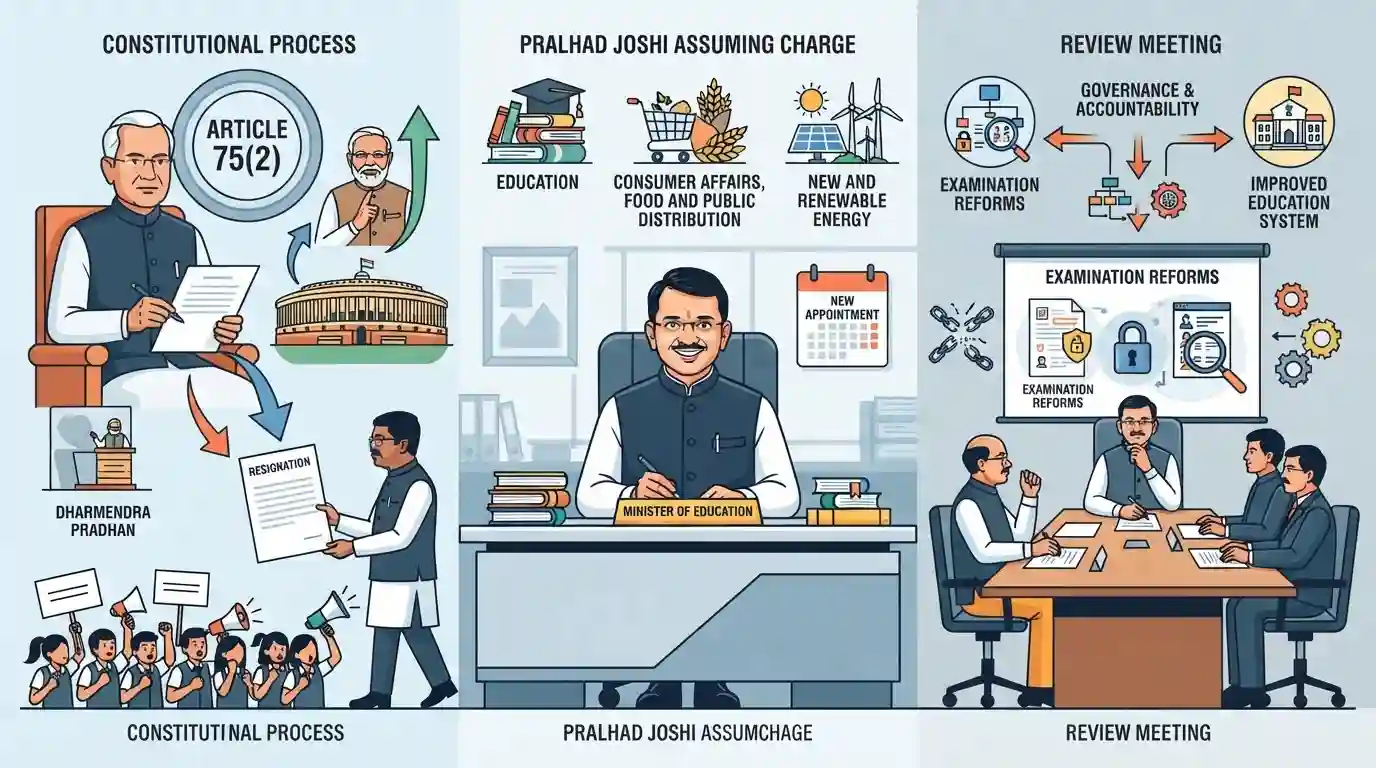
Union Minister Pralhad Joshi has officially assumed charge of the Ministry of Education after the resignation of Dharmendra Pradhan amid intense protests over the NEET examination paper leak scandal. The President accepted Pradhan's resignation with immediate effect under Article 75(2) of the Indian Constitution, as advised by Prime Minister Narendra Modi. Joshi will manage the Education portfolio in addition to his existing portfolios of Consumer Affairs, Food and Public Distribution, and New and Renewable Energy. Following his appointment, he held a review meeting of the ministry's initiatives and schemes.
মূল বিষয়
- Pralhad Joshi took official charge of the Union Ministry of Education on July 26, 2026, at Kartavya Bhavan, New Delhi.
- The appointment follows the resignation of Dharmendra Pradhan on July 25, 2026, amid widespread student protests demanding accountability for the NEET exam paper leak controversy.
- The resignation of Dharmendra Pradhan was accepted by the President under Clause (2) of Article 75 of the Constitution of India, acting on the advice of Prime Minister Narendra Modi.
- Pralhad Joshi is managing the Ministry of Education as an additional charge alongside his primary portfolios of Consumer Affairs, Food and Public Distribution, and New and Renewable Energy.
- A high-level review meeting was conducted immediately upon taking charge, analyzing ongoing educational schemes with the Minister of State Jayant Chaudhary and the Secretaries of Higher Education and School Education & Literacy.
গুরুত্বপূর্ণ শব্দ
Constitution of India (Article 75)

A constitutional provision detailing the appointment, tenure, and collective responsibility of Union Ministers. Article 75(2) specifically mandates that ministers hold office during the pleasure of the President, formalizing their removal or resignation.
UPSC context
GS Paper 2 (Polity): Tests knowledge of the Union Executive, Parliamentary system mechanics, and ministerial accountability.
Public Examination (Prevention of Unfair Means) Act, 2024
A central legislation designed to combat organized cheating, paper leaks, and malpractices in national entrance exams. It enforces strict penalties, including up to 10 years of imprisonment and heavy financial fines.
UPSC context
GS Paper 2 (Governance): Tests knowledge of transparency, institutional integrity, and legal frameworks securing public administration.
National Testing Agency
An autonomous organization under the Ministry of Education that conducts major national-level entrance exams like NEET and JEE. It aims to ensure transparent, efficient, and standardized assessments for higher education admissions.
UPSC context
GS Paper 2 (Governance & Bodies): Evaluates knowledge of autonomous bodies, administrative accountability, and educational reforms.
Union Council of Ministers
India's principal executive body, headed by the Prime Minister. Authorized under Articles 74 and 75, it advises the President and is collectively responsible to the Lok Sabha for formulating government policy.
UPSC context
GS Paper 2 (Polity): Crucial for understanding the structure of the Union Executive and the principle of collective responsibility.
Ministry of Education
The central government ministry responsible for formulating India's education policies. It oversees the implementation of national educational standards and manages autonomous testing and academic bodies like the National Testing Agency.
UPSC context
GS Paper 2 (Social Justice): Relevant for evaluating government policies, educational sector interventions, and institutional administration.
প্রিলিমস ফাঁদ
A Union Minister can submit their resignation directly to the President, who accepts it using discretionary powers under Article 75(2).
By constitutional convention, the President cannot act independently. Any resignation or dismissal of a minister must strictly go through the Prime Minister, who advises the President under Article 75.
সংযুক্ত স্থির ধারণা
What is the difference between Individual and Collective Responsibility under Article 75?
- Individual Responsibility (75(2)): Ministers hold office during the pleasure of the President. The PM can demand a minister's resignation or advise the President to dismiss them.
- Collective Responsibility (75(3)): The Council of Ministers is jointly responsible to the Lok Sabha. If a no-confidence motion passes, the entire ministry must resign.
How is the business of the Government of India allocated and conducted?
- Article 77(3) Rules: The President makes rules for the convenient transaction and allocation of government business among ministers.
- Portfolio System: The PM advises the President on the allocation and reshuffling of portfolios; temporary additional charges are formalized under these executive rules.
আন্তঃবিষয় প্যাটার্ন
Public Exams Act + Concurrent List dynamics
Central laws like the Public Examinations Act, 2024 intersect with education (Concurrent List), testing the limits of Union-state cooperation in standardized testing.
Administrative accountability + Union Executive
The National Testing Agency's structural failures demonstrate how administrative lapses in autonomous bodies directly trigger constitutional accountability under Article 75(2).

UPSC 2026 may test the constitutional mechanics of Article 75(2) individual responsibility alongside the 1961 Business Allocation Rules.
সংযুক্ত PYQ · 2
সংযুক্ত PYQ · 2
- 2013PrelimsGS1
Consider the following statements : 1. The Council of Ministers in the Centre shall be collectively responsible to the Parliament. 2. The Union Ministers shall hold the office during the pleasure of the President of India. 3. The Prime Minister shall communicate to the President about the proposals for legislation. Which of the statements given above is/are correct?
- 2024MainsGS2
What are the aims and objects of recently passed and enforced, The Public Examination (Prevention of Unfair Means) Act, 2024? Whether University/State Education Board examinations, too, are covered under the Act ?
