Education Ministry initiates overhaul of CBSE payment gateway
Source:The Hindu ↗
Why It Matters
The overhaul highlights the practical challenges and necessary improvements in e-governance and public service delivery. It serves as a relevant case study for GS Paper 2 on how digital infrastructure must be optimized with robust grievance redressal and refund mechanisms to ensure accountability and citizen-centric governance in the education sector.
Summary
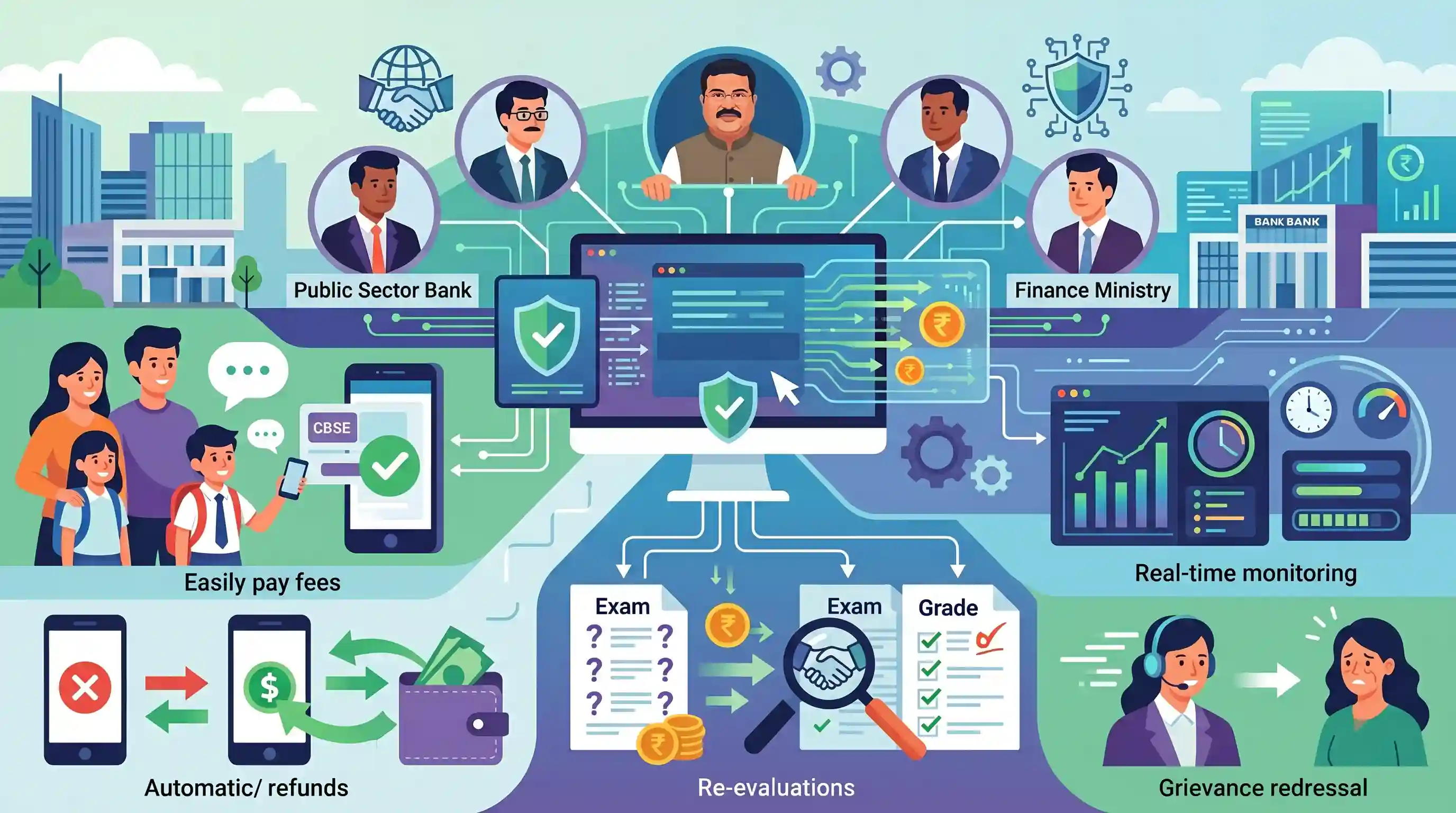
Union Education Minister Dharmendra Pradhan, in consultation with four major public sector banks and the Finance Ministry, has initiated a comprehensive overhaul of the CBSE payment gateway. The objective is to develop a more robust, secure, and student-friendly digital payment ecosystem for educational services, particularly for post-examination fees such as re-evaluations. The proposed upgrades emphasize seamless e-governance through features like automatic refunds for failed transactions, real-time monitoring, advanced technical safeguards, and expedited grievance redressal mechanisms to minimize administrative hurdles for students and parents.
Key Points
- Union Education Minister Dharmendra Pradhan discussed overhauling the CBSE payment gateway with four major public sector banks.
- The initiative aims to build a robust, reliable, and student-friendly payment ecosystem, especially for post-examination processes like re-evaluations and acquiring photocopies of answer sheets.
- Key proposed features include timely transactions, automatic refunds for failed payments, advanced technical safeguards, and real-time monitoring.
- The upgrade will also feature faster grievance redressal mechanisms to resolve payment disputes efficiently, reflecting an emphasis on user-centric e-governance in education.
Important Terms
Central Board of Secondary Education (CBSE)

A national-level board of education in India for public and private schools, managed by the Union Government. It conducts Class 10 and 12 examinations and implements the NCERT curriculum.
UPSC context
GS Paper 2 (Education/Governance); tests understanding of institutional frameworks and administrative reforms in the Indian school education system.
Ministry of Education (MoE)
The nodal Union Ministry responsible for formulating and implementing the National Policy on Education (NPE). It operates through the Department of School Education & Literacy and Department of Higher Education.
UPSC context
GS Paper 2 (Social Justice/Governance); tests knowledge of central policies, educational reforms (like NEP 2020), and government-led welfare schemes.
Ministry of Finance
A Union Ministry responsible for India's fiscal policy, national budget, and the regulation of financial institutions through departments such as the Department of Financial Services.
UPSC context
GS Paper 3 (Indian Economy); tests fiscal management, the budgetary process, and government oversight of the banking and capital markets.
Public Sector Banks (PSBs)
Financial institutions where the Government of India or a State Government holds a majority stake of 51% or more. They are key to implementing financial inclusion and digital infrastructure.
UPSC context
GS Paper 3 (Economy/Banking); focuses on banking sector reforms, recapitalization, and the role of state-owned enterprises in economic development.
State Bank of India (SBI)
A statutory body and India's largest public sector bank. It functions as a key partner for government digital public infrastructure and financial services at scale.
UPSC context
GS Paper 3 (Economy); tests the structure of India's banking system and the role of Domestic Systemically Important Banks (D-SIBs).
Prelims Trap
The CBSE gateway overhaul establishes a centralized digital payment platform mandated by RBI for all schools.
This is a targeted administrative collaboration for CBSE, not a nationwide statutory mandate or a new centralized payment body created by RBI for all schools.
Static Concepts Connected
What is the 'Whole-of-Government' approach in public administration?
- Definition: Public service agencies working collaboratively across portfolio boundaries to achieve a shared goal (e.g., Education + Finance + PSBs).
- Objective: It eliminates departmental silos, reduces duplication of efforts, and provides integrated, seamless service delivery to citizens.
- Key Examples: PM Gati Shakti, JAM Trinity, and integrated citizen portals like e-Shram or PRAGATI.
What are the three foundational layers of India's Digital Public Infrastructure (DPI)?
- Identity Layer: Unique digital identification systems (like Aadhaar) that establish verified, interoperable user identity across services.
- Payments Layer: Interoperable, real-time settlement systems (like UPI and IMPS) enabling fast, high-volume financial transactions.
- Data Exchange Layer: Secure, consent-based frameworks (like DigiLocker and Account Aggregator) allowing users to share credentials safely.
Cross-Topic Patterns
DPI integration in Education (NDEAR/APAAR)
The modernization of CBSE payments aligns with broader digital education architectures like NDEAR and APAAR, shifting focus from mere enrollment to seamless administrative service delivery.
Inter-ministerial coordination (Silos to Synergy)
Combining the Education Ministry, Finance Ministry, and PSBs reflects a shift towards inter-departmental convergence, echoing the whole-of-government model applied to basic public services.

Mains 2026 Governance questions will likely demand specific examples of 'whole-of-government' approaches in resolving citizen grievances.
Linked PYQs · 3
Linked PYQs · 3
- 2024MainsGS2
e-governance is not just about the routine application of digital technology in service delivery process. It is as much about multifarious interactions for ensuring transparency and accountability. In this context evaluate the role of the 'Interactive Service Model' of e-governance.
- 2023MainsGS2
e-governance, as a critical tool of governance, has ushered in effectiveness, transparency and accountability in governments. What inadequacies hamper the enhancement of these features ?
- 2017PrelimsGS1
Which of the following is a most likely consequence of implementing the 'Unified Payments Interface (UPI)'?
