BSP Chief Cautions Against Mixing Religion with Political Agenda
Source:The Hindu ↗
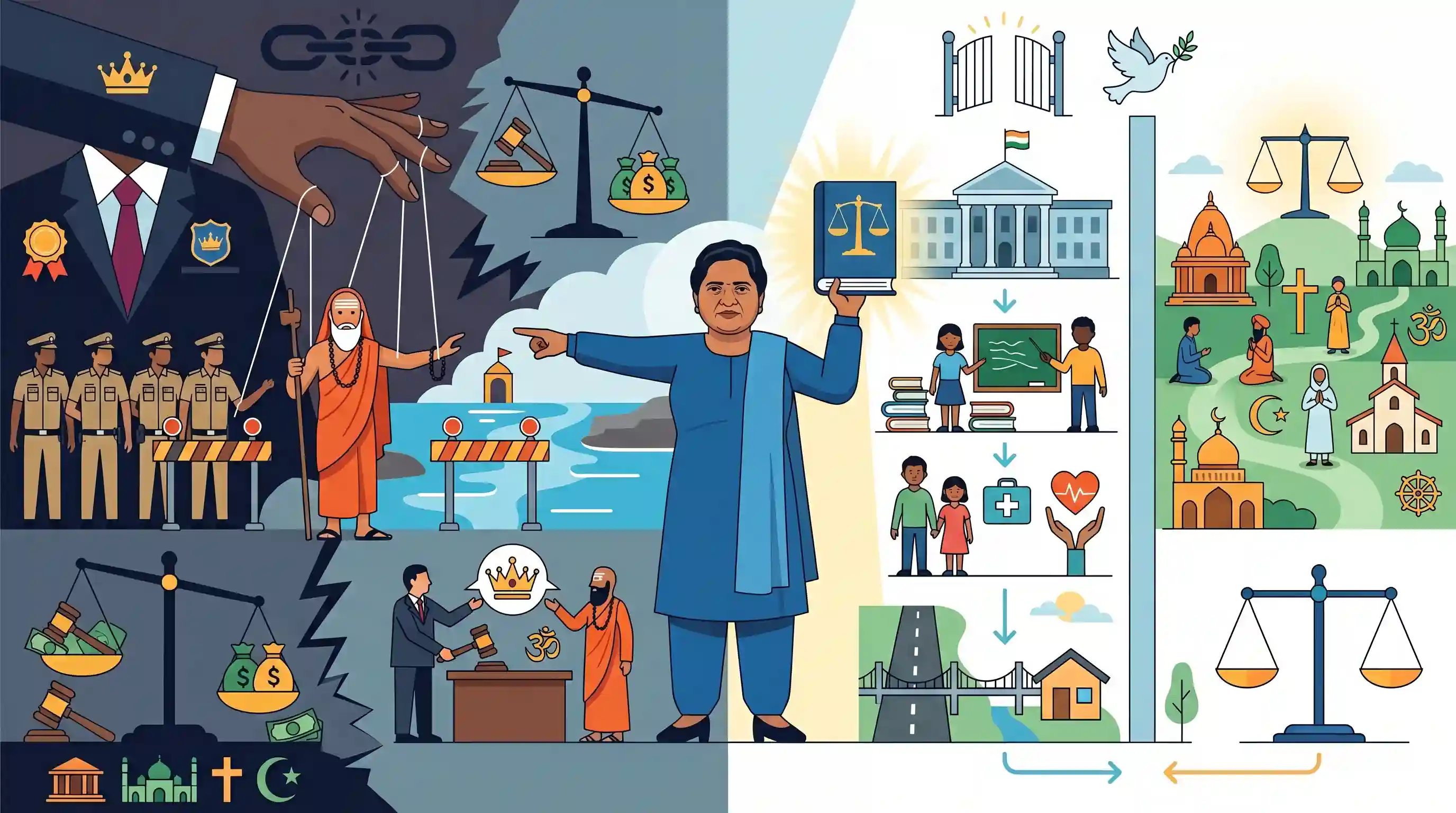
Why It Matters
The article touches upon the core tenets of Indian secularism, which allows for state intervention in religious affairs for administrative or reformative purposes but maintains a principled distance. It provides a real-world example of tensions between religious bodies and state administration, relevant for GS Paper 2 topics on the Constitution, secularism, and fundamental rights (Articles 25-28).
Summary
Bahujan Samaj Party (BSP) President Mayawati has warned against the dangers of linking religion with politics, criticizing increasing political interference in religious festivals and rituals. Her statements come amid a row between Swami Avimukteshwaranand, the head of Jyotirmath, and the Magh Mela administration in Prayagraj over his participation in a holy dip and his claim to the title of Shankaracharya. Mayawati reiterated that the Indian Constitution maintains a separation between religion and politics, with public welfare being the primary constitutional duty.
Key Points
- BSP President Mayawati cautioned against the growing trend of linking religion with politics, warning that it leads to conflicts and disputes.
- The remarks followed a controversy in Prayagraj where the Magh Mela administration stopped Swami Avimukteshwaranand from a holy dip and questioned his title as Shankaracharya, citing a Supreme Court order.
- She emphasized that the Constitution and the law keep religion separate from politics, framing public welfare as the true national duty.
- The incident brings forth questions about state intervention in religious affairs and the secular nature of the Indian state.
Important Terms
Secularism

The constitutional principle of "principled distance" where the state treats all religions equally (Sarva Dharma Sambhava) but can intervene for social reform under Article 25(2).
UPSC context
GS Paper II (Polity/Constitution); tests understanding of the Indian versus Western models of secularism and state-religion relations.
Magh Mela
An annual 45-day Hindu pilgrimage held at the Triveni Sangam in Prayagraj during the month of Magha, featuring ritual bathing (Snan) and the austere "Kalpavasa" tradition.
UPSC context
GS Paper I (Art and Culture); tests knowledge of traditional festivals, pilgrimage sites, and the geographic significance of the Sangam.
Constitution of India
The supreme law of India establishing it as a secular republic. It guarantees religious freedom (Articles 25-28) while mandating that the state prioritize public welfare.
UPSC context
GS Paper II (Fundamental Rights); core for understanding the legal limits of state intervention in religious practices.
Shankaracharya
A title for the heads of the four cardinal monasteries (mathas) established by Adi Shankara. The current dispute involves the legitimacy and succession of the Jyotirmath (North) head.
UPSC context
GS Paper I (History/Religion); relevant for Advaita Vedanta philosophy and the institutional history of Hindu religious leadership.
Bahujan Samaj Party (BSP)
A national political party founded by Kanshi Ram in 1984 to represent the "Bahujan Samaj" (SC, ST, OBC, and minorities) based on Ambedkarite ideology.
UPSC context
GS Paper II (Polity); tests knowledge of political parties, social engineering, and the role of regional/national leadership in governance.
Supreme Court of India
The apex judicial body currently adjudicating the title dispute of Swami Avimukteshwaranand. It has previously stayed coronations to prevent unauthorized claims to religious titles.
UPSC context
GS Paper II (Judiciary); tests the court's role as the final interpreter of religious laws and administrative protocols.
Prelims Trap
The Indian Constitution maintains a strict wall of separation, completely prohibiting the State from intervening in religious affairs.
Aspirants confuse Western 'strict separation' with Indian secularism. Article 25(2) explicitly allows state intervention to regulate secular activities tied to religion and for social reform.
Static Concepts Connected
How does the Indian Constitution regulate State intervention in religious affairs?
- Principled Distance: Unlike Western secularism, India follows a model of principled distance, allowing intervention when necessary.
- Secular Regulation: Article 25(2)(a) permits the State to regulate or restrict economic, financial, political, or secular activities associated with religious practice.
- Social Reform: Article 25(2)(b) allows state intervention for social welfare and reform, such as throwing open Hindu religious institutions to all classes.
What are the four Mathas and the core philosophy of Adi Shankaracharya?
- Advaita Vedanta: He propagated Advaita Vedanta (non-dualism), emphasizing the fundamental unity of the Atman (soul) and Brahman (universal consciousness).
- North and South: Jyotirmath (North, near Badrinath) and Sringeri Sharada Peeth (South, Karnataka).
- East and West: Dwarka Sharada Peeth (West, Gujarat) and Govardhan Peeth (East, Puri, Odisha) completed his effort to unify Hinduism.
Cross-Topic Patterns
Electoral laws and religious appeals
Under Section 123(3) of the RPA 1951, appealing for votes based on religion is a corrupt practice, barring candidates from leveraging faith for electoral gains (Abhiram Singh case).
S.R. Bommai and the Basic Structure
The 1994 S.R. Bommai judgment established secularism as a basic structure feature, ruling that mixing religion with state power is unconstitutional and warrants state government dismissal.

Expect a Prelims match-the-following on Shankaracharya's 4 Mathas, or a Mains question on the 'principled distance' of Indian secularism.
Linked PYQs · 2
Linked PYQs · 2
- 2024MainsGS2
Discuss India as a secular state and compare with the secular principles of the US constitution.
- 2019MainsGS2
What can France learn from the Indian Constitution's approach to secularism?
