Socio-Legal Challenges of Dowry and Patriarchal Violence in India
Source:Indian Express ↗
Why It Matters
Dowry remains a deeply entrenched social evil despite strict legal prohibitions. This article is highly relevant for UPSC aspirants as it provides a multi-dimensional analysis of the issue, framing dowry deaths as femicide, analyzing the psychological impact on both genders, and proposing a structured 'Four Ps' framework. These insights are directly applicable to GS1 (Social Issues), GS2 (Social Justice/Legal mechanisms), and Essays on patriarchy and gender dynamics.
Summary
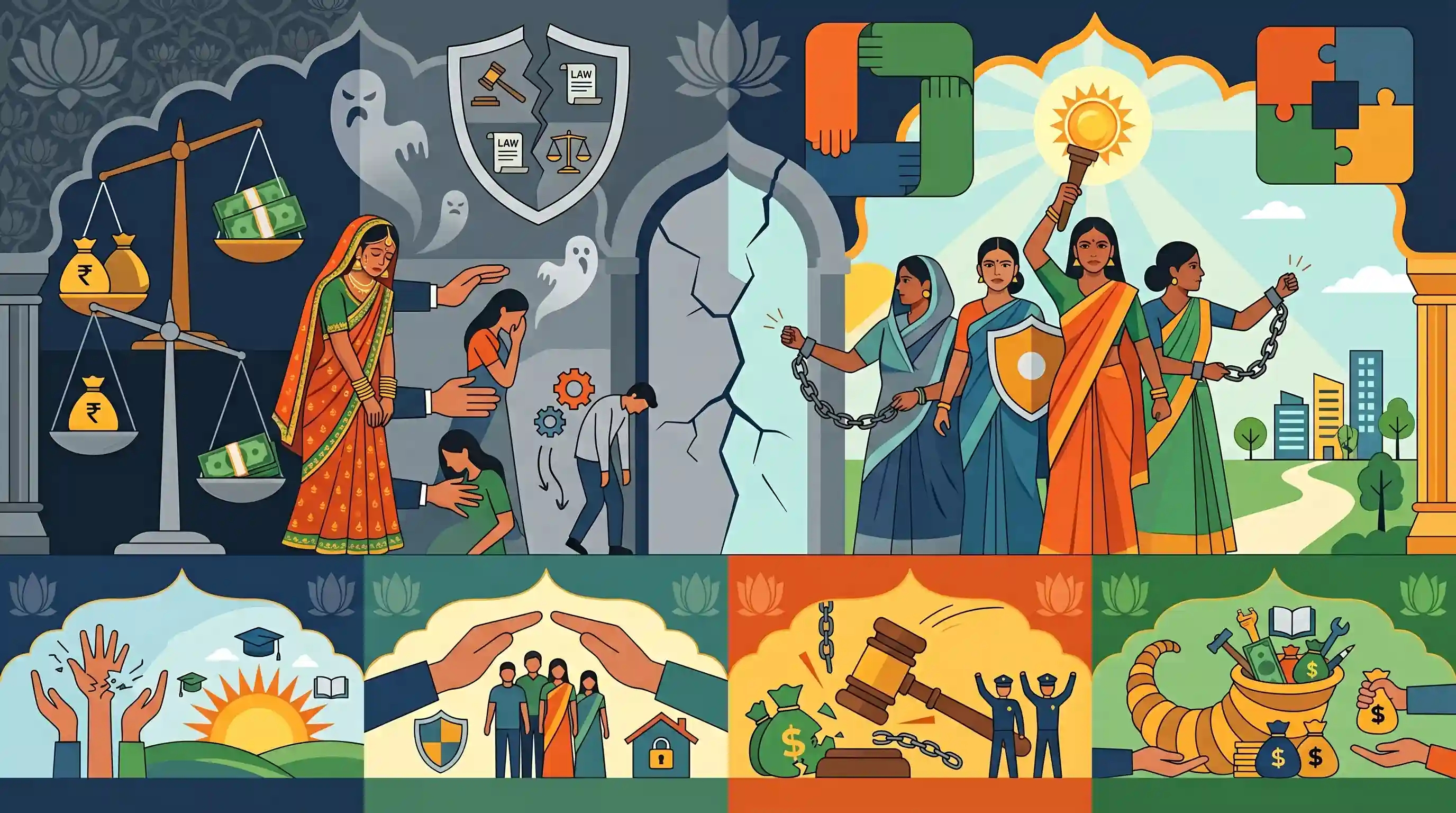
The persistence of the dowry system in India is a profound civilizational contradiction that undermines the cultural reverence for women, resulting in widespread systemic violence and femicide. While strong legal provisions exist—such as the Dowry Prohibition Act of 1961 and relevant sections of the Bharatiya Nyaya Sanhita (BNS)—their effectiveness is severely diluted by low conviction rates and societal acceptance of dowry disguised as 'gifts.' The author argues that patriarchy sustains this social evil, with women themselves sometimes becoming complicit in the harassment of daughters-in-law. Crucially, the article highlights that dowry also emasculates and diminishes men, stripping them of their self-reliance and dignity. To eliminate this practice, society must reject it outright by empowering women to walk away from such demands and adopting a comprehensive 'Four Ps' approach: Prevention, Protection, Prosecution, and Provision.
Key Points
- Despite India's cultural reverence for women (Nari Shakti), the persistence of dowry represents a deep civilizational contradiction and a form of systemic violence, frequently resulting in femicide (e.g., 5,737 dowry deaths in 2024).
- The legal framework against dowry, including the Dowry Prohibition Act and Sections 80 and 85 of the BNS, remains hindered by low conviction rates, poor enforcement, and societal normalization of the practice.
- The practice is deeply rooted in patriarchy, and its perpetuation often involves female complicity, such as mothers-in-law harassing daughters-in-law.
- Dowry not only violates women but also diminishes men by reducing their worth to a price tag, compromising their personal integrity, self-reliance, and dignity (purusharth).
- Eradicating dowry requires a 'Four Ps' framework: Prevention (education and awareness), Protection (safe spaces and helplines), Prosecution (swift justice), and Provision (rehabilitation and support).
Important Terms
Dowry Prohibition Act, 1961

India's primary legislation criminalizing the exchange or demand of property/money in connection with marriage. It prescribes a minimum five-year imprisonment for violators.
UPSC context
GS Paper 1 (Social Issues) and Paper 2 (Laws for vulnerable sections); foundational anti-dowry legal framework.
Bharatiya Nyaya Sanhita (BNS)
India's 2023 criminal code replacing the IPC. It contains Section 80 (Dowry Death) and Section 85 (Cruelty), maintaining strict penalties for dowry-related violence.
UPSC context
GS Paper 2 (Governance/Judiciary); critical for understanding the modernization of criminal justice and gender-based laws.
Sustainable Development Goal 5 (SDG 5)
A United Nations goal to achieve gender equality. Target 5.3 specifically mandates the elimination of harmful practices like child marriage and forced traditions.
UPSC context
GS Paper 2 (International Relations/Governance) and Paper 3; used for benchmarking India's social progress globally.
National Crime Records Bureau (NCRB)
The Indian agency under the Ministry of Home Affairs that compiles annual 'Crime in India' reports, tracking dowry deaths and harassment statistics.
UPSC context
GS Paper 1 (Society) and Paper 3 (Internal Security); essential for factual evidence in Mains answers.
Four Ps Approach
A strategic framework for eradicating dowry through Prevention (deterrence), Protection (helplines), Prosecution (speedy trials), and Provision (crisis services like legal aid).
UPSC context
GS Paper 1 (Social Empowerment); provides a structured 'Way Forward' for essays and social policy questions.
Prelims Trap
All gifts and presents given at the time of marriage are categorized as dowry under the Dowry Prohibition Act, 1961.
The Act specifically exempts voluntary gifts given to the bride or groom without any demand, provided they are recorded in a recognized list.
Static Concepts Connected
What constitutes 'Dowry' under the Dowry Prohibition Act, 1961?
- Definition: Property or valuable security given directly or indirectly at, before, or after marriage in connection with the marriage.
- Exemption: Dower or Mahr under Muslim Personal Law (Shariat) is specifically excluded from the definition of dowry.
- Voluntary Gifts: Voluntary presents given to the bride/groom without any demand are exempted if entered into a formal list.
- Nature of Offence: Both giving and taking dowry are cognizable, non-bailable, and non-compoundable offences.
How does the Bharatiya Nyaya Sanhita (BNS) penalize dowry crimes?
- Dowry Death: Section 80 penalizes death caused by burns/bodily injury or occurring under abnormal circumstances within 7 years of marriage.
- Cruelty: Section 85 punishes cruelty by a husband or his relatives towards a woman with imprisonment up to three years.
- Burden of Proof: Under the Bharatiya Sakshya Adhiniyam (replacing Evidence Act), the court shall presume dowry death if pre-death harassment is proven.
Cross-Topic Patterns
Patriarchy and female complicity
The perpetuation of dowry by mothers-in-law highlights how patriarchal norms are internalized and enforced by women, a frequent analytical theme in GS-IV (human behavior) and GS-I (Indian society).
Toxic masculinity and male vulnerabilities
Dowry reducing male worth to a price tag connects to emerging syllabus themes around how patriarchal structures also dehumanize and place undue societal pressure on men.
BNS transition from IPC frameworks
The shift of 'dowry death' from IPC 304B to BNS Section 80 reflects the broader restructuring of India's criminal codes to prioritize crimes against women and children.

Expect a Mains question analyzing why legal deterrence like BNS fails against dowry without addressing female complicity and social norms.
Linked PYQs · 5
Linked PYQs · 5
- 2014MainsGS1
How does patriarchy impact the position of a middle class working woman in India?
- 2023MainsGS1
Explain why suicide among young women is increasing in Indian society.
- 2023MainsGS2
Explain the constitutional perspectives of Gender Justice with the help of relevant Constitutional Provisions and case laws.
- 2020MainsEssay
Patriarchy is the least noticed yet the most significant structure of social inequality
- 2023MainsEssay
Girls are weighed down by restrictions, boys with demands – two equally harmful disciplines.
