Silent Valley tribal watcher honored for grassroots conservation
Source:The Hindu ↗
Why It Matters
The article highlights grassroots participation in biodiversity conservation and recalls the historic 'Save Silent Valley' movement. This movement is a classic case study for UPSC aspirants regarding the conflict between developmental projects (dams) and ecological preservation, as well as the role of political will and civil society in environmental protection.
Summary
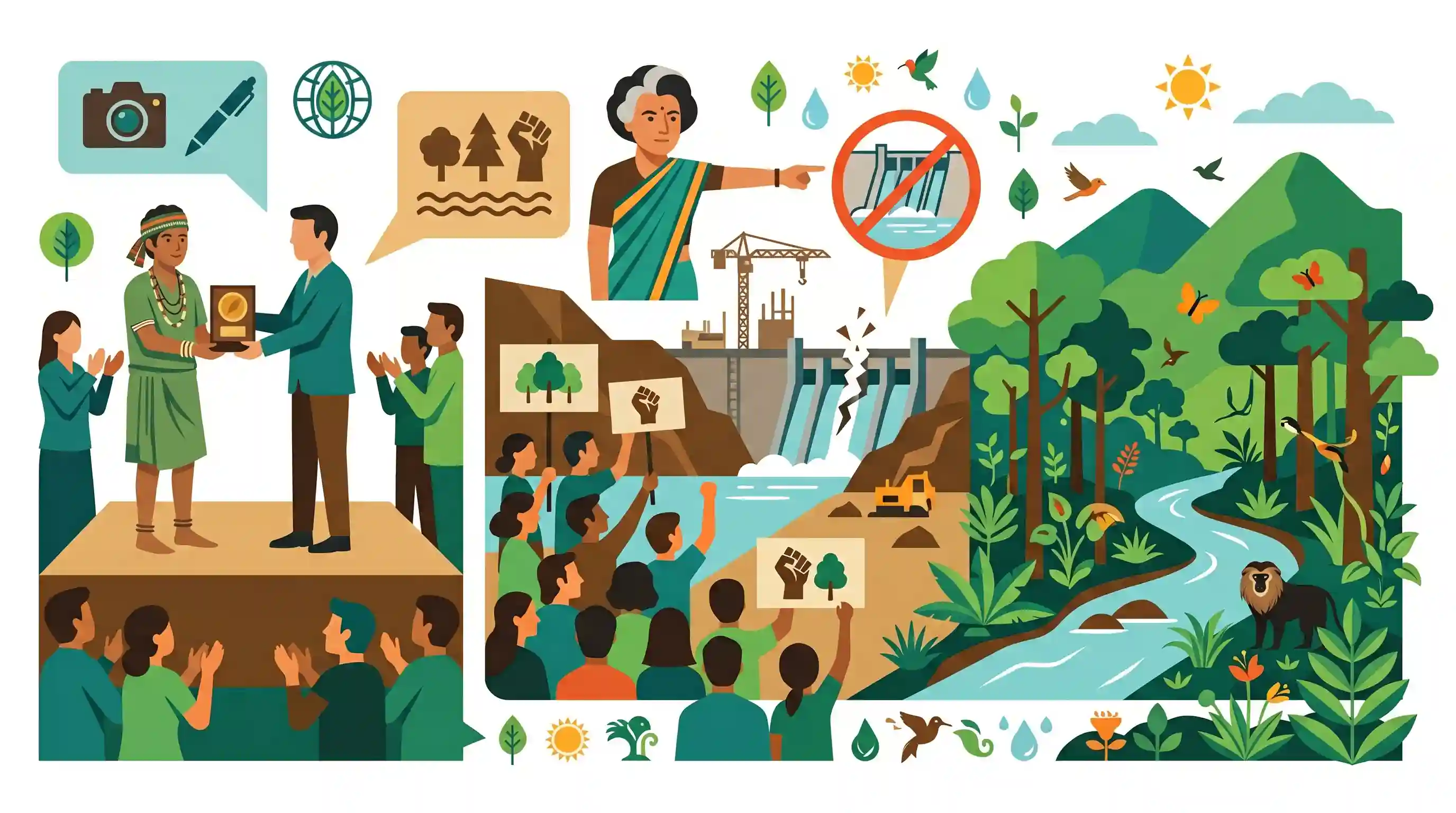
The G. Prabhakaran memorial environment excellence award was presented to Maari, a dedicated tribal forest watcher at the Silent Valley National Park, in recognition of his grassroots conservation efforts. The award, instituted by the family of late journalist G. Prabhakaran and OISCA International, served as an occasion to recall the historic Silent Valley movement. During the ceremony, speakers specifically remembered former Prime Minister Indira Gandhi's decisive intervention that halted a proposed hydroelectric dam project, a milestone that preserved the pristine biodiversity of the Silent Valley.
Key Points
- Maari, a tribal forest watcher, was awarded the G. Prabhakaran memorial environment excellence award for his lifelong service in conserving the Silent Valley National Park.
- The award was instituted by the family of late environmental journalist G. Prabhakaran in collaboration with OISCA International.
- The event commemorated the historic 'Save Silent Valley' conservation movement, which protected the region's unique ecosystem.
- Speakers highlighted former Prime Minister Indira Gandhi's crucial intervention in halting a proposed hydroelectric dam project, which ensured the preservation of Silent Valley.
Important Terms
Silent Valley Movement

A landmark 1970s environmental protest in Kerala against a proposed hydroelectric project on the Kunthipuzha River; it pioneered modern environmental activism in India, prioritizing biodiversity over industrial development.
UPSC context
Relevant for GS3 (Environment/Conservation) and GS4 (Ethics); tests understanding of environmental movements and their impact on policy.
Silent Valley National Park
Located in Kerala's Nilgiri Hills, this park protects India's last remaining tropical evergreen rainforest. It is a core component of the Nilgiri Biosphere Reserve and a UNESCO World Heritage site.
UPSC context
Commonly tested in GS1 (Geography) and GS3 (Biodiversity); focuses on protected areas, forest types, and regional geography.
Lion-tailed Macaque
An endangered primate endemic to the Western Ghats. Its largest viable population resides in Silent Valley, making it the flagship species for the region's conservation efforts.
UPSC context
Key topic for GS3 (Species in news/Wildlife); tests knowledge of endemic species, IUCN status, and habitat requirements.
OISCA International
A Tokyo-based NGO (est. 1961) with UN ECOSOC consultative status. It promotes sustainable development through grassroots environmental restoration, agriculture, and community capacity building.
UPSC context
Relevant for GS2 (International NGOs/Development) and GS3 (Sustainable Development); highlights the role of international cooperation in conservation.
Nilgiri Biosphere Reserve
India's first biosphere reserve (est. 1986), spanning Kerala, Tamil Nadu, and Karnataka. It contains various protected areas, including Silent Valley, and supports high levels of endemism.
UPSC context
A core GS1/GS3 topic; tests understanding of the MAB program, administrative boundaries, and ecological significance.
Muduga Community
An indigenous tribal group inhabiting the Attappadi region of Kerala. They possess traditional ecological knowledge and are increasingly involved in state-led forest conservation and patrolling.
UPSC context
Tested in GS2 (Welfare of vulnerable sections) and GS3 (Conservation); focuses on the role of indigenous tribes in environmental stewardship.
Kunthipuzha River
A perennial river originating in the Nilgiri Hills that flows through Silent Valley. It was the focal point of the historic hydroelectric dam controversy.
UPSC context
Relevant for GS1 (Geography/Drainage systems); tests knowledge of Western Ghats river systems and related environmental conflicts.
Prelims Trap
Silent Valley is in the Nallamalai range, and the Kunthipuzha river flowing through it is a tributary of the Periyar.
Silent Valley is located in the Nilgiri Hills (Western Ghats), not the Nallamalai range. Kunthipuzha is a tributary of the Bharathapuzha, not Periyar.
Static Concepts Connected
What are the core ecological features of the Silent Valley National Park?
- Geography & Biome: Located within the Nilgiri Biosphere Reserve in Kerala, it features largely undisturbed tracts of pristine tropical moist evergreen forests.
- River Drainage: The Kunthipuzha river, a major tributary of the Bharathapuzha river, flows entirely through the length of the national park.
- Flagship Species: It is a critical habitat for the Endangered Lion-Tailed Macaque, an arboreal primate strictly endemic to the Western Ghats.
How did the 'Save Silent Valley' movement shape India's conservation history?
- The Threat: A proposed hydroelectric dam on the Kunthipuzha river in the 1970s threatened to submerge the valley's fragile tropical evergreen ecosystem.
- Key Catalysts: The Kerala Sastra Sahitya Parishad (KSSP) mobilized massive public protests, successfully turning an environmental issue into a major people's science movement.
- Ultimate Outcome: The central government eventually abandoned the project, and the area was officially declared a National Park in 1984.
Cross-Topic Patterns
River basins + Protected Areas
UPSC frequently asks about rivers flowing through national parks. Kunthipuzha's link to Bharathapuzha makes Silent Valley a prime candidate for geographic mapping questions.
Tribal rights + Grassroots Conservation
Recognizing tribal watchers like Maari highlights the critical role of indigenous groups (Irular, Kurumbar) in modern forest governance and biodiversity preservation.

Expect a paired-matching question in 2026 linking specific National Parks to their flowing rivers (e.g., Silent Valley & Kunthipuzha).
Linked PYQs · 3
Linked PYQs · 3
- 2005PrelimsGS1
Consider the following statements: 1. Silent Valley National Park is in the Nallamalai range. 2. Pathrakkadavu Hydroelectric project is proposed to be built near the Silent Valley National Park.
- 2024MainsGS3
What role do environmental NGOs and activists play in influencing Environmental Impact Assessment (EIA) outcomes for major projects in India? Cite four examples with all important details.
- 2019PrelimsGS1
Which of the following are in Agasthyamala Biosphere Reserve?
