Public private partnership model pushed for infrastructure in AP
Source:deccan-chronicle ↗
ఇది ఎందుకు ముఖ్యం
Understanding the AP PPP-VGF Policy, the Swarna Andhra 2047 Vision goals, and key central-state infrastructure funding mechanisms (like VGF and Urban Challenge Fund) is crucial for APPSC Group 1 Prelims and Mains (Economy and Development).
సారాంశం
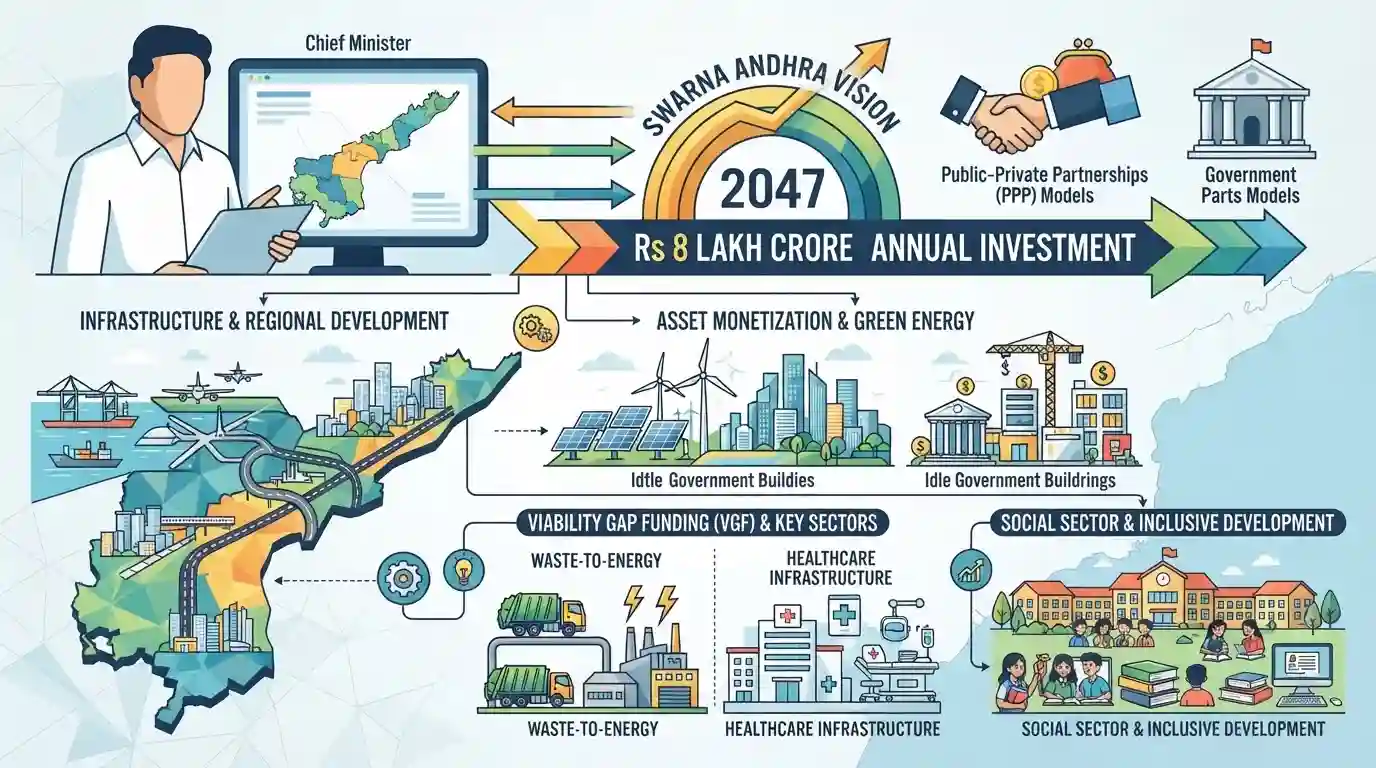
Chief Minister N. Chandrababu Naidu reviewed the status of Public-Private Partnership (PPP) projects in Andhra Pradesh, emphasizing their role in driving an infrastructure revolution. Under the Swarna Andhra 2047 Vision, the state plans to secure Rs 8 lakh crore in annual investments focused around key economic regions, utilizing the upcoming AP PPP-VGF Policy 1.0. Major components include Viability Gap Funding (VGF) for Waste-to-Energy and healthcare infrastructure, commercial monetization of idle government assets, and the development of self-contained residential schools for marginalized communities.
ముఖ్య అంశాలు
- Andhra Pradesh is currently executing 260 PPP projects valued at Rs 1,23,229 crore across industries, infrastructure, tourism, healthcare, and green energy.
- Under the Swarna Andhra 2047 Vision, the state aims to attract Rs 8 lakh crore in investments annually through PPPs, focusing heavily on the Visakhapatnam, Amaravati, and Tirupati Economic Regions.
- The Central Government has sanctioned Rs 178 crore in Viability Gap Funding (VGF) for Waste-to-Energy plants in Vijayawada and Tirupati, with another Rs 1,468 crore expected for PPP-model medical colleges.
- CM Chandrababu Naidu directed the cabinet submission of the Andhra Pradesh Public-Private Partnership–VGF Policy 1.0 to establish robust implementation guidelines.
- Strategies for asset monetization include leveraging idle government land (such as bus stations) and promoting pumped storage, solar energy, and NEDCAP initiatives.
- Inclusive social growth plans involve integrating local fishermen as stakeholders in coastal tourism and building integrated residential schools as 'mini townships' for SC, ST, BC, and Minority students.
ముఖ్యమైన పదాలు
Swarna Andhra 2047 Vision

A strategic roadmap by the Andhra Pradesh government targeting a $2.4 trillion economy, 15% annual growth, and zero poverty by 2047, aligned with the national "Viksit Bharat" initiative.
UPSC context
GS Paper III (Indian Economy & Planning) — tests state economic frameworks and long-term development alignment.
Urban Challenge Fund
A ₹1 lakh crore central reform-linked urban finance platform supporting city redevelopment, growth hubs, and water-sanitation projects through public-private partnerships and institutional loans.
UPSC context
GS Paper II & III (Urbanization & Municipal Finance) — tests innovative federal fiscal instruments.
Andhra Pradesh Public-Private Partnership–VGF Policy 1.0
A state policy framework designed to accelerate infrastructure development by utilizing Viability Gap Funding to attract up to ₹8 lakh crore in annual private investments across key economic regions.
UPSC context
GS Paper III (Investment Models & Infrastructure) — tests state-level public-private partnership policies and viability funding.
NEDCAP
The state nodal agency of Andhra Pradesh established in 1986 to promote, develop, and implement decentralized clean energy programmes, including solar, wind, and waste-to-energy projects.
UPSC context
GS Paper III (Renewable Energy & Sustainable Development) — tests state-level institutions implementing green energy programs.
Department of Economic Affairs
A key department under the Union Ministry of Finance responsible for formulating economic policies, managing capital markets, and overseeing infrastructure financing mechanisms like Viability Gap Funding.
UPSC context
GS Paper III (Indian Economy & Fiscal Policy) — tests understanding of central economic administration and financial mechanisms.
ప్రిలిమ్స్ ఉచ్చు
Asset monetization under PPP involves the permanent transfer of ownership of public land and infrastructure to private entities.
Asset monetization unlocks economic value by transferring revenue rights or operational control for a set period. Absolute ownership remains with the government.
అనుసంధానమైన స్థిర భావనలు
What are the criteria and limits for the Viability Gap Funding (VGF) Scheme?
- Core Purpose: Supports infrastructure projects that are economically and socially justified but fall short of financial viability without a capital grant.
- Funding Cap: The Government of India provides a capital grant of up to 20% of the Total Project Cost (TPC).
- Additional Support: The State Government, sponsoring ministry, or statutory entity can provide an additional grant up to 20% of TPC.
How do Pumped-Storage Hydropower (PSH) plants function as grid stabilizers?
- Mechanism: Operates using two water reservoirs situated at different elevations to store and release potential energy.
- Off-peak Pumping: Water is pumped to the upper reservoir using surplus renewable energy when grid demand is low.
- Peak Generation: Water flows down through turbines to generate electricity during high-demand hours, acting as a giant battery.
అంతర-అంశ నమూనాలు
PPPs shifting to social sectors
Traditionally focused on transport, PPP and VGF are increasingly applied to healthcare and education, marking a notable shift in public infrastructure planning.
Brownfield assets funding green transition
States are monetizing idle public land to fund capital-intensive green initiatives like pumped storage and Waste-to-Energy plants, linking fiscal strategy with climate goals.

Expect a GS3 question linking Asset Monetization with state-level green infra funding, or prelims statements on VGF caps for social sectors.
అనుసంధాన PYQలు · 3
అనుసంధాన PYQలు · 3
- 2024APPSC_PRELIMSGS1
The strategic objective of Asset Monetization Programme may be explained as :
- 2024APPSC_PRELIMSGS1
The Interim Union Budget (FY25) has proposed initiatives to boost India's Green Energy Sector. Which of the following proposals are connected with developing India's Green Energy ? I. Viability Gap Funding (VGF) for utilizing solar energy projects II. To set up coal gasification and liquefaction capacity of 100MT by 2030 III. Optional blending of Compressed Bio Gas (CBG) in Compressed Natural Gas (CNG) for transport and Piped Natural Gas (PNG) for domestic purposes IV. Provision of financial assistance for procurement of biomass aggregation machinery V. Setting up of a payment security system for expanding the bio-manufacturing system in the country Select the correct answer using the codes given below :
- 2024APPSC_PRELIMSGS1
Which of the following statements are valid in connection with Andhra Pradesh Green Hydrogen and Green Ammonia Policy (2023)? I. The objective is to target Green Energy production up to the capacity of 1 MPTA (Million Tonnes Per Annum) or Green Ammonia production up to the capacity of 2-0 MTPA in the next five years. II. New and Renewable Energy Development Corporation of A.P. Ltd (NREDCAP) shall act as a Nodal Agency under this policy. III. All the Ports in the State have infrastructure for storing liquid nitrogen which can then be utilized for storing Green Hydrogen for exporting to other countries. IV. The Policy prohibits the production of Green Hydrogen/Green Ammonia by using Renewable Energy and/or Biomass from 'Third-Party/Power exchange'. Select the correct answer using the codes given below :
