Australia India Clean Energy Partnership and Mineral Security
Source:The Hindu ↗
Why It Matters
Securing critical mineral supply chains and fostering joint green technology development are essential for India to meet its net-zero targets and maintain strategic autonomy in the Indo-Pacific clean energy landscape.
Summary
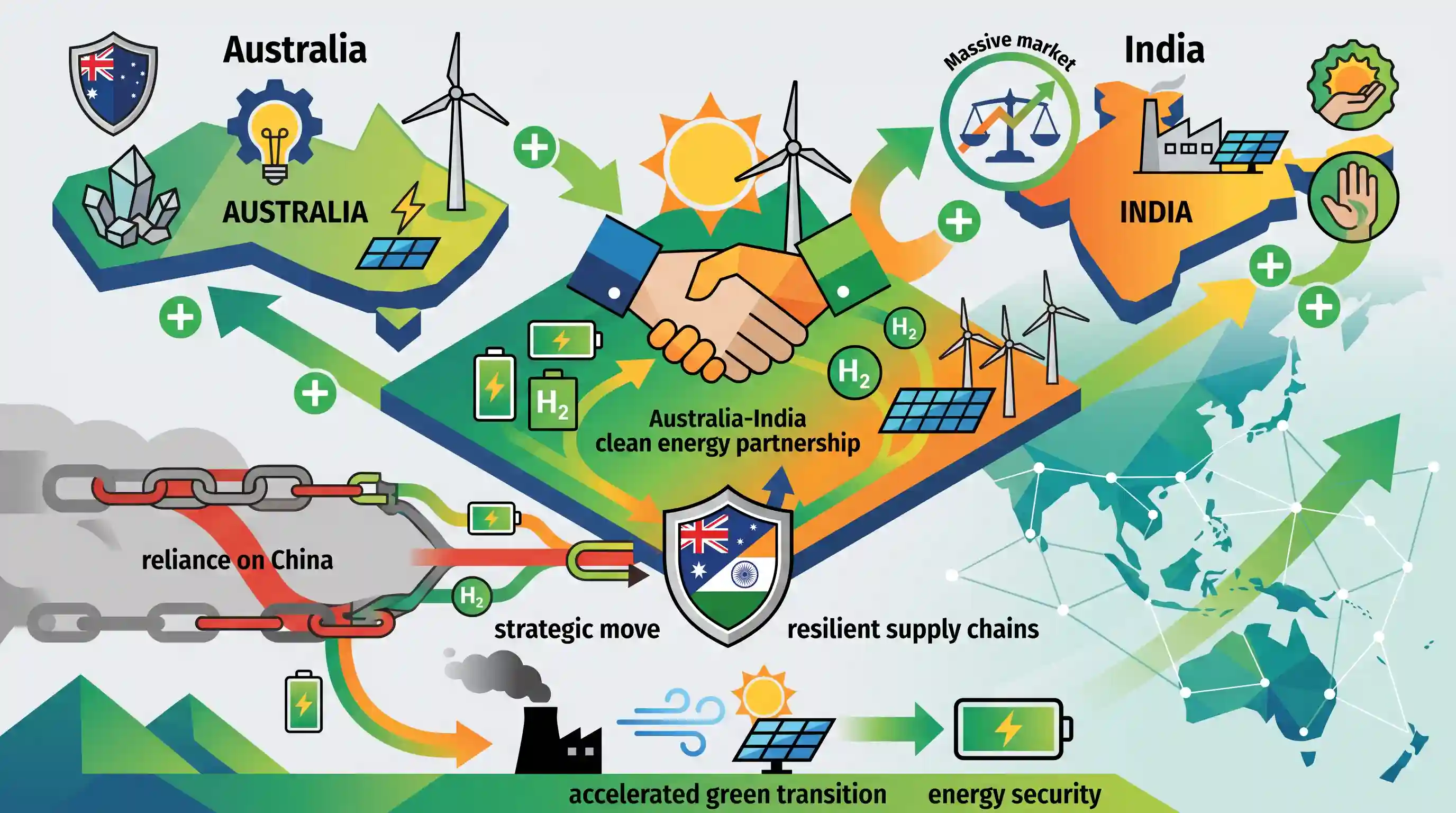
The article underscores the growing significance of the Australia-India clean energy partnership as a cornerstone of their bilateral relations. It highlights how combining Australia's abundance of critical minerals and renewable tech expertise with India's massive market scale and manufacturing drive can accelerate the green transition. This collaboration is framed not just as an environmental imperative, but as a strategic move to build resilient, diversified clean energy supply chains in the Indo-Pacific and reduce reliance on China.
Key Points
- Strategic synergy in critical minerals: Australia's vast reserves of lithium and cobalt are vital for India's renewable energy and electric vehicle (EV) manufacturing goals.
- Collaboration on green technologies: Both nations share ambitious targets for green hydrogen and solar energy, offering opportunities for joint research, investment, and technology transfer.
- Supply chain resilience: The partnership is crucial for diversifying clean energy supply chains in the Indo-Pacific, reducing dependencies on single nations like China.
- Multilateral reinforcement: Bilateral efforts are complemented by frameworks like the Quad Climate Working Group and the International Solar Alliance (ISA).
Important Terms
National Green Hydrogen Mission

Launched in 2023, this ₹19,744 crore initiative aims to make India a global hub for green hydrogen production and export, targeting 5 million metric tonnes (MMT) annual capacity by 2030.
UPSC context
GS Paper-III (Energy & Economy); tests knowledge of decarbonization strategies, energy security, and manufacturing incentives like the SIGHT program.
Comprehensive Strategic Partnership (CSP)
Elevated in 2020, this framework governs India-Australia ties across defense, trade, and technology, serving as the foundation for the 2024 Renewable Energy Partnership (REP) to diversify clean energy supply chains.
UPSC context
GS Paper-II (International Relations); tests understanding of bilateral strategic shifts and regional alignment in the Indo-Pacific.
Quad
An informal strategic forum of India, Australia, Japan, and the U.S. committed to a 'free and open Indo-Pacific,' focusing on maritime security and resilient clean energy supply chains (Q-CHAMP).
UPSC context
GS Paper-II (International Relations); evaluates comprehension of multilateral groupings, Indo-Pacific geopolitics, and collaborative climate action.
International Solar Alliance (ISA)
A treaty-based intergovernmental organization launched by India and France in 2015 to promote solar energy deployment, targeting $1 trillion in investments and 1,000 GW capacity by 2030.
UPSC context
GS Paper-II (Global Groupings) and GS Paper-III (Environment); assesses India’s leadership in global climate diplomacy and institution-building.
Prelims Trap
"Australia holds the world's largest reserves of lithium."
While Australia is the world's leading *producer* of lithium, the largest *reserves* are found in South America's "Lithium Triangle" (Bolivia, Argentina, Chile).
Static Concepts Connected
What differentiates Green, Blue, and Grey Hydrogen?
- Green Hydrogen: Produced via electrolysis of water using renewable energy sources (like solar or wind), resulting in zero carbon emissions.
- Blue Hydrogen: Produced from natural gas via steam methane reforming, but the resulting carbon emissions are captured and stored (CCS).
- Grey Hydrogen: The most common form, produced from natural gas without capturing the greenhouse gases, leading to high emissions.
What is the Supply Chain Resilience Initiative (SCRI)?
- Core Objective: A trilateral approach launched in 2021 by India, Japan, and Australia to reduce supply chain dependencies on a single nation (China).
- Key Pillars: Focuses on sharing best practices, promoting foreign direct investment, and enhancing digital technology adoption across the Indo-Pacific.
Cross-Topic Patterns
Quad's Non-Security Evolution
The Quad is pivoting from a pure maritime security dialogue toward providing regional public goods, heavily emphasizing the Quad Climate Working Group and critical emerging technologies.
SCRI + Critical Mineral Decoupling
Australia's lithium production aligns with the Supply Chain Resilience Initiative (SCRI), directly supporting India's domestic EV manufacturing and minimizing over-dependence on Chinese critical mineral processing.

Expect a 2026 prelims matrix question interlinking critical mineral supply chains, the Quad Climate Working Group, and India's KABIL.
Linked PYQs · 4
Linked PYQs · 4
- 2021MainsGS3
Explain the purpose of the Green Grid Initiative launched at World Leaders Summit of the COP26 UN Climate Change Conference in Glasgow in November, 2021. When was this idea first floated in the International Solar Alliance (ISA)?
- 2022MainsGS3
Do you think India will meet 50 percent of its energy needs from renewable energy by 2030 ? Justify your answer. How will the shift of subsidies from fossil fuels to renewables help achieve the above objective ? Explain.
- 2021MainsGS2
The newly tri-nation partnership AUKUS is aimed at countering China's ambitions in the Indo-Pacific region. Is it going to supersede the existing partnerships in the region? Discuss the strength and impact of AUKUS in the present scenario.
- 2023PrelimsGS1
With reference to green hydrogen, consider the following statements: 1. It can be used directly as a fuel for internal combustion. 2. It can be blended with natural gas and used as fuel for heat or power generation. 3. It can be used in the hydrogen fuel cell to run vehicles. How many of the above statements are correct?
