PowerGrid secures renewable energy transmission project in Gujarat
Source:solarquarter ↗
Why It Matters
Grid integration is the biggest bottleneck in India's renewable energy transition. TBCB and BOOT models are frequently tested in GPSC/UPSC exams to assess understanding of public-private partnerships and regulatory mechanisms in the power sector.
Summary
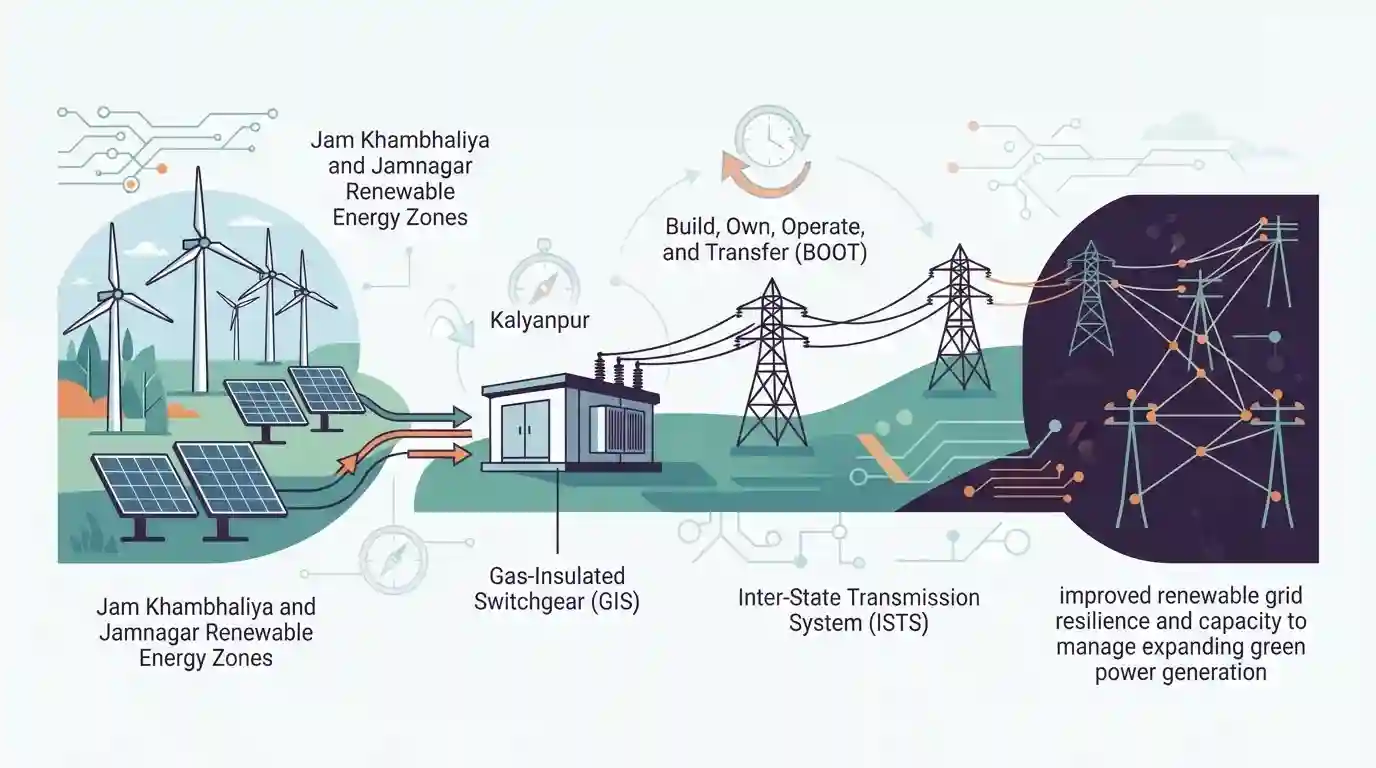
Power Grid Corporation of India Limited (POWERGRID) has successfully secured an INR 822.91 crore renewable energy transmission project in Gujarat through Tariff Based Competitive Bidding (TBCB). Awarded on a Build, Own, Operate, and Transfer (BOOT) basis, the project focuses on expanding the Inter-State Transmission System (ISTS) to integrate green energy from the Jam Khambhaliya and Jamnagar Renewable Energy Zones. Central to this initiative is the construction of a new 765/400 kV Gas-Insulated Switchgear (GIS) substation in Kalyanpur, which will significantly improve India's renewable grid resilience and capacity to manage the country’s expanding green power generation.
Key Points
- POWERGRID won a major INR 822.91 crore power transmission project in Gujarat under Tariff Based Competitive Bidding (TBCB).
- The project will be developed on a Build, Own, Operate, and Transfer (BOOT) model to augment the Inter-State Transmission System (ISTS).
- The infrastructure supports the integration of 5,500 MW from Jam Khambhaliya Renewable Energy Zone Phase II and 1,000 MW from Jamnagar Phase I into the national grid.
- A new Gas-Insulated Switchgear (GIS) substation will be established at Kalyanpur, demonstrating efforts to modernize power infrastructure and minimize land usage.
Important Terms
Tariff Based Competitive Bidding (TBCB)

A procurement framework where power transmission projects are awarded to developers quoting the lowest annual transmission charge over a specified concession period, promoting private investment, transparency, and cost-efficiency.
UPSC context
GS Paper 3 (Infrastructure/Energy). Highlights the shift to competitive market-driven models ensuring affordable electricity and private participation.
Build, Own, Operate, and Transfer (BOOT)
A public-private partnership model where a private developer finances, builds, owns, and operates an infrastructure project to recover costs via user charges, before transferring ownership to the public sector.
UPSC context
GS Paper 3 (Investment Models). Tests knowledge of PPP frameworks critical for financing large-scale national infrastructure without upfront government expenditure.
Power Grid Corporation of India Limited (POWERGRID)
A Maharatna Central Public Sector Enterprise under the Ministry of Power, responsible for planning, executing, and operating India's primary interstate electric power transmission network.
UPSC context
GS Paper 3 (Infrastructure/Energy). Relevant for analyzing the role of CPSUs in national energy security and renewable power integration.
Inter-State Transmission System (ISTS)
India's national high-voltage electricity grid that transports power across state boundaries, crucial for moving surplus renewable energy from resource-rich states to high-demand regions nationwide.
UPSC context
GS Paper 3 (Infrastructure). Essential for understanding the grid integration of renewables and government policies like ISTS transmission charge waivers.
Gas-Insulated Switchgear (GIS) Substation
A compact high-voltage substation that uses pressurized insulating gas (such as SF6) instead of air, making it highly reliable, space-efficient, and suitable for urban or extreme environments.
UPSC context
GS Paper 3 (Science & Tech/Infrastructure). Highlights technological upgrades in grid infrastructure to improve disaster-resilience and land-use efficiency.
Prelims Trap
"The GIS substation relies on natural gas to generate supplementary green energy."
GIS uses Sulfur Hexafluoride (SF6) gas strictly for electrical insulation to reduce the facility's footprint. It does not use natural gas as a fuel for power generation.
Static Concepts Connected
How does the BOOT model differ from EPC in infrastructure projects?
- Asset Ownership: Under BOOT, the private player owns and operates the asset during the concession period. Under EPC, the government assumes ownership upon completion.
- Risk Allocation: BOOT shifts financing and operational risks to the private developer. EPC keeps financial risk primarily with the government.
- Revenue Recovery: BOOT recovers capital and operational costs via user tariffs (TBCB). EPC contractors are paid a fixed contract sum for the construction work alone.
What is the regulatory framework for India's Inter-State Transmission System (ISTS)?
- Regulatory Authority: Tariffs and technical regulations for the inter-state flow of electricity are determined by the Central Electricity Regulatory Commission (CERC).
- Network Planning: The Central Transmission Utility of India Limited (CTUIL) manages ISTS planning and nationwide grid coordination.
- Renewable Waivers: The Centre offers ISTS transmission charge waivers for certain renewable energy projects to financially incentivize green grid integration.
Cross-Topic Patterns
GIS Tech + Land Acquisition Hurdles
The shift from air-insulated to gas-insulated switchgear (GIS) directly addresses right-of-way (RoW) and land acquisition bottlenecks, a recurring governance theme in state infrastructure delays.
TBCB vs. Cost-Plus Tariffs
The transition from the old "cost-plus" model to Tariff Based Competitive Bidding (TBCB) reflects broader economic reforms aimed at market efficiency and reducing power purchase costs for DISCOMs.

Expect a multi-statement question contrasting BOOT vs EPC models, pegged to Gujarat's RE evacuation infrastructure.
Linked PYQs · 3
Linked PYQs · 3
- 2026GPSC_PRELIMSGS1
Which of the following statement/s is/are correct regarding Renewable Energy Installed Capacity in India? 1. Wind energy is second only to solar energy in the Indian renewable sector. 2. Biomass power capacity accounts for around 30% of India's total renewable energy. 3. India ranks among the top three countries in the world in Hydropower Installed Capacity. Choose the correct option from the following.
- 2025GPSC_PRELIMSGS1
Under the Green Open Access Rules, 2022, the minimum size of the renewable energy project eligible for open access is
- 2025GPSC_PRELIMSGS1
A key technical feature of the "One Nation - One Grid - One Frequency" system in India is
