Powergrid Equity Cap Hike for Green Energy Transmission Projects
Source:Indian Express ↗
Why It Matters
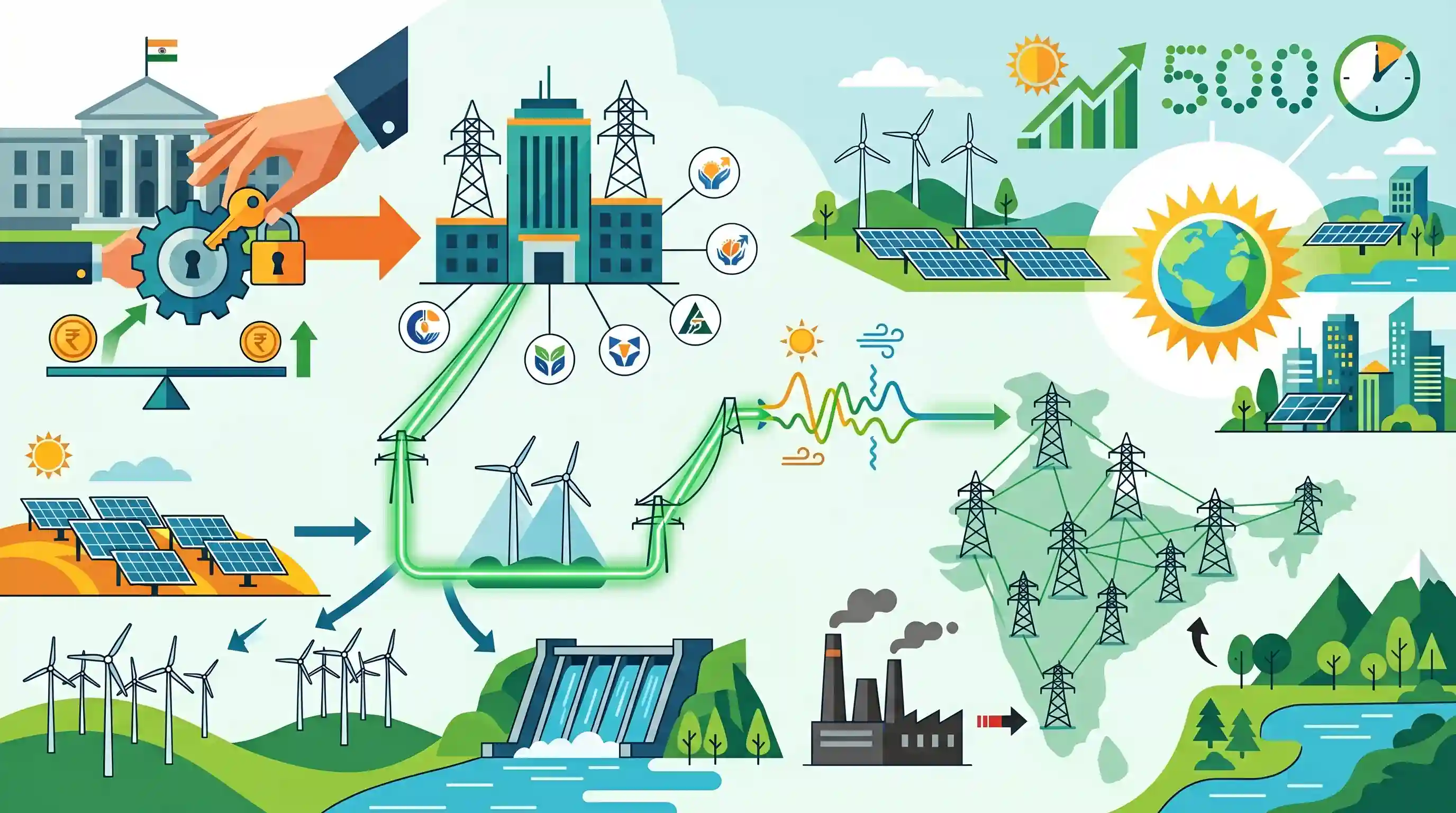
A significant bottleneck in renewable energy deployment is grid integration. Giving higher financial autonomy to a Maharatna CPSE like POWERGRID accelerates the creation of Green Energy Corridors, crucial for meeting India's 2030 climate targets.
Summary
The Union Cabinet has approved an increase in the equity investment cap for Power Grid Corporation of India Limited (POWERGRID) to ₹7,500 crore, surpassing the standard investment limits for Maharatna CPSEs. This enhanced financial autonomy empowers the state-owned transmission utility to undertake larger, capital-intensive investments in joint ventures and subsidiaries focused on green energy transmission projects. Developing robust transmission networks (like Green Energy Corridors) is essential to overcome the intermittency of renewable sources and integrate them efficiently into the national grid. This policy decision acts as a crucial enabler for India's transition to clean energy and its target of achieving 500 GW of non-fossil fuel power capacity by 2030.
Key Points
- The Union Cabinet raised the equity investment limit for Power Grid Corporation of India Limited (POWERGRID) to ₹7,500 crore.
- This enhanced financial cap allows the Maharatna CPSE to invest more capital into joint ventures and subsidiaries dedicated to green energy transmission.
- The initiative addresses the critical need for robust transmission infrastructure to evacuate and integrate intermittent renewable energy into the national grid.
- The decision directly supports India's ambitious climate commitments, including the target of installing 500 GW of non-fossil fuel electricity capacity by 2030.
Important Terms
Green Energy Corridor (GEC)

An infrastructure project designed to synchronize electricity produced from renewable sources (solar, wind, etc.) with the national grid, facilitating efficient power evacuation from resource-rich states to demand centers.
UPSC context
GS-III: Infrastructure and Energy. Tests knowledge of grid integration challenges and India's transition to a renewable-heavy energy mix.
Maharatna CPSE
A status granted to top-performing Central Public Sector Enterprises, providing highest financial autonomy for investments (standard cap: ₹5,000 crore) and mergers without prior government approval.
UPSC context
GS-III: Economy and Public Sector Undertakings. Relevant for corporate governance, PSU autonomy, and their role in national infrastructure.
Cabinet Committee on Economic Affairs (CCEA)
A high-level committee chaired by the Prime Minister responsible for reviewing economic trends and making final decisions on large investments, infrastructure projects, and pricing of essential commodities.
UPSC context
GS-II: Executive and Governance. Tests understanding of the cabinet system and specialized bodies driving national economic policy.
Power Grid Corporation of India Limited (POWERGRID)
A Maharatna PSU under the Ministry of Power; it is India's largest electric transmission utility, managing the majority of the country's inter-state power transfer networks.
UPSC context
GS-III: Energy Infrastructure. Important for questions on grid reliability, power evacuation, and the energy transition.
Panchamrit Targets
India’s five-fold climate commitment announced at COP26, including targets to reach 500 GW non-fossil fuel capacity by 2030 and Net Zero emissions by 2070.
UPSC context
GS-III: Environment and Climate Change. Crucial for understanding India’s international climate policy and domestic energy transition.
High Voltage Direct Current (HVDC)
A technology used to transmit bulk electricity over long distances as direct current at very high voltages, reducing transmission losses and stabilizing interconnected grids.
UPSC context
GS-III: Science and Technology/Infrastructure. Relevant for grid modernization and technical solutions for renewable energy evacuation.
Prelims Trap
"The standard financial limit for all Maharatna CPSEs to invest in a single joint venture is ₹7,500 crore."
The standard DPE limit for Maharatnas is ₹5,000 crore (or 15% of net worth). The ₹7,500 crore cap is a special exemption specifically granted to POWERGRID.
Static Concepts Connected
What are the mandatory criteria for a CPSE to attain Maharatna status?
- Prior Status: Must already hold Navratna status and be listed on the Indian stock exchange with prescribed public shareholding.
- Annual Turnover: Average annual turnover of over ₹25,000 crore during the last three years.
- Worth & Profit: Average annual net worth of over ₹15,000 crore and average annual net profit of over ₹5,000 crore (last 3 years).
- Global Presence: Should have a significant global footprint or international operations.
What is the Green Energy Corridor (GEC) project?
- Core Objective: A massive infrastructure initiative to synchronize electricity produced from intermittent renewables with the conventional national grid.
- Evacuation Infrastructure: Creates dedicated intra-state (by State Transmission Utilities) and inter-state (by POWERGRID) transmission infrastructure for RE-rich states.
- Grid Stability: Includes forecasting and scheduling mechanisms to manage the fluctuating nature of solar and wind power.
Cross-Topic Patterns
Maharatnas as Climate Action Vehicles
India is increasingly using special financial exemptions for CPSEs to bypass standard limits, treating them as sovereign execution vehicles to meet the capital-intensive 2030 Panchamrit targets.
Renewable Intermittency & The Duck Curve
The massive transmission expansion runs parallel to Battery Energy Storage Systems (BESS) and pumped hydro schemes to solve grid instability and the 'duck curve' caused by variable renewable generation.

Expect a multi-statement Prelims question combining standard Maharatna financial autonomy limits with Green Energy Corridor objectives.
Linked PYQs · 3
Linked PYQs · 3
- 2013MainsGS3
Write a note on India's green energy corridor to alleviate the problem of conventional energy.
- 2022MainsGS3
Do you think India will meet 50 percent of its energy needs from renewable energy by 2030 ? Justify your answer. How will the shift of subsidies from fossil fuels to renewables help achieve the above objective ? Explain.
- 2021MainsGS3
Explain the purpose of the Green Grid Initiative launched at World Leaders Summit of the COP26 UN Climate Change Conference in Glasgow in November, 2021. When was this idea first floated in the International Solar Alliance (ISA)?
