Rajasthan Green Energy Corridor Expands With New Transmission Network
Source:solar-quarter ↗
Why It Matters
This development is a key part of India's Green Energy Corridor and its target to achieve 500 GW of non-fossil fuel capacity by 2030. For RPSC RAS, understanding Rajasthan's leading role in solar/wind potential and how the generated power is transmitted via major infrastructure projects (like the 20 GW REZ Phase-III) to the national grid is highly crucial for the Economy and Geography sections.
Summary
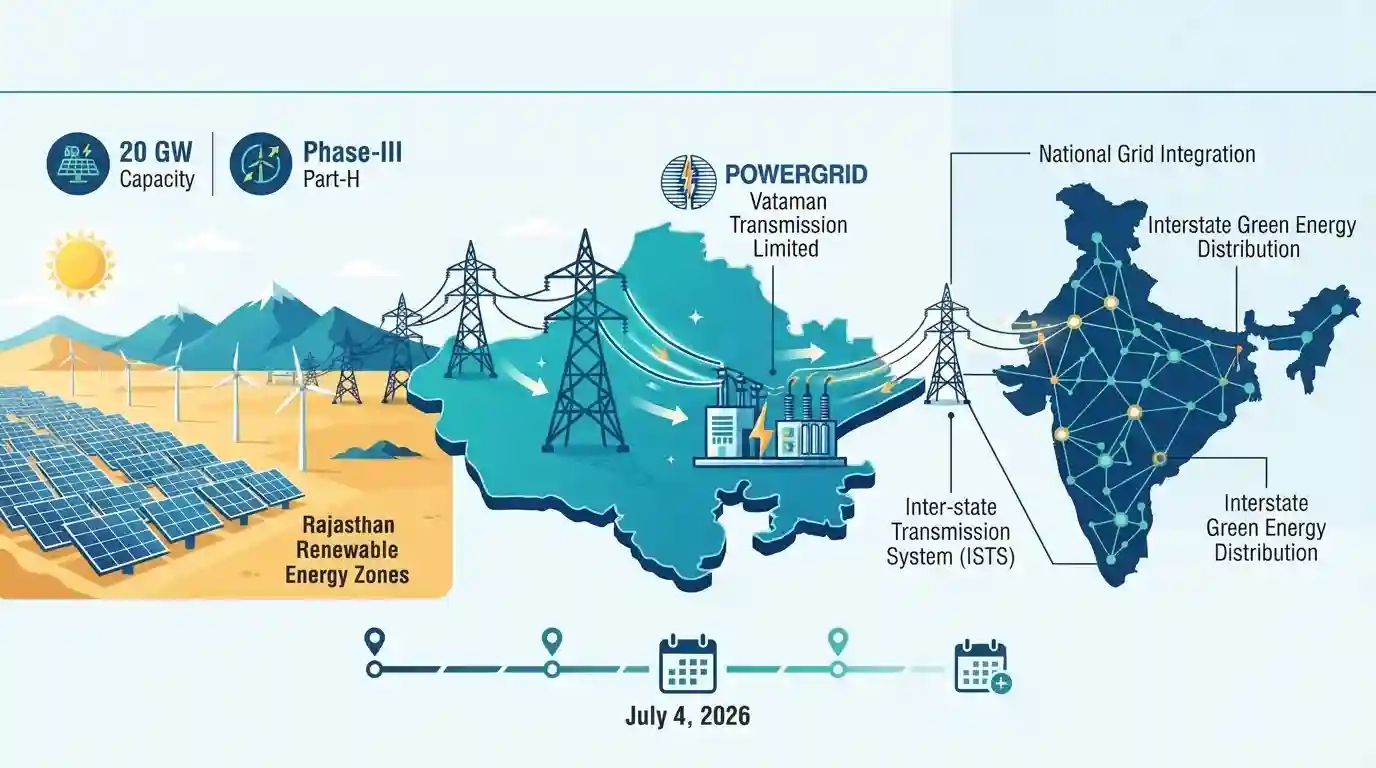
POWERGRID has officially commissioned a major 20 GW capacity transmission project—specifically Phase-III Part-H of the Rajasthan Renewable Energy Zones (REZ) evacuation system. Fully operational from July 4, 2026, the project was completed under POWERGRID Vataman Transmission Limited (following its merger with the Beawar Dausa subsidiary). The infrastructure serves to integrate Rajasthan's massive solar and wind potentials directly into the national grid, bolstering interstate green energy distribution.
Key Points
- Power Grid Corporation of India Limited (POWERGRID) successfully commissioned the "Transmission System for Evacuation of Power from Renewable Energy Zones (REZ) in Rajasthan (20 GW) under Phase-III Part-H" on July 4, 2026.
- Initially executed by POWERGRID Beawar Dausa Transmission Limited, the project was transferred to POWERGRID Vataman Transmission Limited following an amalgamation order by the Ministry of Corporate Affairs in early 2026.
- The transmission system acts as a key infrastructure development to evacuate up to 20 GW of solar and wind-generated electricity from Rajasthan's high-potential renewable energy zones.
- The project strengthens the national grid and India’s interstate transmission system (ISTS), facilitating the smooth transfer of clean energy from western supply pockets to major pan-India demand centers.
Important Terms
Power Grid Corporation of India Limited (POWERGRID)

A Maharatna Central Public Sector Enterprise (CPSE) under the Ministry of Power, responsible for managing the national power grid and transmitting bulk electricity across Indian states.
UPSC context
GS-3 (Infrastructure/Energy). Tests knowledge of key PSUs driving India's inter-state power distribution and renewable energy grid integration.
Green Energy Corridor Scheme
A dedicated power transmission infrastructure initiative by the Indian government to synchronize electricity generated from renewable sources, such as solar and wind, with the conventional national grid.
UPSC context
GS-3 (Environment/Infrastructure). Vital for understanding India's strategy to meet its renewable energy capacity targets and reduce carbon emissions.
POWERGRID Vataman Transmission Limited
A special purpose vehicle and wholly-owned subsidiary of POWERGRID. Following corporate amalgamation, it is responsible for implementing the Phase-III transmission system to evacuate renewable energy from Rajasthan.
UPSC context
GS-3 (Infrastructure). Demonstrates how public sector units utilize corporate restructuring and SPVs to manage large-scale renewable evacuation projects.
SEBI (Listing Obligations and Disclosure Requirements) Regulations, 2015
A comprehensive set of guidelines by SEBI that mandates transparency, ensuring listed companies disclose material events like commercial project commissioning to stock exchanges in a timely manner.
UPSC context
GS-3 (Indian Economy). Tests understanding of corporate governance, financial market regulation, and transparency standards for publicly traded enterprises.
Ministry of Corporate Affairs
The Indian government ministry responsible for regulating the corporate sector. It administers the Companies Act and grants regulatory approvals for corporate restructuring, such as company amalgamations and mergers.
UPSC context
GS-2 (Governance/Regulatory Bodies). Important for understanding the regulatory framework governing corporate administration, mergers, and legal compliance in India.
Prelims Trap
POWERGRID continues to operate as the Central Transmission Utility (CTU) responsible for planning national transmission corridors.
In 2021, the government split CTU functions from POWERGRID, making CTUIL a separate 100% state-owned company to avoid conflict of interest.
Static Concepts Connected
What is the Green Energy Corridor (GEC) initiative?
- Primary Objective: Facilitates grid integration of large-scale renewable energy by strengthening both interstate and intrastate transmission networks.
- Two-Tier Structure: Divided into ISTS (Inter-State) handled at the central level, and InSTS (Intra-State) managed by state-level transmission utilities.
- Funding Mechanism: Financed through a mix of Central Financial Assistance (CFA) from MNRE, state equity, and international soft loans.
How is India's power transmission regulated?
- Regulatory Overseer: The Central Electricity Regulatory Commission (CERC) regulates interstate tariffs, licensing, and resolves key sector disputes.
- Planning Utility: Central Transmission Utility of India Limited (CTUIL) acts as the neutral, independent body planning interstate grid systems.
- Grid Operator: Grid Controller of India Limited (formerly POSOCO) ensures the real-time security and reliable operation of the national grid.
Cross-Topic Patterns
Federalism + green energy corridors
Interstate clean energy transfer tests cooperative federalism, balancing resource-rich western states with energy-deficit industrial hubs via national grid planning.
Arid land-use + energy security
Transforming Rajasthan's arid wasteland into high-yield solar zones demonstrates how optimized land-use planning directly accelerates India's climate commitments.

Grid integration of variable RE and the role of ISTS waivers will likely be framed as a core GS-3 infrastructure question in 2026.
Linked PYQs · 2
Linked PYQs · 2
- 2023RPSC_PRELIMSGS1
Which agency has been given the responsibility of implementing the PM-KUSUM scheme (Component A) in Rajasthan, which involves the establishment of solar power plants with a capacity of 0.5 MW to 2 MW?
- 2024RPSC_PRELIMSGS1
Which of the following statements about Rajasthan Multi Bijli Yojana is/are correct? A. Provide plants on one side to provide 100 solar plants. B. Subsidy for setting up rooftop solar panels. C. Provision of loan at book interest.
