US-China Export Controls and Semiconductor Technology Denial Regimes
Source:The Hindu ↗
Why It Matters
Illustrates the crucial intersection of technology and geopolitics, where export controls on advanced AI chips are used as strategic foreign policy tools. It provides a real-world example of supply chain weaponization, directly relevant to UPSC questions on global tech decoupling and nations' pursuit of strategic autonomy.
Summary
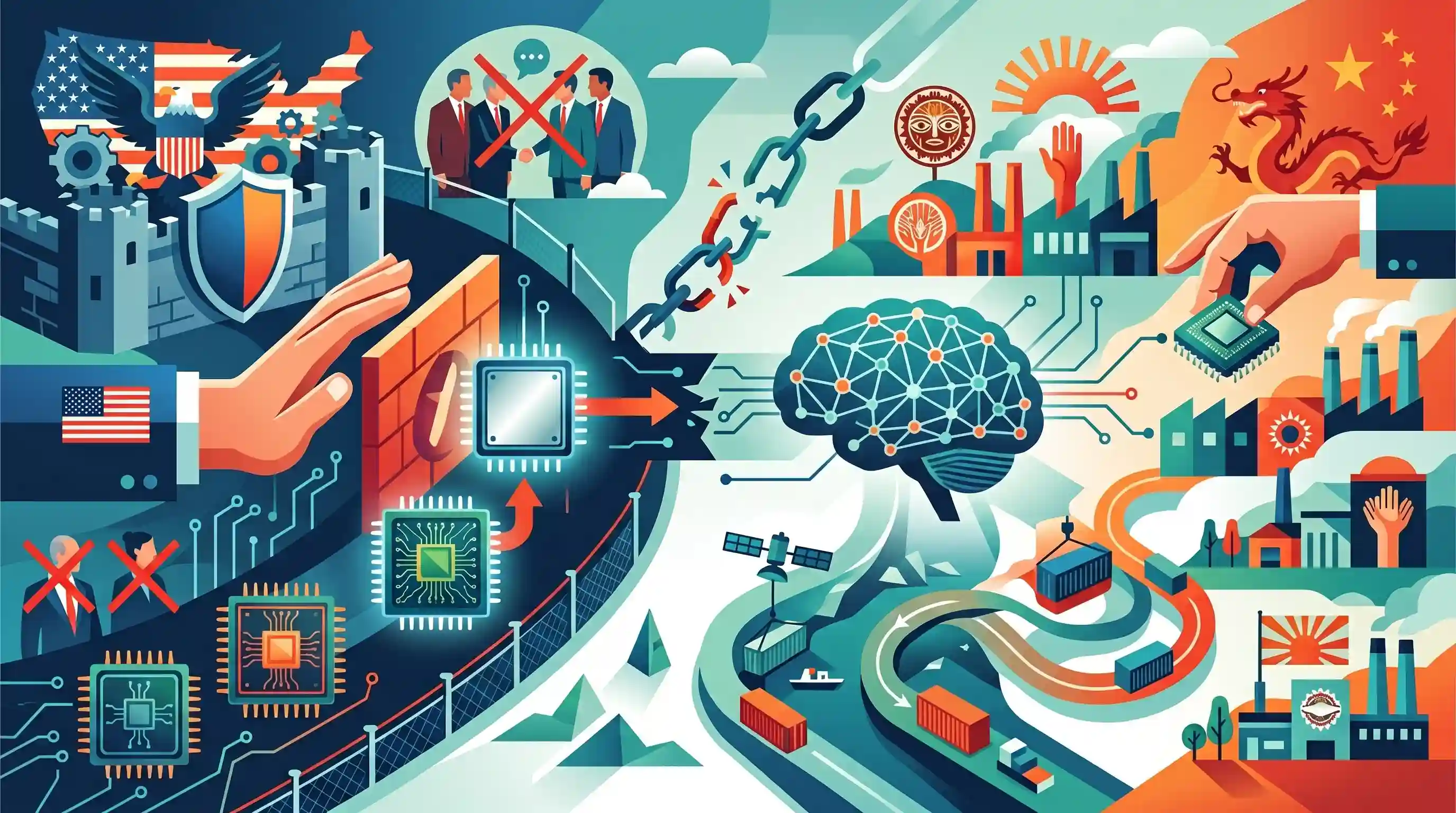
The US government has blocked the sale of Nvidia's H200 AI chips to China over unmet export conditions, despite prior diplomatic efforts to ease technology restrictions. With next-generation chips like Blackwell and Rubin entirely banned, the move underscores the intensifying US-China tech war and highlights how critical technologies like artificial intelligence and semiconductors are increasingly weaponized for national security. This strategic technology denial is driving countries toward domestic tech self-reliance and restructuring global supply chains.
Key Points
- The US Commerce Department confirmed that no Nvidia H200 AI chips have been sold to China due to unmet regulatory conditions.
- The restriction continues despite an earlier diplomatic understanding between the US and China to ease tech export bans in exchange for a 25% revenue cut for the US government.
- Nvidia's most advanced AI processors, including the Blackwell and Rubin series, remain under a complete export ban to China.
- This ongoing technology denial regime is accelerating China's strategic drive toward domestic semiconductor self-sufficiency.
Important Terms
US Export Controls

Federal laws and regulations that restrict the transfer of sensitive goods, software, and technology to foreign entities to protect national security and economic interests.
UPSC context
Critical for GS-2 (International Relations) and GS-3 (Security), testing understanding of how trade is used as a tool of foreign policy.
Technology Denial Regime
A strategic policy designed to block specific nations from acquiring frontier technologies (like advanced semiconductors) to maintain a technological edge or curb military modernization.
UPSC context
GS-2/GS-3 topic; reflects historical parallels like sanctions on India and current global competition for AI dominance.
US-China Tech War
The strategic competition between the US and China over leadership in critical technologies like AI, 5G, and semiconductors, impacting global supply chains and trade alliances.
UPSC context
Essential for GS-2 (Bilateral Relations), focusing on the shift from economic cooperation to strategic decoupling and 'de-risking'.
Bureau of Industry and Security (BIS)
An agency under the US Department of Commerce that manages export controls on 'dual-use' items—products with both commercial and military applications.
UPSC context
Relevant for GS-2 (International Institutions/Agencies) as the primary enforcer of global semiconductor trade restrictions.
Semiconductor Industry
The sector involved in designing and fabricating microchips. These chips are the 'brain' of modern electronics and are vital for national security and digital transformation.
UPSC context
Key for GS-3 (Economy/S&T); relates to India's Semiconductor Mission (ISM) and efforts toward 'Atmanirbhar Bharat'.
Nvidia
A dominant global designer of Graphics Processing Units (GPUs) essential for AI. Its chips (like H100/H200) are central to the current US-China export disputes.
UPSC context
Used as a case study in GS-3 for the weaponization of technology and private sector roles in geopolitics.
Prelims Trap
The ban on Nvidia's AI chips to China is mandated by the Wassenaar Arrangement on dual-use goods.
The US block is a unilateral domestic export control measure, not a multilateral mandate under the Wassenaar Arrangement, though both deal with restricting dual-use technologies.
Static Concepts Connected
What are Multilateral Export Control Regimes (MECRs)?
- Definition: Voluntary agreements among major supplier countries to prevent the proliferation of weapons and dual-use technologies.
- Wassenaar Arrangement: It specifically controls conventional arms and dual-use goods/technologies. India became a member in 2017, but China is not a member.
- Dual-Use Goods: Products or technologies (like advanced semiconductors or AI processing algorithms) that have both civilian commercial applications and military uses.
What are the key pillars of the India Semiconductor Mission (ISM)?
- Nodal Agency: A specialized business division within the Digital India Corporation (MeitY) designed to build a vibrant semiconductor and display ecosystem in India.
- Financial Incentives: Offers fiscal support (up to 50% of project cost) for setting up Silicon CMOS based Semiconductor Fabs and Display Fabs.
- Strategic Autonomy: Focuses on self-reliance in critical sectors by funding strategic national security fabrication plants (like the 'Shakti' project).
Cross-Topic Patterns
Tech War + Supply Chain Resilience
The US-China tech decoupling accelerates minilateral agreements like the India-Japan-Australia Supply Chain Resilience Initiative (SCRI), pushing "friend-shoring" of critical technologies away from Chinese dominance.
Tech Denial + Financial Weaponization
Just as the US used SWIFT to weaponize global finance against Russia, it uses IP laws and export controls to weaponize tech against China, prompting India's push for "tech sovereignty."

Expect a 2026 Prelims question mapping AI chip models (Blackwell, Rubin) to dual-use tech and India's Semiconductor Mission (ISM).
Linked PYQs · 3
Linked PYQs · 3
- 2024MainsGS2
‘The West is fostering India as an alternative to reduce dependence on China's supply chain and as a strategic ally to counter China's political and economic dominance.’ Explain this statement with examples.
- 2023MainsGS3
Introduce the concept of Artificial Intelligence (AI). How does Al help clinical diagnosis? Do you perceive any threat to privacy of the individual in the use of Al in healthcare?
- 2024PrelimsGS1
Consider the following statements: I. It is expected that Majorana 1 chip will enable quantum computing. II. Majorana 1 chip has been introduced by Amazon Web Services (AWS). III. Deep learning is a subset of machine learning. Which of the statements given above are correct?
