Telangana CM highlights green energy and economic growth at summit
Source:The Hindu ↗
Why It Matters
The article provides an excellent state-level case study for GS3 answers on how sub-national governments are integrating climate action (Net Zero, EV adoption) with aggressive economic and industrial expansion ('China Plus One', manufacturing clusters). It highlights the intersection of energy transition and economic policy.
Summary
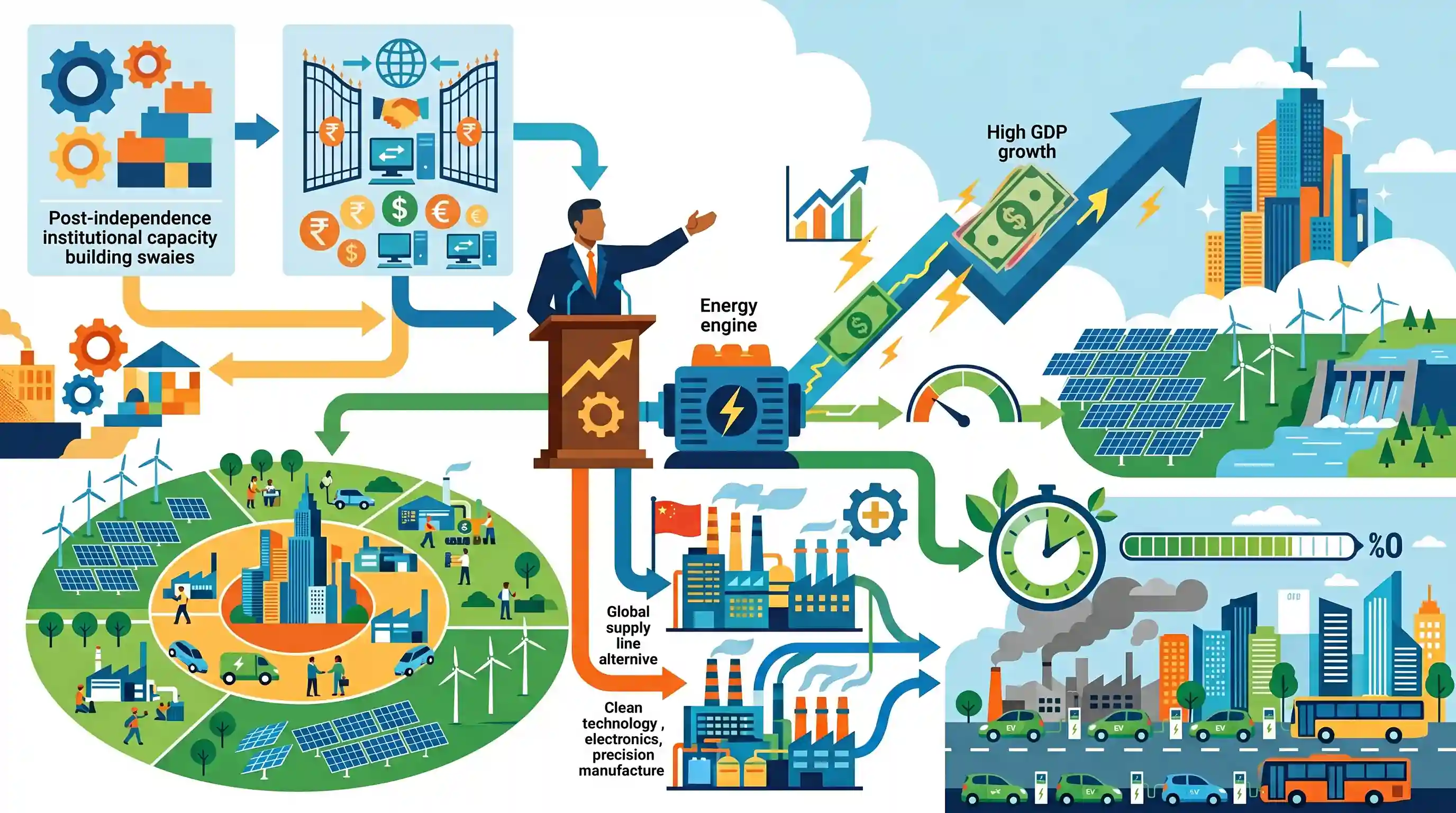
Speaking at the Mumbai Climate Week, Telangana Chief Minister A. Revanth Reddy articulated a development strategy that inextricably links energy consumption, climate action, and economic growth. Declaring power as the "real currency" of an economy, he outlined plans to scale Telangana's GDP to $3 trillion by 2047 by positioning the state as a green-powered 'China Plus One' manufacturing alternative. Central to this vision is a three-zone development model around Hyderabad, coupled with an aggressive target for the city to achieve Net Zero by 2034. Transition strategies include large-scale adoption of electric vehicles, decentralizing industries to peri-urban zones, and expanding green energy, which currently constitutes 25% of the state's power matrix. He contextualized this future trajectory within India's historical phases of post-independence institutional capacity building and the transformative 1991 LPG reforms.
Key Points
- Telangana Chief Minister framed power consumption as the primary metric of economic growth, projecting the state's peak demand to rise from 19,000 MW to 34,000 MW by 2034.
- Hyderabad is targeting a Net Zero status by 2034, which includes initiating a carbon footprint audit and relocating industries from urban to peri-urban areas to create decentralized green manufacturing zones.
- Green mobility is being heavily incentivized through 100% tax exemptions for electric vehicles (EVs) in Hyderabad, retrofitting of existing auto-rickshaws, and replacing diesel RTC buses with electric fleets.
- The state aims to capitalize on the 'China Plus One' supply chain strategy by offering green-powered manufacturing ecosystems.
- The economic trajectory was mapped in historical phases: post-independence institution-building (1950-1990) creating foundations like IITs and dams, followed by the 1991 LPG reforms that transformed India into a services powerhouse.
Important Terms
China Plus One Strategy

A global business strategy where companies diversify manufacturing and supply chains by adding alternative locations to China to mitigate geopolitical risks and over-reliance.
UPSC context
GS Paper 3: Industrial Policy and Economy; relevant for discussions on global supply chain resilience and India’s manufacturing potential.
LPG Reforms 1991
Economic reforms involving Liberalisation, Privatisation, and Globalisation, launched to address the 1991 Balance of Payments crisis by shifting India toward a market-oriented economy.
UPSC context
GS Paper 3: Indian Economy; tests understanding of structural shifts, deregulation, and integration with the global economy.
Net Zero
A state where greenhouse gas emissions released into the atmosphere are balanced by an equivalent amount being removed, achieving a neutral climate impact.
UPSC context
GS Paper 3: Environment and Conservation; critical for climate change mitigation goals (Panchamrit) and sustainable urban planning.
Three-Zone Development Model
Telangana’s regional planning framework: CURE (Core Urban Region Economy), PURE (Peri-Urban Region Economy), and RARE (Rural Agri Region Economy) to ensure balanced state-wide growth.
UPSC context
GS Paper 1 & 3: Urbanisation and Regional Development; a case study for decentralized industrialization and balanced regional growth.
Institutions of National Importance (INI)
Premier autonomous public institutes (IITs, IIMs, IISc) established to build human capital, scientific capacity, and technical leadership in post-independence India.
UPSC context
GS Paper 2 & 3: Education and S&T; tests knowledge of institutional capacity building and its impact on economic development.
Road Transport Corporation (RTC)
State-owned public transport utilities in India that are currently central to the green transition through the large-scale deployment of electric buses (e-buses).
UPSC context
GS Paper 3: Infrastructure and Environment; relevant for public transport modernization and FAME-II scheme implementation.
Prelims Trap
India's COP26 commitments mandate major metropolitan cities to achieve Net Zero emissions by 2034.
India's sovereign Net Zero target is 2070. Sub-national targets like Hyderabad's 2034 are voluntary municipal or state-led initiatives, not binding central UNFCCC mandates.
Static Concepts Connected
Why did 1991 LPG reforms trigger services-led growth rather than manufacturing dominance?
- Skipped transition: India largely bypassed the classic agriculture-to-manufacturing transition, leapfrogging directly into a high-growth service sector heavily led by IT and ITES.
- Factor constraints: Restrictive labor laws, complex land acquisition processes, and severe infrastructural bottlenecks deterred large-scale manufacturing FDI in the 1990s.
- Educational bias: Heavy early state investments in tertiary institutes (like IITs) fueled high-skill services, while vocational training for mass manufacturing lagged.
What is the 'China Plus One' macro-economic strategy?
- De-risking strategy: A global business approach where MNCs diversify their supply chains away from sole reliance on China to mitigate geopolitical risks.
- India's pull factors: India attempts to capture this supply chain shift using Production Linked Incentives (PLI), massive infrastructure upgrades, and green-powered industrial zones.
Cross-Topic Patterns
Sub-national Paradiplomacy & FDI
States are independently pitching 'green manufacturing' to foreign investors. This directly connects GS2 (Federalism/Paradiplomacy) with GS3 (Investment Models & Climate Change).
Peri-urban Decarbonization Strategies
Relocating industries to peri-urban zones connects GS1 (Urbanization issues) to GS3 (Carbon footprints), simultaneously addressing urban heat islands and decentralizing economic growth.

GS3 Mains 2026: Assess if India's renewable energy grid can realistically absorb and power the manufacturing influx from 'China Plus One'.
Linked PYQs · 4
Linked PYQs · 4
- 2023MainsGS3
The adoption of electric vehicles is rapidly growing worldwide. How do electric vehicles contribute to reducing carbon emissions and what are the key benefits they offer compared to traditional combustion engine vehicles?
- 2022MainsGS3
Do you think India will meet 50 percent of its energy needs from renewable energy by 2030 ? Justify your answer. How will the shift of subsidies from fossil fuels to renewables help achieve the above objective ? Explain.
- 2023MainsGS3
Faster economic growth requires increased share of the manufacturing sector in GDP, particularly of MSMEs. Comment on the present policies of the Government in this regard.
- 2017MainsGS3
Industrial growth rate has lagged-behind in the overall growth of Gross-Domestic-Product (GDP) in the post-reform period." Give reasons. How far the recent changes in Industrial-Policy are capable of increasing the industrial growth rate?
