Powergrid Commissions 20 GW Renewable Transmission System in Rajasthan
Source:powerline ↗
Why It Matters
The development of high-capacity power evacuation infrastructure is crucial for states like Rajasthan, which have vast renewable energy potential but require robust transmission networks to supply this power to the national grid. This topic is highly relevant for RPSC Prelims questions related to state infrastructure projects, renewable energy policies, and energy corridors like the Green Energy Corridor.
Summary
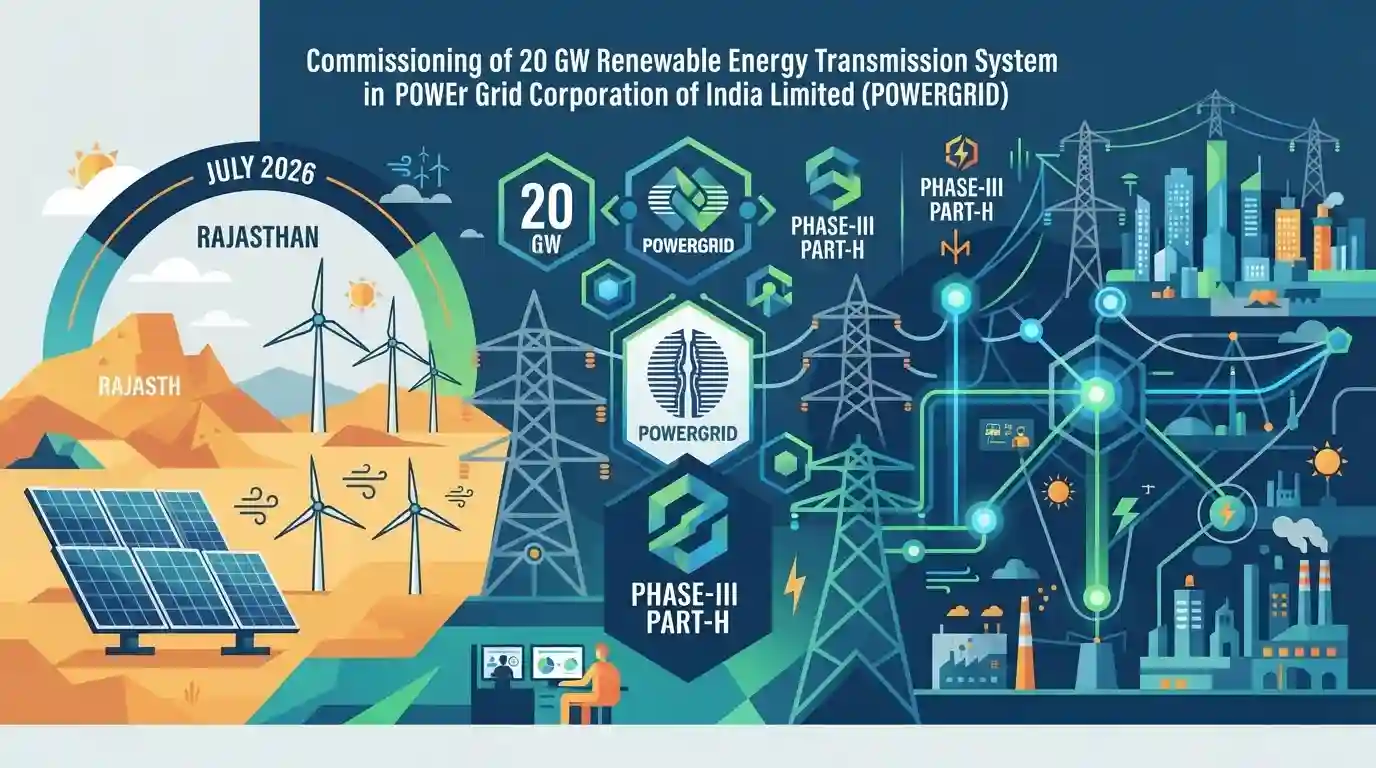
Power Grid Corporation of India Limited (POWERGRID) has successfully commissioned a major 20 GW renewable energy evacuation transmission system in Rajasthan. Executed under Phase-III Part-H for Renewable Energy Zones (REZ) in the state, the project connects Rajasthan's significant solar and wind power generation capacity to the national grid. Commissioned in July 2026, this infrastructure upgrade is pivotal for the reliable transmission of green energy, reinforcing Rajasthan's position as a leading renewable energy hub and supporting India's broader clean energy transition targets.
Key Points
- POWERGRID has commissioned a 20 GW renewable energy evacuation transmission system in Rajasthan.
- The project, executed by POWERGRID Beawar Dausa Transmission Limited, facilitates the integration of Renewable Energy Zones (REZ) in Rajasthan with the national grid.
- The system was commissioned on July 4, 2026.
- This development is a significant step towards achieving India's renewable energy goals by enhancing the power evacuation infrastructure in a key solar and wind energy-producing state.
Important Terms
Transmission System for evacuation of Power from REZ in Rajasthan (20 GW) under Phase-III Part-H

A high-capacity power grid infrastructure project commissioned in 2026 to transmit 20 gigawatts of clean electricity from Rajasthan's Renewable Energy Zones to India's national grid, bolstering energy reliability.
UPSC context
GS Paper III (Infrastructure, Energy); tests knowledge of clean energy evacuation, interstate grid integration, and achieving national net-zero targets.
POWERGRID
Power Grid Corporation of India Limited is a Maharatna Central Public Sector Enterprise responsible for transmitting about 50 percent of the total power generated in India through its extensive interstate transmission grid.
UPSC context
GS Paper III (Infrastructure, Economy); tests understanding of public sector undertakings, energy security, and the development of national electric grids.
POWERGRID Beawar Dausa Transmission Limited
A former wholly owned subsidiary of POWERGRID, originally established as a Special Purpose Vehicle to execute transmission projects in Rajasthan, which was merged with POWERGRID Vataman Transmission Limited in March 2026.
UPSC context
GS Paper III (Energy, Infrastructure); tests familiarity with executing infrastructure projects via Special Purpose Vehicles and corporate restructuring in public utilities.
POWERGRID Vataman Transmission Limited
An active public limited Union Government company and subsidiary of POWERGRID that absorbed POWERGRID Beawar Dausa Transmission Limited to execute the 20 GW Rajasthan renewable energy evacuation transmission system.
UPSC context
GS Paper III (Infrastructure, Corporate Governance); tests understanding of organizational structures and entities executing critical national energy projects.
Prelims Trap
POWERGRID is responsible for managing both the inter-state and intra-state transmission networks under the Green Energy Corridor.
POWERGRID (Central Transmission Utility) manages inter-state transmission (connecting REZs to the national grid). Intra-state Green Energy Corridors are managed by State Transmission Utilities (STUs), not POWERGRID.
Static Concepts Connected
What is the Green Energy Corridor (GEC) Project?
- Objective: To synchronize variable renewable energy (solar/wind) from RE-rich states with the conventional national grid.
- Components: Divided into Intra-state (managed by State Utilities) and Inter-state (managed by POWERGRID) transmission networks.
- Funding: Intra-state phases are funded through a mix of central grants (usually 33%), state equity, and external loans (e.g., KfW Germany).
What are the primary grid integration challenges for Renewable Energy?
- Intermittency: Solar and wind power are weather-dependent and highly variable, causing voltage and frequency fluctuations that threaten grid stability.
- Spatial Mismatch: RE potential is geographically concentrated (e.g., western Rajasthan), requiring massive capital for long-distance evacuation infrastructure to consumption centers.
- Duck Curve Effect: High solar generation during mid-day lowers net grid load, but requires rapid, expensive ramping of thermal power at sunset to meet peak demand.
Cross-Topic Patterns
Mega grids vs. Decentralized Solar
While POWERGRID builds massive inter-state evacuation for utility-scale REZs, schemes like PM-KUSUM push decentralized grid-connected solar to reduce transmission losses and DISCOM subsidy burdens.
Asset Monetization via InvITs
POWERGRID frequently uses Infrastructure Investment Trusts (InvITs) to monetize operational transmission lines, raising vital private capital to fund new Green Energy Corridor phases.

Prelims 2026: Expect a multi-statement question combining Green Energy Corridor funding, PM-KUSUM eligibility, and POWERGRID's CTU status.
Linked PYQs · 5
Linked PYQs · 5
- 2021RPSC_PRELIMSGS1
In which year was the Rajasthan Solar Energy Policy announced?
- 2023RPSC_PRELIMSGS1
Which agency has been given the responsibility of implementing the PM-KUSUM scheme (Component A) in Rajasthan, which involves the establishment of solar power plants with a capacity of 0.5 MW to 2 MW?
- 2012RPSC_PRELIMSGS1
The first solar energy policy was announced by the Government of Rajasthan in -
- 2021RPSC_PRELIMSGS1
'Green Energy Corridor' – Through which of the following districts will it pass in Rajasthan?
- 2023RPSC_PRELIMSGS1
When is Energy Conservation Day celebrated in Rajasthan?
