Chandrayaan 3 Discovery of Lunar Mantle Material
Source:Indian Express ↗
Why It Matters
This article details the direct scientific outputs of the Chandrayaan-3 mission, emphasizing its contributions to global lunar geology. Understanding the specific findings (e.g., sulfur enrichment, lunar mantle materials, SPA basin) and the instruments used (Alpha Particle X-ray Spectrometer) is crucial for Prelims and GS3 Science & Tech questions regarding India's space achievements.
Summary
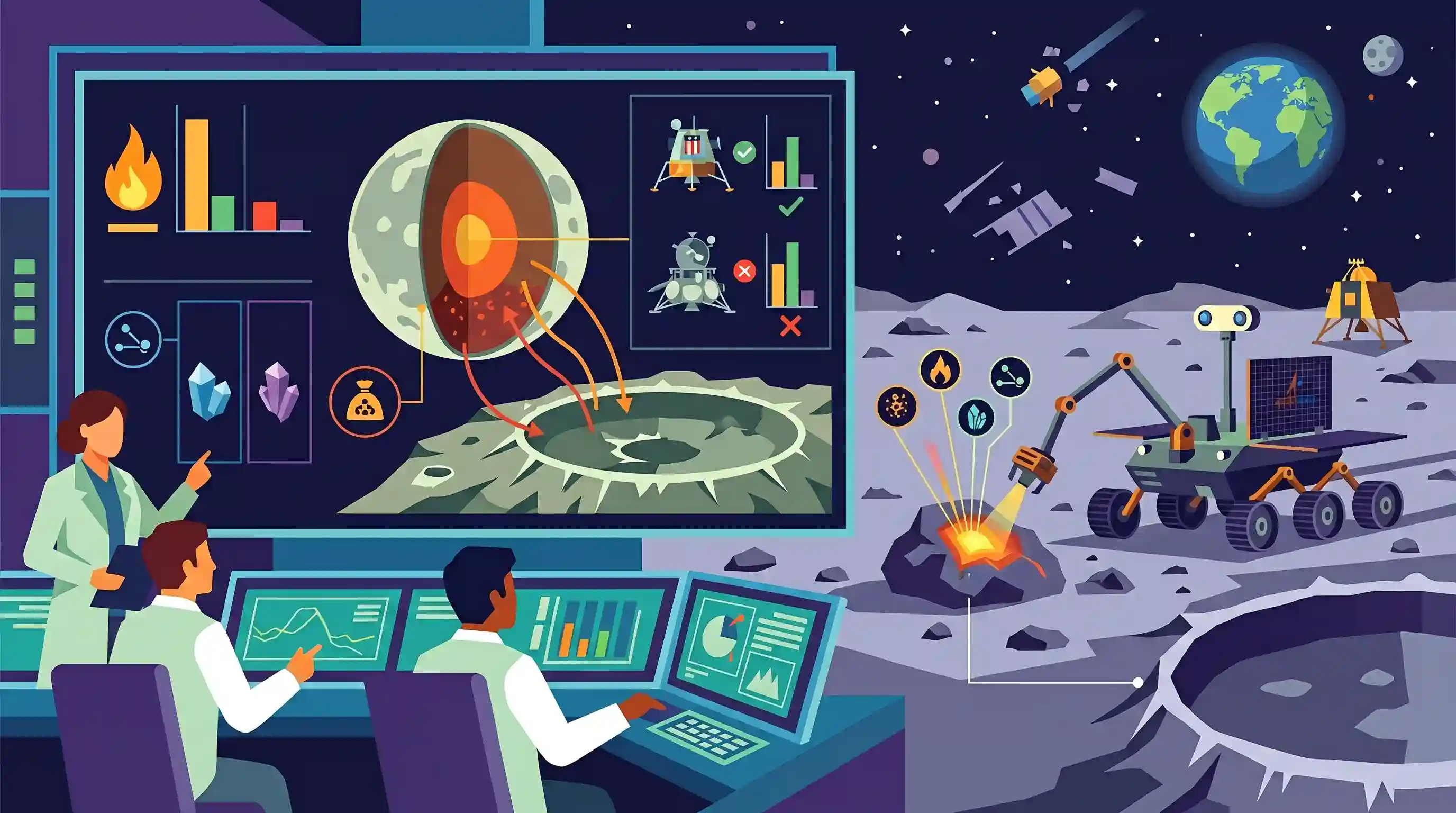
Scientists at the Physical Research Laboratory (PRL) analyzing data from Chandrayaan-3's Pragyan rover have discovered potential primitive lunar mantle material at the Shiv Shakti landing site. Utilizing the Alpha Particle X-ray Spectrometer, researchers identified an anomalous depletion in sodium and potassium alongside an enrichment in sulfur. These materials are believed to have been excavated during the formation of the South Pole-Aitken basin approximately 4.3 billion years ago, offering novel insights into lunar geology that overturn assumptions based on earlier Apollo 16 and Luna 20 missions.
Key Points
- Data from Chandrayaan-3's Pragyan rover, utilizing the Alpha Particle X-ray Spectrometer, indicates the potential presence of primitive lunar mantle material at the Shiv Shakti landing site.
- The analysis revealed an anomalous depletion in sodium and potassium, alongside an enrichment in sulfur in the lunar soil.
- These materials were likely excavated during the formation of the South Pole-Aitken (SPA) basin around 4.3 billion years ago.
- The SPA basin is one of the oldest and largest known impact craters on the lunar surface, and these findings provide new insights that differ from previous Apollo and Luna missions.
Important Terms
Chandrayaan-3

India's third lunar mission that achieved the first-ever soft landing near the lunar South Pole on August 23, 2023, using the Vikram lander and Pragyan rover.
UPSC context
GS Paper III: Science & Technology. Significant for Space exploration, ISRO's indigenous capabilities, and demonstrating soft-landing and rover technology.
Physical Research Laboratory (PRL)
A premier Indian research institute under the Department of Space, responsible for designing scientific payloads like the APXS and conducting advanced studies on planetary evolution.
UPSC context
GS Paper III: Awareness in Space and institutional frameworks. Tests knowledge of India's scientific research infrastructure.
Alpha Particle X-ray Spectrometer (APXS)
A scientific instrument on the Pragyan rover that uses radioactive Curium-244 to identify the chemical and mineralogical composition of lunar soil through characteristic X-rays.
UPSC context
GS Paper III: Space payloads and scientific discoveries. Tests technical understanding of in-situ lunar surface analysis.
South Pole-Aitken (SPA) Basin
The largest, oldest, and deepest impact crater on the Moon, believed to have excavated primitive mantle material from deep within the lunar interior.
UPSC context
GS Paper I/III: Geography/Science. Vital for understanding lunar geology, planetary evolution, and the impact history of the early Solar System.
Shiv Shakti Point
The official name for the Chandrayaan-3 landing site, located in the southern high-latitude highlands of the Moon's nearside.
UPSC context
Current Affairs: Space landmarks and mission outcomes. Relevant for mapping and mission-specific nomenclature.
Lunar Magma Ocean (LMO) Hypothesis
A scientific theory suggesting the Moon's early exterior was entirely molten; findings at Shiv Shakti Point regarding magnesium and sulfur levels provide supporting evidence.
UPSC context
GS Paper III: General Science. Core concept for testing knowledge of planetary formation and recent scientific breakthroughs.
KREEP
An acronym for lunar materials rich in Potassium (K), Rare Earth Elements (REE), and Phosphorus (P), typically found in younger volcanic lunar regions.
UPSC context
GS Paper III: Science. Important for understanding the geochemical evolution of the Moon and identifying ancient vs. modern surfaces.
Prelims Trap
Chandrayaan-3 landed inside the South Pole-Aitken basin to directly study the lunar mantle.
Pragyan landed at Shiv Shakti point, not inside the SPA basin. The primitive material was excavated and ejected from the basin to the landing site billions of years ago.
Static Concepts Connected
What are the primary scientific payloads on the Pragyan Rover?
- APXS: Measures elemental composition of lunar soil using X-rays. It detected the sulfur enrichment and depleted sodium/potassium.
- LIBS: Determines chemical and mineralogical composition of the lunar surface using intense laser pulses.
Why is the South Pole-Aitken (SPA) basin scientifically significant?
- Oldest & Deepest: Formed 4.3 billion years ago on the Moon's far side, it is one of the largest and deepest known impact craters in the Solar System.
- Mantle Exposure: The massive impact likely pierced the Moon's crust, exposing primitive mantle material that is crucial for studying early planetary formation and geology.
Cross-Topic Patterns
Artemis Accords & Space Mining
The discovery of enriched sulfur highlights the practical resource-mapping aspect of lunar missions, directly linking to the strategic geopolitics of the Artemis Accords and lunar outpost planning.
Planetary differentiation
Finding primitive mantle material bridges space tech with basic physical geography, aiding our understanding of how terrestrial planets and moons stratify into crust, mantle, and core.

Expect a multi-statement Prelims question matching Chandrayaan-3 payloads (APXS, LIBS) with their exact discoveries (Sulfur, Mantle).
Linked PYQs · 2
Linked PYQs · 2
- 2023MainsGS3
What is the main task of India's third moon mission which could not be achieved in its earlier mission? List the countries that have achieved this task. Introduce the subsystems in the spacecraft launched and explain the role of the Virtual Launch Control Centre' at the Vikram Sarabhai Space Centre which contributed to the successful launch from Sriharikota.
- 2017MainsGS3
India has achieved remarkable successes in unmanned space missions including the Chandrayaan and Mars Orbitter Mission, but has not ventured into manned space missions. What are the main obstacles to launching a manned space mission, both in terms of technology and logistics? Examine critically.
