James Webb Space Telescope Detection of Exoplanet Biosignatures
Source:Indian Express ↗
Why It Matters
Exoplanet research and the search for extraterrestrial life are central to global space missions. Understanding the capabilities of the James Webb Space Telescope (JWST), concepts like the habitable zone, and the significance of biosignatures like DMS are crucial for the Science & Technology segment of GS3, which frequently tests knowledge on cutting-edge space observatories.
Summary
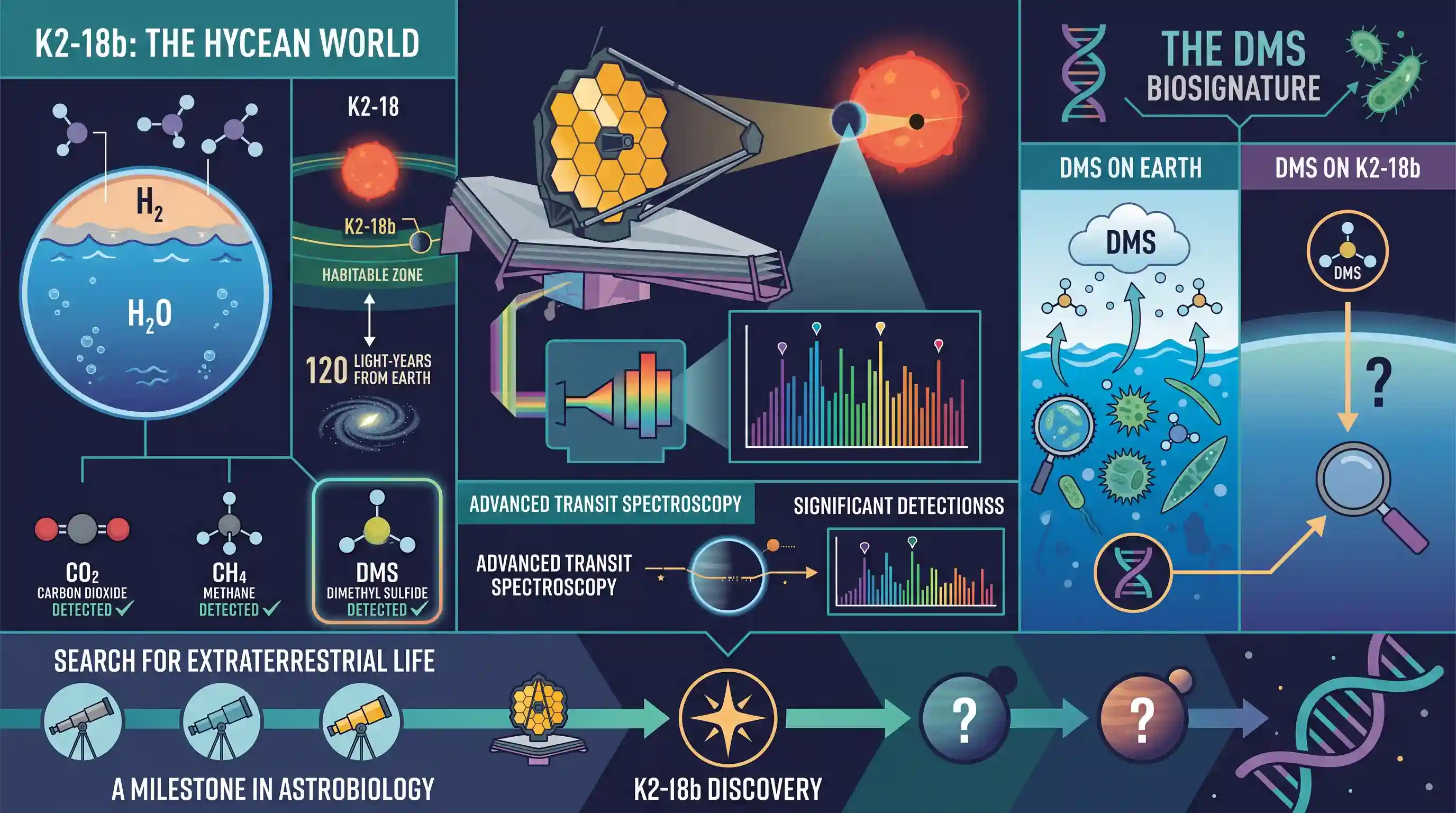
The article explores the profound implications of potential biosignatures discovered on the exoplanet K2-18b using the James Webb Space Telescope (JWST). Located 120 light-years away in the habitable zone of its host star, K2-18b is believed to be a "Hycean" world—characterized by a hydrogen atmosphere and a global water ocean. Alongside carbon dioxide and methane, JWST detected tentative traces of dimethyl sulfide (DMS), a molecule that on Earth is produced solely by biological activity, primarily marine phytoplankton. This discovery highlights JWST's advanced capability to conduct transit spectroscopy and marks a significant milestone in the search for extraterrestrial life.
Key Points
- Exoplanet K2-18b, located 120 light-years away in the Leo constellation, orbits its red dwarf star within the 'habitable' or Goldilocks zone where liquid water can exist.
- K2-18b is hypothesized to be a 'Hycean' planet, a theoretical class of exoplanets possessing a hydrogen-rich atmosphere covering a vast global water ocean.
- The James Webb Space Telescope (JWST) previously identified carbon-bearing molecules like methane and carbon dioxide in K2-18b's atmosphere, adding weight to the Hycean hypothesis.
- A groundbreaking preliminary detection of dimethyl sulfide (DMS) was made by JWST; on Earth, DMS is produced exclusively by life, predominantly by marine phytoplankton, making it a strong potential biosignature.
- JWST analyzes exoplanet atmospheres using transit spectroscopy, measuring the absorption spectrum of starlight as it filters through the planet's atmosphere during a transit.
Important Terms
Exoplanet

A planet orbiting a star outside our solar system. They vary in size and composition, including rocky terrestrial worlds and gas giants, often studied for potential habitability.
UPSC context
GS Paper 3 (Space Technology). Relevant for planetary discovery methods and the search for habitable environments.
Hycean World
A portmanteau of 'hydrogen' and 'ocean,' describing a class of exoplanets featuring hydrogen-rich atmospheres and global water oceans, considered a prime candidate for hosting extraterrestrial life.
UPSC context
GS Paper 3 (Space Technology). A specific planetary classification relevant for modern astrobiological search strategies.
James Webb Space Telescope (JWST)
The most powerful infrared space telescope ever built, located at the L2 Lagrange point. It is an international collaboration designed to study cosmic history and exoplanet atmospheres.
UPSC context
GS Paper 3 (Science & Tech). Specifically mentioned in the 2022 Mains; vital for major space missions.
Biosignature
Any measurable substance or pattern—such as specific atmospheric gases—providing scientific evidence of past or present life, distinguishing biological origin from abiotic natural processes.
UPSC context
GS Paper 3 (Science & Tech). Essential concept in astrobiology and the scientific search for life beyond Earth.
Dimethyl sulfide (DMS)
An organic compound produced on Earth primarily by marine phytoplankton. Its potential detection in an exoplanet’s atmosphere is a significant indicator of possible biological activity.
UPSC context
GS Paper 3 (Science & Tech). Notable as a specific biomarker molecule in current space exploration news.
Transit Spectroscopy
An observational technique that analyzes starlight filtered through an exoplanet's atmosphere as it transits its star, allowing scientists to identify the atmosphere's chemical components.
UPSC context
GS Paper 3 (Science & Tech). Technical method for atmospheric characterization in remote astronomical observations.
NASA
The primary United States government agency responsible for civil space programs and aeronautics. It leads major missions like JWST and frequently collaborates with global partners like ISRO.
UPSC context
GS Paper 3 (Space). Key international partner and leader in pioneering space exploration technologies and missions.
Prelims Trap
"Dimethyl sulfide (DMS) is primarily a byproduct of volcanic or geological activity on Earth."
UPSC often swaps biological origins with geological ones to create false statements. On Earth, DMS is produced exclusively by biological activity (marine phytoplankton), not volcanism.
Static Concepts Connected
What defines the 'Goldilocks Zone' in astrophysics?
- Definition: The circumstellar area around a star where planetary surface temperatures are neither too hot nor too cold, allowing liquid water to pool.
- Star dependence: The zone's exact distance varies based on the host star; it is closer for cooler red dwarfs and further away for hotter, more massive stars.
- Astrobiological significance: It provides the fundamental baseline condition for an exoplanet to potentially host life as we understand it.
How does Transit Spectroscopy analyze exoplanet atmospheres?
- Mechanism: It analyzes the starlight that filters through an exoplanet's atmosphere when the planet transits (passes directly in front of) its host star from the telescope's perspective.
- Light absorption: Atmospheric chemicals absorb specific wavelengths of light, leaving unique dark bands or 'fingerprints' in the resulting light spectrum.
- Application: Used extensively by JWST to accurately identify the presence of water vapor, carbon dioxide, methane, and potential biosignatures far beyond our solar system.
Cross-Topic Patterns
Biosignatures & Marine Phytoplankton
Connecting deep-space biosignatures (DMS) to Earth's marine phytoplankton bridges GS3 Space Tech directly with GS3 Environment, echoing UPSC's tendency to test interdisciplinary ecology-technology concepts.
Observatory Tech Shifts
The detection relies on JWST's mid-infrared capabilities. UPSC frequently tests the functional advantages of newer space observatories (JWST) over legacy optical systems (Hubble).

Expect a 2026 Prelims question pairing terms like 'Hycean planet', 'Goldilocks Zone', or 'Transit Spectroscopy' with definitions.
Linked PYQs · 1
Linked PYQs · 1
- 2022MainsGS3
Launched on 25th December, 2021, James Webb Space Telescope has been much in the news since then. What are its unique features which make it superior to its predecessor Space Telescopes ? What are the key goals of this mission ? What potential benefits does it hold for the human race?
