State Finances Fiscal Prudence and Populist Expenditure
Source:Indian Express ↗
Why It Matters
State-level fiscal health is a cornerstone of India's macroeconomic stability. Understanding the trade-offs between populist revenue expenditures (like cash transfers) and productive capital expenditure is crucial for evaluating governance, the sustainability of welfare models, and the necessity of statutory frameworks like the FRBM Act (Article 293).
Summary
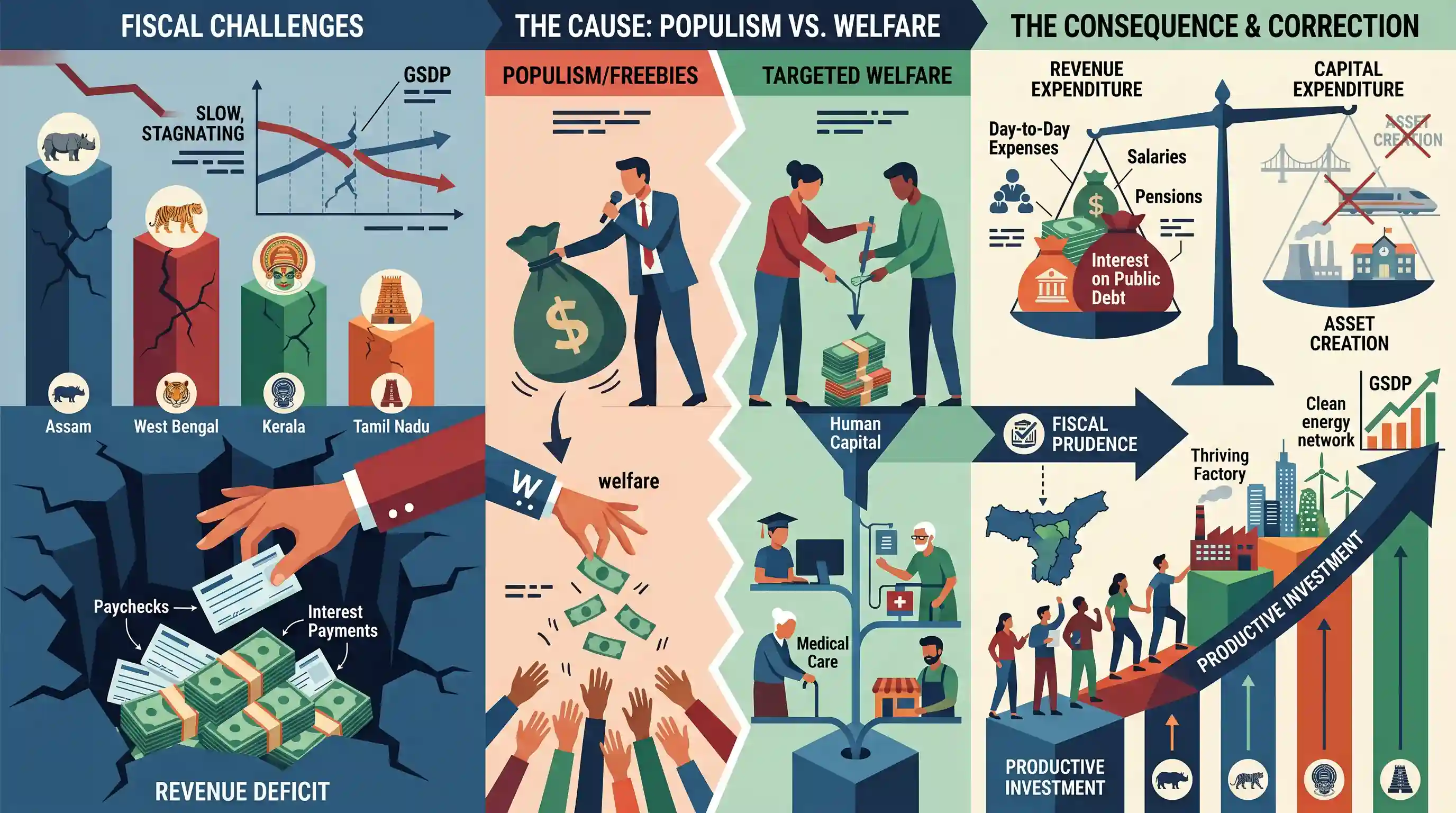
The editorial analyzes the economic challenges awaiting the governments of Assam, West Bengal, Kerala, and Tamil Nadu following recent elections. It highlights a common pattern of fiscal deterioration characterized by slow GSDP growth, burgeoning debt levels, and persistent revenue deficits. The core issue stems from an increasing reliance on populist measures, specifically unconditional cash transfers, which forces states to borrow to fund day-to-day revenue expenditures (such as salaries and interest payments). This practice crowds out vital capital expenditure needed for asset creation and infrastructure, thereby stifling long-term economic growth. The article underscores the urgent necessity for these states to abandon unsustainable populism in favor of fiscal prudence and productive investment to ensure macroeconomic stability.
Key Points
- Four states (Assam, West Bengal, Tamil Nadu, and Kerala) face severe fiscal stress post-elections, driven by sluggish GSDP growth and mounting debt.
- A key driver of this financial strain is the growing reliance on populist, unconditional cash transfers rather than targeted welfare or asset creation.
- Revenue deficits in these states mean governments are borrowing simply to meet everyday expenses like salaries, pensions, and rising interest payments.
- The lack of capital expenditure restricts long-term infrastructure and economic development, creating a vicious cycle of low growth and high debt.
- There is an urgent need for these states to pivot towards fiscal prudence, balancing necessary welfare with sustainable economic management and productive investments.
Prelims Trap
"A rising revenue deficit indicates the government is borrowing heavily to fund infrastructure and asset creation."
A revenue deficit strictly means revenue receipts fall short of revenue expenditure (salaries, pensions, freebies). It indicates borrowing is being used for everyday consumption, not asset creation.
Static Concepts Connected
What distinguishes Capital Expenditure (CapEx) from Revenue Expenditure (RevEx)?
- Asset Creation: CapEx either creates physical/financial assets or reduces government liabilities. RevEx does neither.
- Multiplier Effect: CapEx has a high macroeconomic multiplier, driving long-term economic growth. RevEx primarily stimulates short-term consumption.
- Core Examples: CapEx includes infrastructure spending and loan repayments. RevEx includes salaries, pensions, interest payments, and unconditional cash transfers.
How is state borrowing structurally regulated in India?
- Constitutional Limits: Under Article 293(3), states cannot raise loans without Centre's consent if any previous central loan remains outstanding.
- External Borrowing: States cannot borrow directly from foreign countries or international institutions; external borrowing is routed via the Centre.
- FRBM Mandates: States enact their own FRBM acts, aligning with Finance Commission recommendations, usually capping the fiscal deficit at 3% of GSDP.
Cross-Topic Patterns
Fiscal Federalism vs Central Limits
Centre’s use of Article 293(3) to restrict state borrowing over off-budget liabilities (like populist schemes) often triggers Centre-State friction, bridging GS3 Economy with GS2 Federalism.
RBI’s Role as State Debt Manager
The RBI acts as the banker and debt manager for state governments. Its annual reports frequently warn how non-merit freebies mask true state debt and strain macroeconomic stability.

Expect a GS3 Mains question linking state-level unconditional cash transfers to the crowding out of CapEx and macroeconomic instability.
Linked PYQs · 5
Linked PYQs · 5
- 2025MainsGS3
Explain how the Fiscal Health Index (FHI) can be used as a tool for assessing the fiscal performance of states in India. In what way would it encourage the states to adopt prudent and sustainable fiscal policies?
- 2013MainsGS3
What were the reasons for the introduction of Fiscal Responsibility and Budget Management (FRBM) Act, 2003 ? Discuss critically its salient features and their effectiveness.
- 2021MainsGS3
Distinguish between Capital Budget and Revenue Budget. Explain the components of both these Budgets.
- 2018PrelimsGS1
Consider the following statements: 1. The Fiscal Responsibility and Budget Management (FRBM) Review Committee Report has recommended a debt to GDP ratio of 60% for the general (combined) government by 2023, comprising 40% for the Central Government and 20% for the State Governments. 2. The Central Government has domestic liabilities of 21% of GDP as compared to that of 49% of GDP of the State Governments. 3. As per the Constitution of India, it is mandatory for a State to take the Central Government's consent for raising any loan if the former owes any outstanding liabilities to the latter. Which of the statements given above is/are correct?
- 2025MainsGS2
Examine the evolving pattern of Centre-State financial relations in the context of planned development in India. How far have the recent reforms impacted the fiscal federalism in India?
