India deploys all party delegations for global diplomatic outreach
Source:Indian Express ↗
Why It Matters
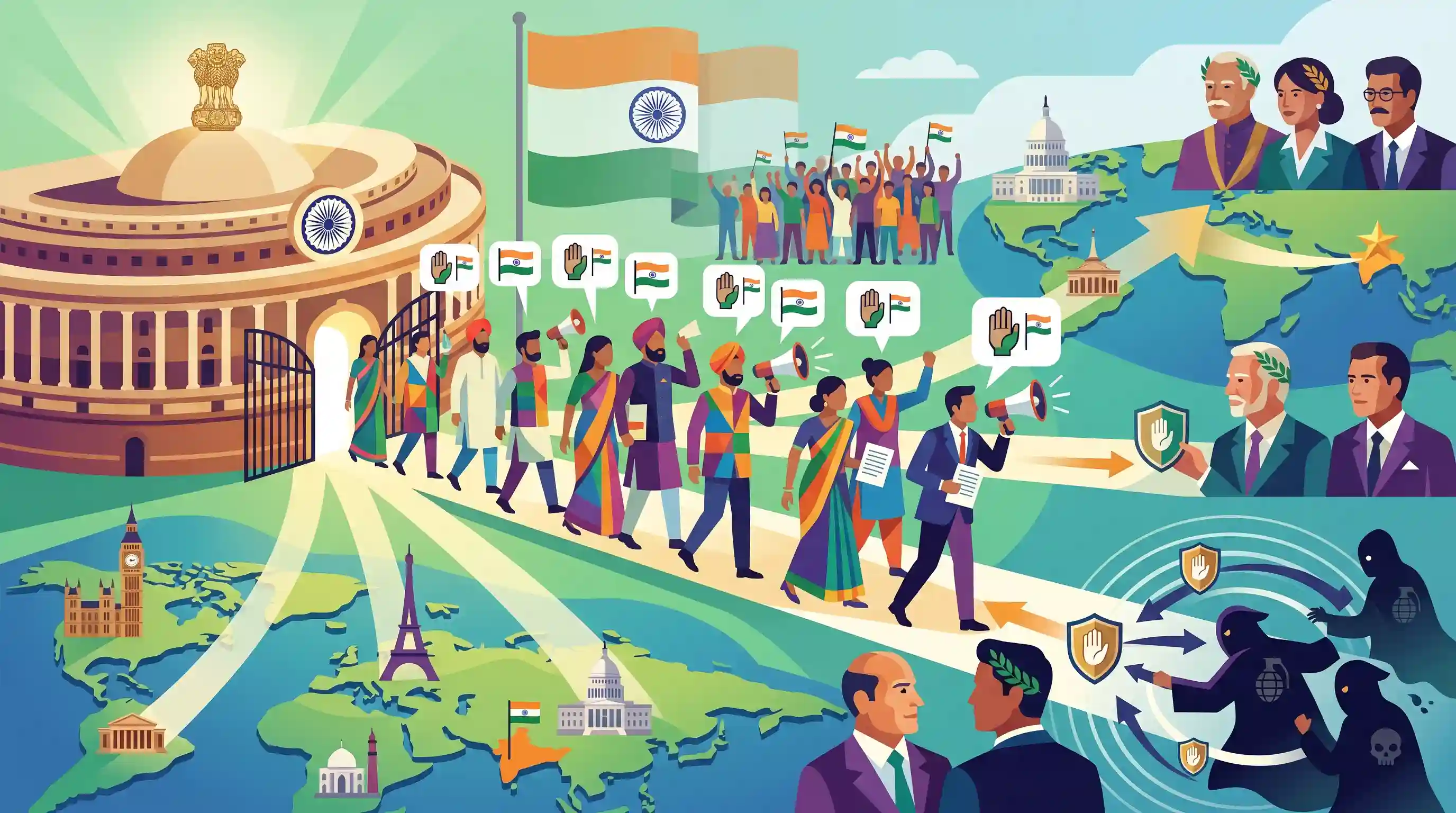
It illustrates the practical application of 'parliamentary diplomacy' and bipartisan political consensus as crucial instruments of India's foreign policy, especially in countering cross-border terrorism and shaping international narratives following major internal security crises.
Summary
The article discusses India's strategic diplomatic offensive following a significant security event in Pahalgam. To project a strong, unified national front globally, the government is dispatching all-party parliamentary delegations for international outreach. These delegates are being provided with coordinated talking points to ensure consistent messaging regarding India's security concerns and stance on cross-border terrorism. This move highlights the strategic use of parliamentary diplomacy and bipartisan consensus to advance India's foreign policy interests and build international pressure against state-sponsored terror.
Key Points
- In the aftermath of a major security incident in Pahalgam, the Indian government has initiated a global diplomatic outreach campaign.
- All-party parliamentary delegations are being deployed internationally to present a united, bipartisan front on India's national security and foreign policy stance.
- Before departure, delegates are receiving synchronized talking points from the government to ensure uniform messaging at global forums.
- The strategy emphasizes 'parliamentary diplomacy' as a tool to garner international consensus against cross-border terrorism and isolate state sponsors of terror.
Important Terms
Parliamentary Diplomacy

The conduct of international relations by Members of Parliament to foster mutual understanding and advance national interests, complementing traditional executive-led diplomacy.
UPSC context
GS2 (International Relations); tests understanding of non-traditional diplomatic channels and the legislature's role in foreign policy.
All-Party Delegation
A representative group of lawmakers from various political parties (ruling and opposition) dispatched to project a unified national front on critical security or foreign policy issues.
UPSC context
GS2 (Parliamentary functioning); tests knowledge of bipartisan mechanisms for promoting national interest during international crises.
Ministry of External Affairs (MEA)
The central government department responsible for formulating and implementing India’s foreign policy, managing diplomatic relations, and representing the nation globally.
UPSC context
GS2 (Bilateral/Global groupings); tests institutional knowledge of India’s primary agency for international outreach and policy execution.
Cross-border Terrorism
Terrorist activities where the soil of one country is used to launch attacks against a neighboring nation to create instability or achieve political goals.
UPSC context
GS3 (Internal Security); tests understanding of challenges posed by external state/non-state actors and border management.
State-sponsored Terrorism
The provision of financial, logistical, or military support by a government to violent non-state actors to destabilize rivals while maintaining plausible deniability.
UPSC context
GS3 (Internal Security); tests ability to analyze proxy wars and the strategic use of terror as a foreign policy tool.
Parliament of India
The supreme legislative body of India, which provides the mandate for diplomatic initiatives and oversees the executive’s response to international security challenges.
UPSC context
GS2 (Polity); tests the constitutional role of the legislature in approving foreign policy and participating in diplomatic missions.
Prelims Trap
All-party parliamentary delegations are a form of Track II diplomacy.
Parliamentary diplomacy involves elected state representatives. Track II refers exclusively to unofficial dialogues by non-state actors (private citizens, academics, retired officials).
Static Concepts Connected
What are the primary tracks of diplomacy in international relations?
- Track I: Official, formal government-to-government diplomatic engagement led by the executive.
- Track II: Unofficial, informal dialogues involving non-state actors like academics, think tanks, or retired officials.
- Track 1.5: Mixed interactions where both official and non-official figures engage collaboratively in unofficial settings.
How do hostile states utilize non-state actors for proxy warfare?
- Plausible Deniability: Funding and training insurgent groups to inflict damage without triggering direct, legal military retaliation.
- Asymmetric Warfare: Deploying cost-effective terror outfits to persistently drain a larger conventional adversary's security resources.
- Safe Havens: Providing territorial sanctuaries to shield terrorist leadership from international law enforcement and targeted strikes.
Cross-Topic Patterns
Parliamentary Diplomacy vs Executive Prerogative
While Article 73 vests foreign policy in the Union Executive, all-party delegations project democratic consensus and amplify the executive's stance on global stages.
FATF and Diplomatic Isolation
Post-attack diplomatic drives are crucial for presenting evidence to the Financial Action Task Force (FATF), converting bilateral security issues into multilateral terror-financing sanctions.

Expect a GS2 Mains question linking 'Parliamentary Diplomacy' to India's global narrative-building against state-sponsored proxy warfare.
Linked PYQs · 3
Linked PYQs · 3
- 2025MainsGS3
Terrorism is a global scourge. How has it manifested in India? Elaborate with contemporary examples. What are the counter measures adopted by the State? Explain.
- 2021MainsGS3
Analyse the multidimensional challenges posed by external state and non-state actors, to the internal security of India. Also discuss measures required to be taken to combat these threats.
- 2015MainsGS2
Terrorist activities and mutual distrust have clouded India-Pakistan relations. To what extent the use of soft power like sports and cultural exchanges could help generate goodwill between the two countries? Discuss with suitable examples.
