Supreme Court Review of Post-Facto Environmental Clearances
Source:Indian Express ↗
આ શા માટે મહત્વનું છે
It addresses a crucial regulatory loophole in India's environmental jurisprudence—post-facto environmental clearance—striking at the heart of the preventive framework of the EIA regime and sustainable development.
સારાંશ
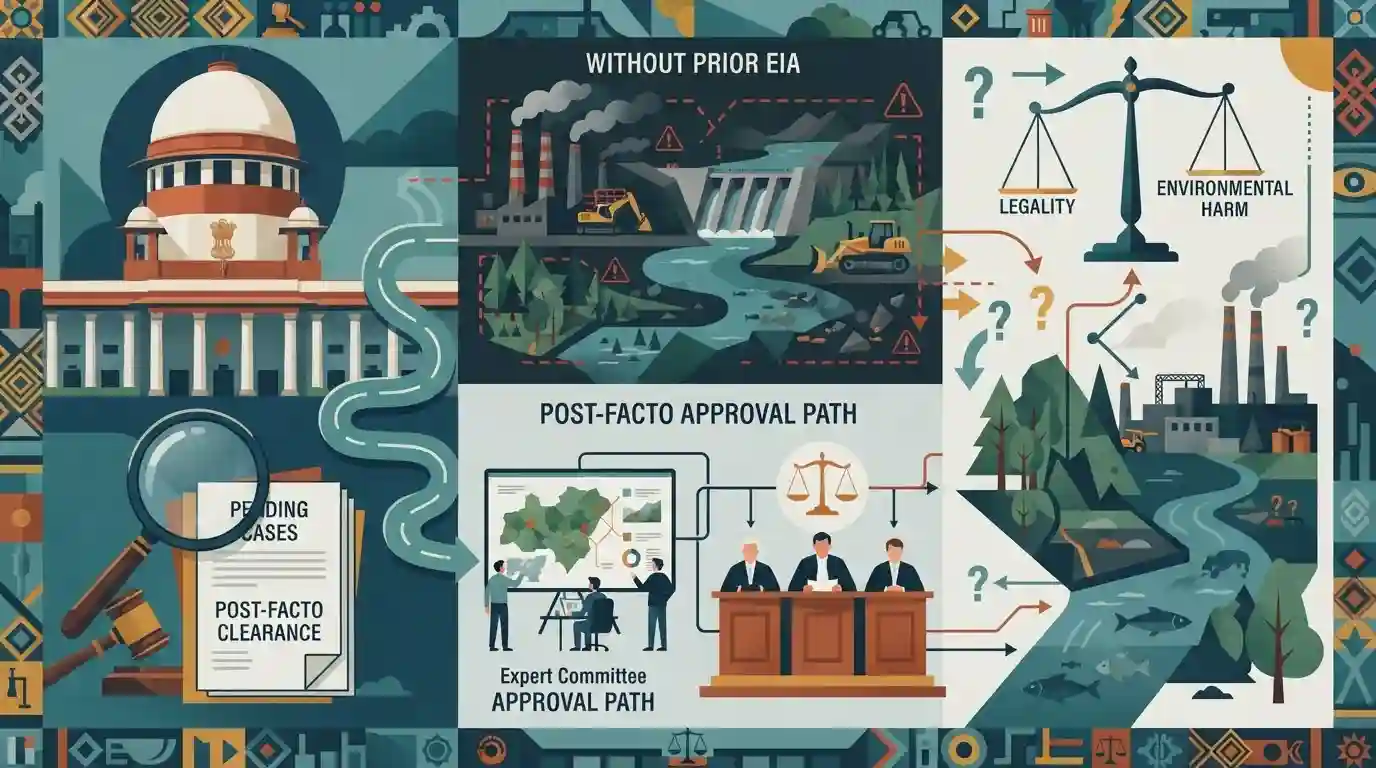
The Supreme Court of India is examining pending cases concerning post-facto environmental clearances, addressing the legality and environmental repercussions of granting permissions to projects that functioned or developed without prior statutory environmental assessments.
મુખ્ય મુદ્દા
- The Supreme Court addressed issues surrounding post-facto environmental clearances (ECs), where projects operate or are constructed without prior statutory environmental appraisal.
- Post-facto clearance is fundamentally contrary to the preventive philosophy of environmental jurisprudence and the Environment (Protection) Act, 1986.
- The legal debate focuses on how to handle pending cases and operational projects that bypassed initial Environmental Impact Assessment (EIA) norms while balancing economic development and ecological damage.
- Such clearances undermine the core mandate of sustainable development and the 'precautionary principle'.
મહત્વપૂર્ણ શબ્દો
Environment (Protection) Act, 1986

An umbrella legislation enacted in 1986 under Article 253, empowering the Central Government to coordinate actions, set standards, and frame rules for protecting and improving the quality of the environment.
UPSC context
UPSC Prelims/Mains (GS Paper III): Core environmental legislation tested for statutory powers, delegated legislation, and regulatory compliance mechanisms.
Environmental Impact Assessment (EIA) Notification, 2006
A statutory framework under the EPA that mandates prior environmental appraisal and clearance for specified developmental and industrial projects before any construction or operational activity begins.
UPSC context
UPSC Prelims/Mains (GS Paper III): Frequently tested on screening, scoping, public consultation stages, and sustainable development trade-offs.
Post-Facto Environmental Clearance
The practice of granting environmental approval to a project after it has already been established, constructed, or operated without obtaining prior statutory environmental clearance.
UPSC context
UPSC Mains (GS Paper II & III): Tests judicial activism, administrative rule-making limits, the Precautionary Principle, and sustainable development jurisprudence.
પ્રિલિમ્સ ટ્રેપ
The Environment (Protection) Act, 1986 expressly permits post-facto environmental clearances under exceptional circumstances.
The Environment (Protection) Act, 1986 does not explicitly provide for post-facto environmental clearances; rather, such clearances are creatures of executive notifications/office memorandums that courts have repeatedly struck down.
સંલગ્ન સ્થિર ખ્યાલો
What are the core principles of environmental jurisprudence established under Indian statutory and constitutional law?
- Precautionary Principle: Stipulates that preventive measures must be taken when there is a plausible threat of environmental degradation, shifting the burden of proof onto the developer.
- Polluter Pays Principle: Requires the polluter to bear the financial cost of remedying pollution and compensating victims, expanding the scope of Article 21.
- Sustainable Development: Balancing present economic needs with the capacity of ecosystems to regenerate for future generations, explicitly read into Article 21.
- Public Trust Doctrine: The state acts as a trustee of natural resources (air, water, forests) for the public, preventing their privatization or depletion.
આંતર-વિષય પેટર્ન
EIA Norms vs Ease of Doing Business
Ex post facto clearances collide with the ease of doing business and industrial growth mandates, testing the judiciary's balancing act between developmental needs and sustainable jurisprudence.
Judicial Review vs Executive Office Memorandums
Judicial interventions against executive office memorandums testing the boundaries of delegated legislation and executive overreach in environmental governance.

Post-facto ECs + Precautionary Principle + EPA 1986 likely to be tested via a statement-based prelims question or a mains GS3 ethics/environment link.
સંલગ્ન PYQ · 3
સંલગ્ન PYQ · 3
- 2014MainsGS3
Environmental Impact Assessment studies are increasingly undertaken before a project is cleared by the Government. Discuss the environmental impacts of coal-fired thermal plants located at coal pitheads.
- 2022MainsGS2
“The most significant achievement of modern law in India is the constitutionalization of environmental problems by the Supreme Court.” Discuss this statement with the help of relevant case laws.
- 2024MainsGS3
What role do environmental NGOs and activists play in influencing Environmental Impact Assessment (EIA) outcomes for major projects in India? Cite four examples with all important details.
