Post-Facto Environmental Clearance and Judicial Review
Source:Indian Express ↗
Why It Matters
It directly addresses the legality and environmental impact of post-facto environmental clearances, a contentious policy and judicial issue affecting sustainable development, regulatory compliance, and ecological governance in India.
Summary
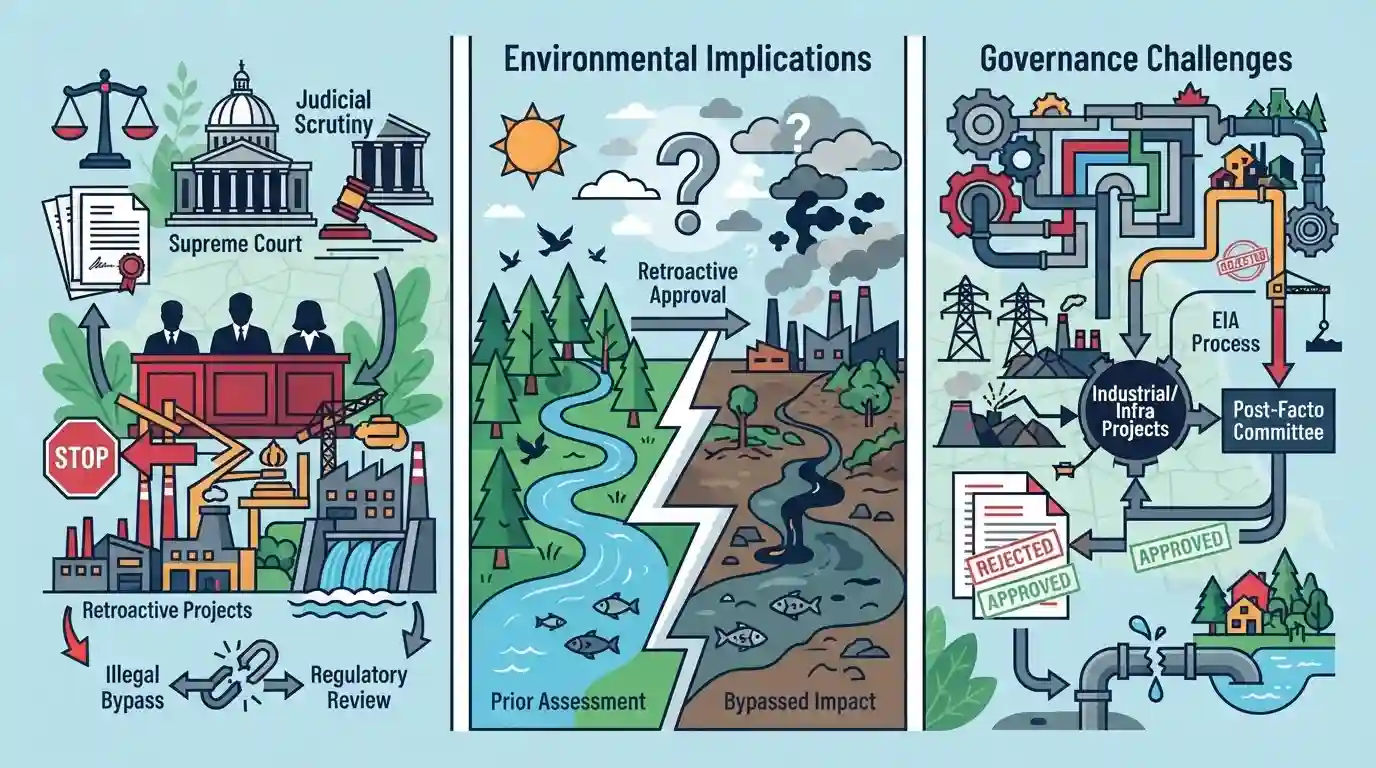
The article covers Supreme Court proceedings regarding pending cases of post-facto environmental clearance, addressing the legal validity, environmental implications, and governance challenges associated with granting retroactive approvals to industrial and infrastructure projects that bypassed prior assessment.
Key Points
- The Supreme Court is dealing with crucial issues surrounding pending cases of post-facto environmental clearances (ECs).
- Post-facto environmental clearance refers to granting permissions to projects that have already commenced or been completed without prior statutory approval.
- Such mechanisms run contrary to the fundamental principles of environmental jurisprudence, such as the precautionary principle and sustainable development.
- The judiciary's scrutiny highlights tensions between industrial development and strict adherence to environmental impact assessment (EIA) norms.
Important Terms
Environment (Protection) Act, 1986

An umbrella legislation enacted in 1986 under Article 253 to implement decisions of the UN Conference on the Human Environment, empowering the central government to protect and improve environmental quality.
UPSC context
UPSC Paper III (Environment and Biodiversity). Tests understanding of core statutory frameworks, pollution control powers, and judicial interpretation of environmental laws.
Environment Impact Assessment Notification, 2006
A key subordinate legislation under the EPA 1986, issued by the MoEFCC, which mandates prior environmental clearance for listed industrial and developmental projects based on screening, scoping, public consultation, and appraisal.
UPSC context
UPSC Paper III (Environment Impact Assessment). Crucial for questions on project appraisal mechanisms, sustainable development, and administrative procedures.
Supreme Court of India
The apex judicial body in India that interprets environmental laws, balances developmental needs with ecological preservation, and reviews the legality of administrative orders regarding post-facto clearances.
UPSC context
UPSC Paper II (Judiciary, Separation of Powers) & Paper III (Environment). Evaluates judicial activism, rule of law, and environmental jurisprudence.
Ministry of Environment, Forest and Climate Change
The nodal central ministry responsible for planning, promoting, coordinating, and overseeing environmental and forestry policies, including the administration of the EIA framework and pollution standards in India.
UPSC context
UPSC Paper II (Government Policies and Interventions) & Paper III (Environment). Tests institutional architecture and governance of natural resources.
Prelims Trap
Post-facto environmental clearances can be legally granted under administrative office memorandums provided the project pays ecological compensation.
Aspirants often assume post-facto ECs are permissible under the Environment (Protection) Act, 1986, if a heavy penalty or fine is paid by the defaulting industry.
Static Concepts Connected
What are the key stages in the Environmental Impact Assessment (EIA) process in India?
- Screening & Scoping: First stage involves categorizing projects into Category A (appraised at the central level by EAC) and Category B (appraised at the state level by SEIAA).
- Public Consultation: Involves preparation of the EIA report and mandatory public consultation by the State Pollution Control Board to hear local grievances.
- Expert Appraisal: The Expert Appraisal Committee (EAC) or SEIAA evaluates the final EIA report and recommends granting or rejecting the clearance.
Cross-Topic Patterns
EIA Norms vs Fait Accompli Industrialization
Post-facto regularisation of environmental violations mirrors the 'fait accompli' doctrine addressed in illegal mining and Coastal Regulation Zone (CRZ) enforcement cases.
Delegated Legislation vs Executive Overreach
Judicial strike-down of executive OMs bypassing statutory EIA notification highlights executive overreach and violation of the doctrine of separation of powers.

Post-facto EC judgments + Precautionary Principle + EP Act 1986 delegation limits make a prime multi-statement prelims question.
Linked PYQs · 3
Linked PYQs · 3
- 2024MainsGS3
What role do environmental NGOs and activists play in influencing Environmental Impact Assessment (EIA) outcomes for major projects in India? Cite four examples with all important details.
- 2020MainsGS3
How does the draft Environment Impact Assessment (EIA) Notification, 2020 differ from the existing EIA Notification, 2006?
- 2014MainsGS3
Environmental Impact Assessment studies are increasingly undertaken before a project is cleared by the Government. Discuss the environmental impacts of coal-fired thermal plants located at coal pitheads.
