Balancing farm incomes and food inflation in post Diwali economy
Source:Indian Express ↗
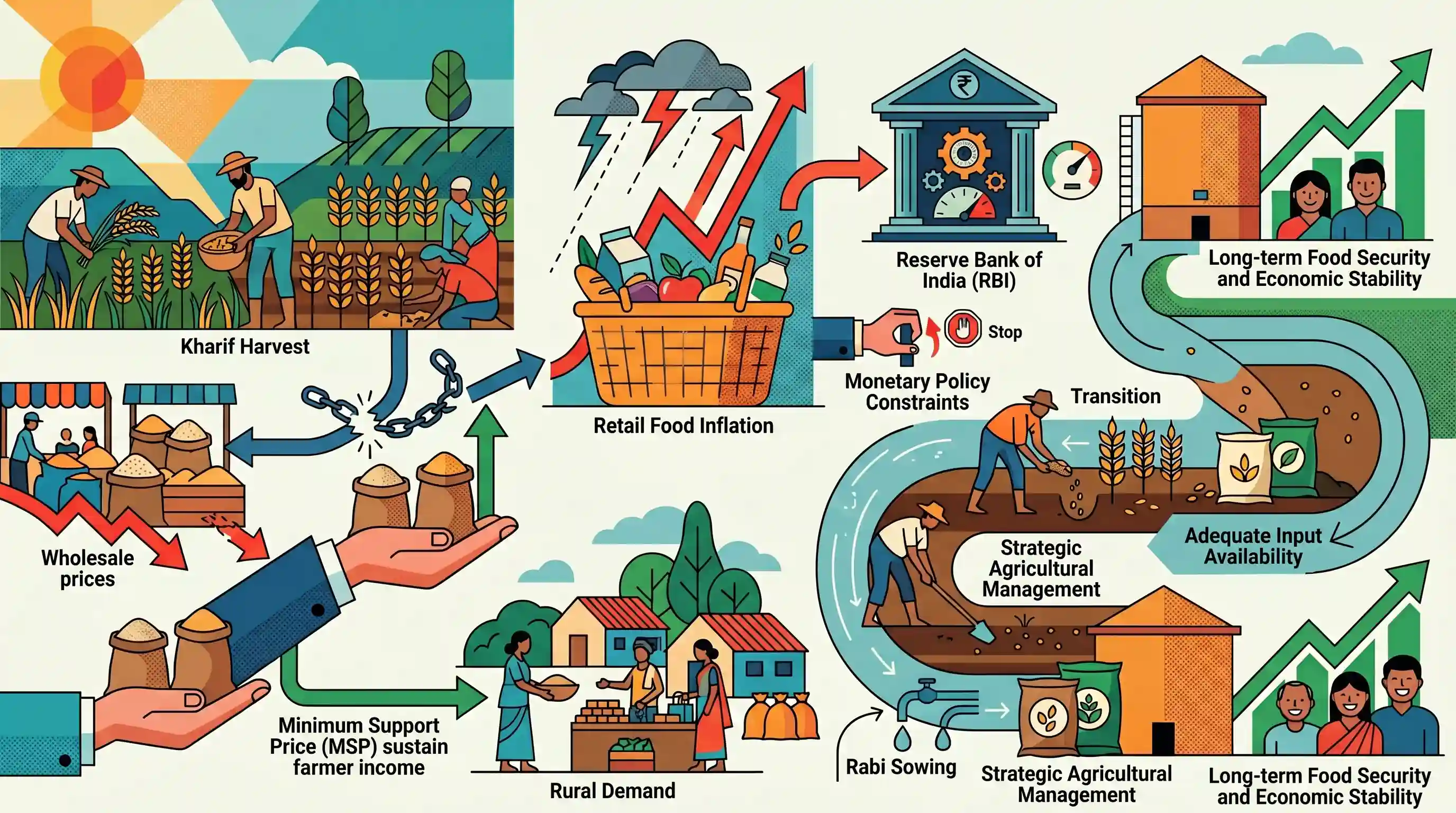
Why It Matters
The article encapsulates the classic macroeconomic dilemma of balancing producer (farmer) welfare with consumer price stability. It is highly relevant for GS-3 (Indian Economy and Agriculture), directly addressing topics like MSP, supply-chain constraints, and the limitations of RBI's monetary policy in combating supply-side food inflation.
Summary
Following Diwali, the Indian government confronts a significant dual challenge in the agricultural sector: mitigating persistent retail food inflation while ensuring remunerative prices for farmers amidst the Kharif harvest. As fresh crops flood the mandis, wholesale prices often decline, making robust Minimum Support Price (MSP) procurement essential to protect farm incomes and sustain rural demand. Concurrently, high retail inflation, largely driven by supply-side agricultural shocks, complicates the Reserve Bank of India's (RBI) monetary policy stance. The period also marks the critical transition to Rabi sowing, necessitating adequate input availability and strategic agricultural management to ensure long-term food security and economic stability.
Key Points
- The government faces a delicate balancing act post-Diwali: containing high retail food inflation for consumers while preventing a crash in wholesale prices for farmers as the Kharif harvest arrives.
- Supply-side disruptions, such as erratic weather impacting crop yields, remain the primary drivers of food inflation, limiting the efficacy of the RBI's monetary policy tools in containing price rise.
- Effective and timely procurement under the Minimum Support Price (MSP) regime is vital to prevent distress sales by farmers, stabilize rural incomes, and boost overall rural consumption.
- A smooth transition to the Rabi sowing season requires adequate soil moisture and an uninterrupted supply of essential inputs like fertilizers to ensure future food security.
Important Terms
Minimum Support Price (MSP)

The guaranteed price at which the government procures crops directly from farmers to protect them against steep price declines and market volatility.
UPSC context
GS Paper III (Agriculture); essential for understanding farm subsidies, price stability, and food security.
Reserve Bank of India (RBI)
India's central bank responsible for monetary policy, currency issuance, and regulating the banking sector to maintain price stability and economic growth.
UPSC context
GS Paper III (Indian Economy); focuses on inflation targeting, liquidity management, and financial regulation.
Cabinet Committee on Economic Affairs (CCEA)
A high-level committee chaired by the Prime Minister that reviews economic trends and takes final decisions on major policies, including fixing MSPs.
UPSC context
GS Paper II (Governance); tests knowledge of institutional decision-making and executive committees.
Food Corporation of India (FCI)
A statutory body responsible for procuring, storing, and distributing foodgrains across India to maintain national food security and support the Public Distribution System (PDS).
UPSC context
GS Paper III (PDS/Buffer Stocks); key for analyzing food security and procurement challenges.
Kharif and Rabi Crops
The two primary cropping seasons: Kharif (monsoon-sown, autumn-harvested, e.g., rice) and Rabi (winter-sown, spring-harvested, e.g., wheat).
UPSC context
GS Paper III (Agriculture); fundamental to cropping patterns, irrigation, and seasonal food supply.
Retail Inflation (CPI)
The rate of change in the Consumer Price Index (CPI), reflecting the average price increases for a basket of consumer goods and services.
UPSC context
GS Paper III (Economy); central to debates on cost of living and RBI monetary policy.
Prelims Trap
An increase in the Minimum Support Price (MSP) helps the government reduce retail food inflation.
Higher MSP sets a higher wholesale price floor, which usually translates to increased retail prices. It presents a trade-off, protecting farmers but often worsening consumer inflation.
Static Concepts Connected
Why is monetary policy ineffective against food-driven inflation?
- Supply-side origin: Food inflation is usually caused by erratic weather or logistical bottlenecks, not by excess money supply or consumer demand.
- Interest rate limits: Repo rate hikes suppress aggregate demand but cannot produce more crops, improve yields, or fix broken agricultural supply chains.
- Policy dilemma: The RBI legally targets Headline CPI (which includes food). Persistently high food inflation forces hawkish stances, which inadvertently hurts industrial growth.
What climatic factors dictate the Kharif-to-Rabi transition?
- Residual moisture: Rabi sowing depends heavily on the residual soil moisture left behind by the retreating southwest monsoon and northeast monsoon showers.
- Temperature drops: Winter crops like wheat require a distinct drop in temperatures (vernalization) for proper vegetative growth and tillering.
- Input timing: A smooth transition requires an uninterrupted supply of inputs like DAP fertilizers before the short sowing window closes.
Cross-Topic Patterns
MSP hikes vs. Fiscal Deficit
Aggressive MSP procurement stabilizes rural incomes but inflates the FCI's economic cost, directly widening the government's food subsidy bill and straining fiscal deficit targets.
Climate Risks in Monetary Policy
Erratic monsoons causing recurring food supply shocks force the RBI to maintain hawkish stances, demonstrating how climate change directly drives macroeconomic tightening and interest rate paths.

Expect a 2026 GS3 Mains question analyzing the structural conflict between MSP-driven rural income support and RBI's inflation targeting.
Linked PYQs · 5
Linked PYQs · 5
- 2024MainsGS3
What are the causes of persistent high food inflation in India? Comment on the effectiveness of the monetary policy of the RBI to control this type of inflation.
- 2018MainsGS3
What do you mean by Minimum Support Price (MSP)? How will MSP rescue the farmers from the low income trap?
- 2020PrelimsGS1
Consider the following statements: 1. In the case of all cereals, pulses and oil-seeds, the procurement at Minimum Support Price (MSP) is unlimited in any State/UT of India. 2. In the case of cereals and pulses, the MSP is fixed in any State/UT at a level to which the market price will never rise. Which of the statements given above is/are correct?
- 2019PrelimsGS1
The economic cost of food grains to the Food Corporation of India is Minimum Support Price and bonus (if any) paid to the farmers plus
- 2018PrelimsGS1
Consider the following: 1. Areca nut 2. Barley 3. Coffee 4. Finger millet 5. Groundnut 6. Sesamum 7. Turmeric The Cabinet Committee on Economic Affairs has announced the Minimum Support Price for which of the above?
