Kota Caesarean Kidney Failure Victims Petition President
Source:the-statesman ↗
Why It Matters
This incident highlights critical systemic failures in maternal healthcare leading to life-threatening complications. It brings medical ethics (the demand for euthanasia) and state responsibility for public health into sharp focus, especially concerning Rajasthan's Right to Health framework and constitutional rights under Article 21.
Summary
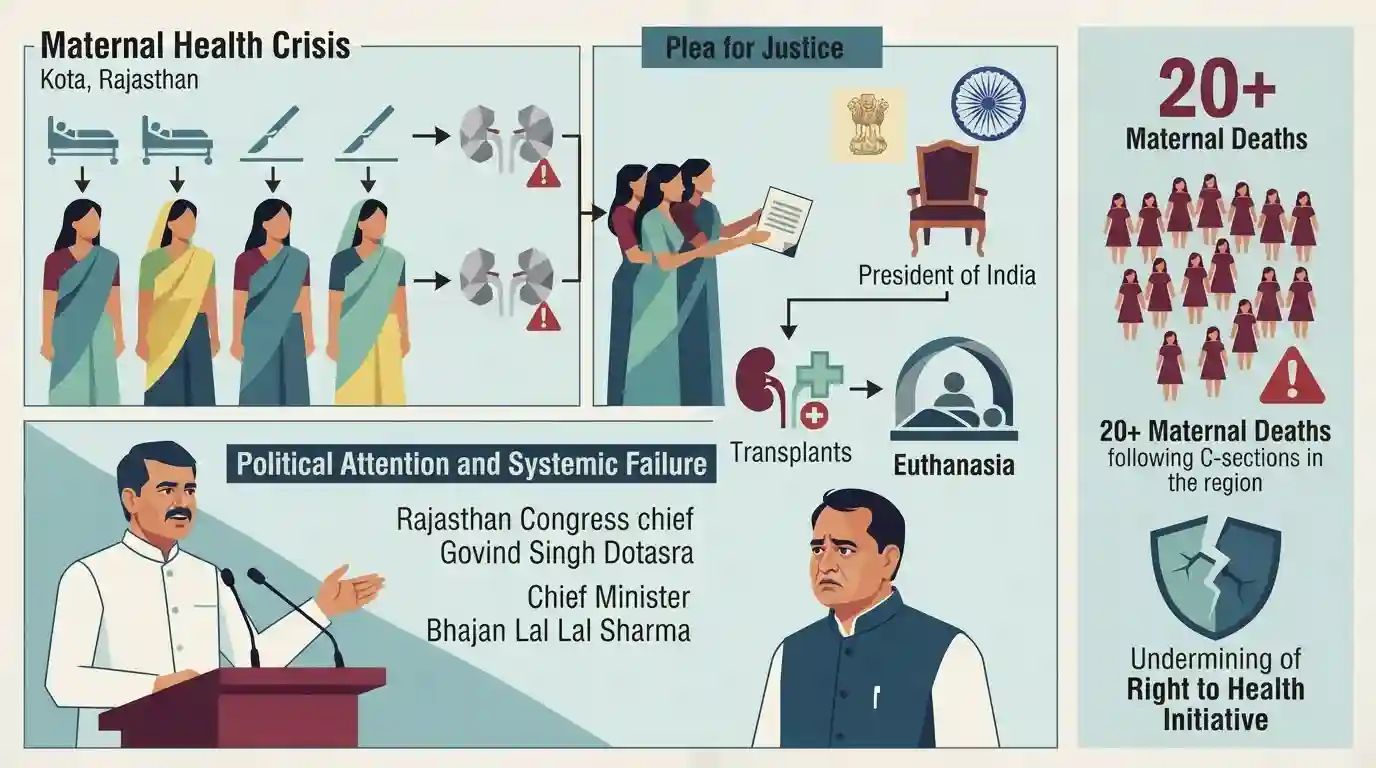
Five women in Kota, Rajasthan, who suffered kidney failure after undergoing caesarean deliveries, have submitted a memorandum to President Droupadi Murmu seeking either kidney transplants or euthanasia. Citing the severe physical and financial toll of twice-weekly dialysis, their plea has drawn political attention. Rajasthan Congress chief Govind Singh Dotasra urged Chief Minister Bhajan Lal Sharma to provide state-funded treatment for the victims. He also raised alarms over systemic healthcare failures, noting that around 20 maternal deaths following caesarean deliveries have occurred in the state over the last month, undermining the state's pioneering Right to Health initiatives.
Key Points
- Five women in Kota suffered kidney failure following caesarean deliveries at two different hospitals.
- Unable to bear the physical and financial trauma of regular dialysis, they have written to President Droupadi Murmu seeking immediate kidney transplants or euthanasia.
- Rajasthan Congress President Govind Singh Dotasra has urged the Chief Minister to ensure the state government bears their entire treatment cost.
- Dotasra highlighted that over the past month, approximately 20 post-caesarean maternal deaths have been reported across various districts in Rajasthan.
- The incident underscores severe issues in maternal healthcare quality and revives debates around medical negligence and the Right to Health in the state.
Important Terms
Rajasthan Right to Health Act

A 2023 state law making Rajasthan the first Indian state to guarantee residents free healthcare services, including emergency treatment, at public and select private hospitals without financial constraints.
UPSC context
Highly relevant for GS-2 (Health & Governance). It tests welfare state obligations, universal health coverage, and public-private healthcare dynamics.
Medical Negligence
A breach of duty by a healthcare professional failing to meet accepted standards of care, directly causing harm or death. It requires proving duty of care, dereliction, direct causation, and resulting damages.
UPSC context
Crucial for GS-2 (Governance) and GS-4 (Ethics). Tests accountability, consumer protection in healthcare, and balancing doctor safety with patient rights.
Euthanasia
The act of intentionally ending a life to relieve incurable suffering. India legally permits "passive euthanasia" (withdrawing life support) for terminally ill patients under strict guidelines, but bans "active euthanasia."
UPSC context
Important for GS-2 (Polity) and GS-4 (Ethics). It tests understanding of the right to die with dignity, living wills, and bioethics.
Article 21 (Right to Life)
A fundamental right in the Indian Constitution protecting life and personal liberty. The Supreme Court has extensively expanded it to include the right to health and the right to die with dignity.
UPSC context
Central to GS-2 (Polity/Constitution). Tests awareness of judicial activism and the evolving interpretation of fundamental rights beyond mere existence.
Prelims Trap
The Supreme Court has legalized active and passive euthanasia for terminally ill patients in India.
Only passive euthanasia (withdrawing life support) is legal in India (Common Cause 2018). Active euthanasia, which the victims are essentially requesting here, remains strictly illegal.
Static Concepts Connected
What is the legal status of Euthanasia and Living Wills in India?
- Passive Euthanasia: Legalized by the Supreme Court in 2018 (Common Cause v. Union of India); allows the withdrawal of life support for terminally ill patients.
- Active Euthanasia: Strictly illegal in India. It involves an active intervention, such as administering a lethal injection, to deliberately end a life.
- Article 21: The Supreme Court ruled that Article 21 (Right to Life) inherently includes the 'Right to Die with Dignity'.
How is medical negligence legally addressed in India?
- Consumer Protection Act: Patients can claim compensation for a "deficiency of service" against doctors and hospitals under the Consumer Protection Act, 2019.
- Criminal Liability: Gross medical negligence causing death is addressed and punishable under Section 106 of the Bharatiya Nyaya Sanhita (formerly Sec 304A IPC).
Cross-Topic Patterns
Right to Health vs State Capacity
Rajasthan's pioneering Right to Health Act provides statutory guarantees, but systemic maternal negligence exposes severe deficits in public health infrastructure and capacity implementation.
Euthanasia vs Presidential Powers
A plea to the President for euthanasia highlights a constitutional misperception; the President's Article 72 pardoning powers apply to criminal convictions, not authorizing active euthanasia.
Maternal Healthcare and SDG 3.1
Post-caesarean complications threaten India's progress toward reducing the Maternal Mortality Ratio (MMR) below 70 by 2030, a key UN Sustainable Development Goal (SDG 3.1).

Expect a Mains GS2 question linking statutory Right to Health guarantees with systemic medical negligence and infrastructure deficits.
Linked PYQs · 2
Linked PYQs · 2
- 2023RPSC_PRELIMSGS1
Which scheme aims to improve the health and nutritional status of pregnant women and lactating mothers and their infants (0 to 6 months) by promoting the use of appropriate practices, care, and services during pregnancy, safe delivery, and breastfeeding?
- 2023RPSC_PRELIMSGS1
Identify the incorrect statement regarding the Menaka Gandhi case, 1978, concerning the judicial interpretation of Article 21.
