RBI warns of global supply shocks translating to domestic demand
Source:The Hindu ↗
Why It Matters
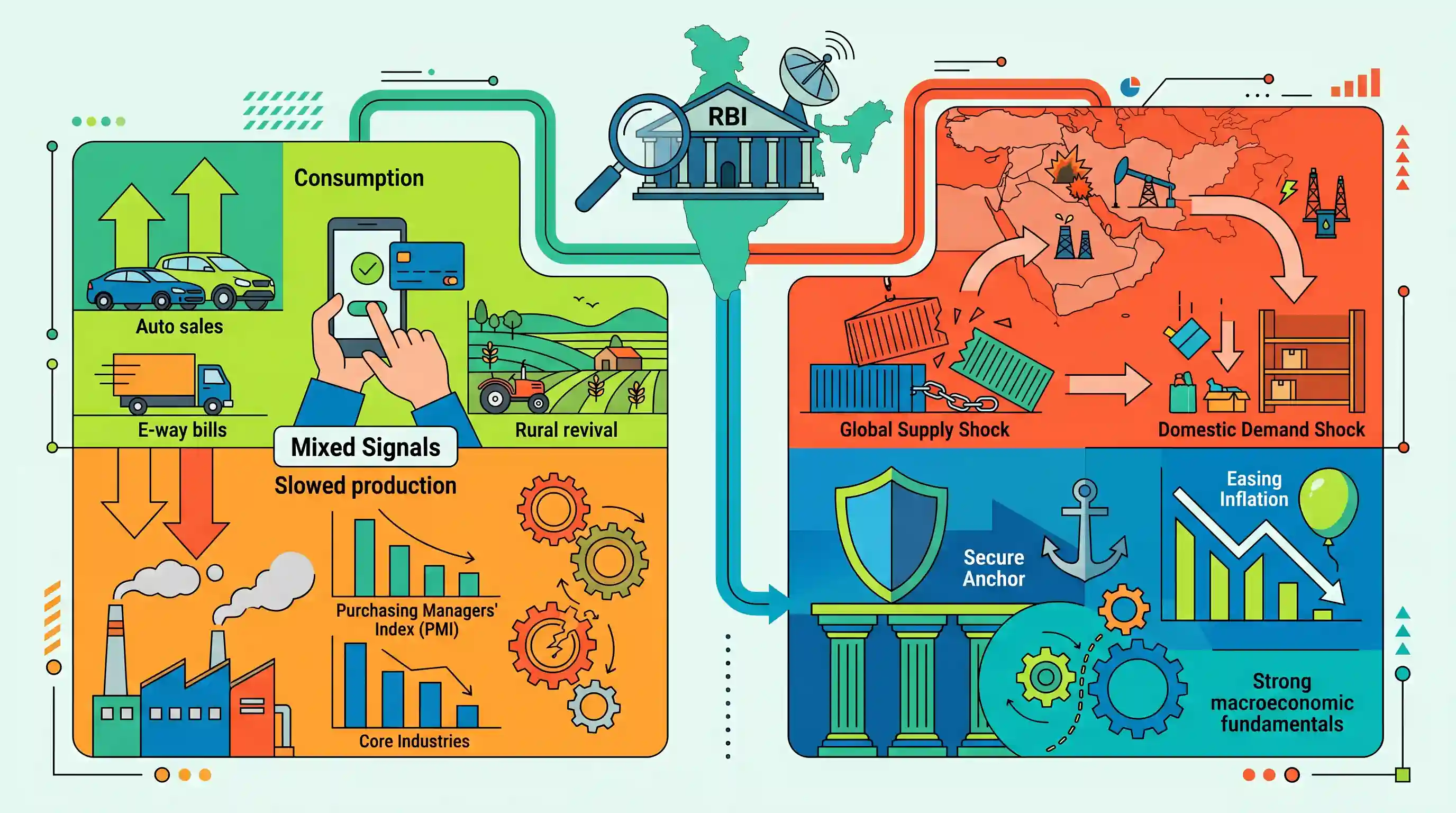
Understanding the divergence between supply-side constraints and demand-side resilience is crucial for macroeconomics. It highlights how global geopolitical events (like the West Asia crisis) can create supply shocks that eventually dampen domestic demand, and it shows candidates how the RBI utilizes high-frequency indicators (PMI, Core Industries, e-way bills) to monitor economic health.
Summary
The Reserve Bank of India (RBI) has emphasized the need to closely monitor the Indian economy amid mixed signals from high-frequency indicators and ongoing geopolitical tensions in West Asia. The central bank highlighted the risk of a global "supply shock" translating into a domestic "demand shock." While consumption and demand indicators like auto sales, e-way bills, and digital payments remain robust—bolstered by a reviving rural economy—production metrics such as the Purchasing Managers' Index (PMI) and the index of eight core industries have slowed significantly. Despite these headwinds, the RBI notes that India's strong macroeconomic fundamentals and easing inflation offer substantial resilience against external disruptions.
Key Points
- The RBI warned that mixed signals from high-frequency indicators require close monitoring to ensure a potential "supply shock" from geopolitical tensions does not turn into a domestic "demand shock."
- Demand indicators remain resilient, supported by strong rural consumption, robust GST collections, high e-way bill generation, and record digital payments.
- Conversely, several supply and production indicators have decelerated, including the manufacturing PMI (a four-year low), the index of eight core industries (falling for the first time in 42 months), and slowed port and air cargo traffic.
- Geopolitical conflicts in West Asia have stressed global supply chains, but a US-Iran ceasefire and India's strong macroeconomic fundamentals provide a buffer against external shocks.
Important Terms
Supply Shock

A sudden, unexpected event that disrupts the production or supply of a commodity, leading to sharp price increases and potential economic instability (e.g., energy price spikes).
UPSC context
GS Paper III: Vital for understanding cost-push inflation and external vulnerabilities in the Indian economy.
Demand Shock
A sudden surprise event that significantly increases or decreases the demand for goods or services, impacting economic growth and inflation patterns.
UPSC context
GS Paper III: Relevant for studying consumer behavior, purchasing power, and counter-cyclical monetary policy.
High-Frequency Indicators (HFIs)
Real-time or near real-time data points (e.g., power consumption, GST collections, auto sales) used to track current economic activity before official GDP figures are released.
UPSC context
GS Paper III: Essential for monitoring the Indian economy and timely policy interventions.
Index of Eight Core Industries (ICI)
A monthly index measuring the combined and individual performance of eight vital sectors (Coal, Crude, Steel, etc.) that account for 40.27% of the Index of Industrial Production.
UPSC context
GS Paper III: A primary indicator of industrial health; frequently tested in UPSC Prelims.
Purchasing Managers' Index (PMI)
A survey-based economic indicator reflecting the health of the manufacturing and services sectors. A reading above 50 indicates expansion; below 50 indicates contraction.
UPSC context
GS Paper III: Used as a leading indicator to predict business sentiment and future GDP trends.
E-way Bill
Electronic document mandatory under the GST regime for the movement of goods worth more than ₹50,000, serving as a proxy for domestic trade volume.
UPSC context
GS Paper III: Relevant for resource mobilization, tax compliance, and tracking internal trade.
Second-Round Effects
The follow-on impact of an initial economic shock, such as when high input costs (supply shock) eventually lead to lower consumer spending (demand shock).
UPSC context
GS Paper III: Crucial for analyzing how localized disruptions spread to the broader economy.
Prelims Trap
The Index of Eight Core Industries is published by the RBI and its eight components carry equal weightage.
The index is compiled by the Office of the Economic Adviser (DPIIT), not the RBI. Furthermore, the components have varying weights, with petroleum refinery products holding the highest share.
Static Concepts Connected
What is the Index of Eight Core Industries (ICI)?
- Core Components: Coal, crude oil, natural gas, refinery products, fertilizers, steel, cement, and electricity.
- IIP Weightage: These eight industries comprise approximately 40.27% of the total weight of items included in the broader Index of Industrial Production (IIP).
- Publishing Authority: Released monthly by the Office of the Economic Adviser (OEA) under the Ministry of Commerce and Industry.
How does a macroeconomic Supply Shock differ from a Demand Shock?
- Supply Shock: An unexpected event that drastically alters the supply of goods (e.g., geopolitical conflicts disrupting oil supply lines), usually leading to cost-push inflation and reduced industrial output.
- Demand Shock: A sudden change in consumer purchasing power or willingness to spend, often triggering deflationary pressures, inventory buildup, or economic recession.
- The Linkage: Persistent supply shocks increase production costs, leading to factory slowdowns, lower wages, and job losses. This subsequently crushes consumer purchasing power, creating a demand shock.
Cross-Topic Patterns
High-Frequency Indicators (HFIs) & Policy
The RBI increasingly relies on real-time High-Frequency Indicators like UPI volumes and e-way bills to adjust policy rates pre-emptively, compensating for the lag in traditional quarterly GDP data.
Red Sea crisis & Imported Inflation
West Asian conflicts disrupt maritime trade routes, inflating freight and crude oil prices. This creates imported inflation in India, complicating the RBI's flexible inflation targeting framework.

Expect a 2026 Prelims question interlinking high-frequency indicators (PMI) with the exact weightage mechanics of IIP and Core Industries.
Linked PYQs · 2
Linked PYQs · 2
- 2024MainsGS3
What are the causes of persistent high food inflation in India? Comment on the effectiveness of the monetary policy of the RBI to control this type of inflation.
- 2012PrelimsGS1
In India, in the overall Index of Industrial Production, the Indices of Eight Core Industries have a combined weight of 37.90%. Which of the following are among those Eight Core Industries? 1. Cement 2. Fertilizers 3. Natural gas 4. Refinery products 5. Textiles Select the correct answer using the codes given below:
