RBI Warns of Supply Shocks Affecting Domestic Demand
Source:The Hindu ↗
Why It Matters
Understanding the transmission mechanism from a global supply shock (like a geopolitical crisis altering oil prices) to domestic demand shocks is fundamental for UPSC aspirants. It illustrates how the RBI utilizes high-frequency indicators to assess real-time economic health and calibrate monetary policy.
Summary
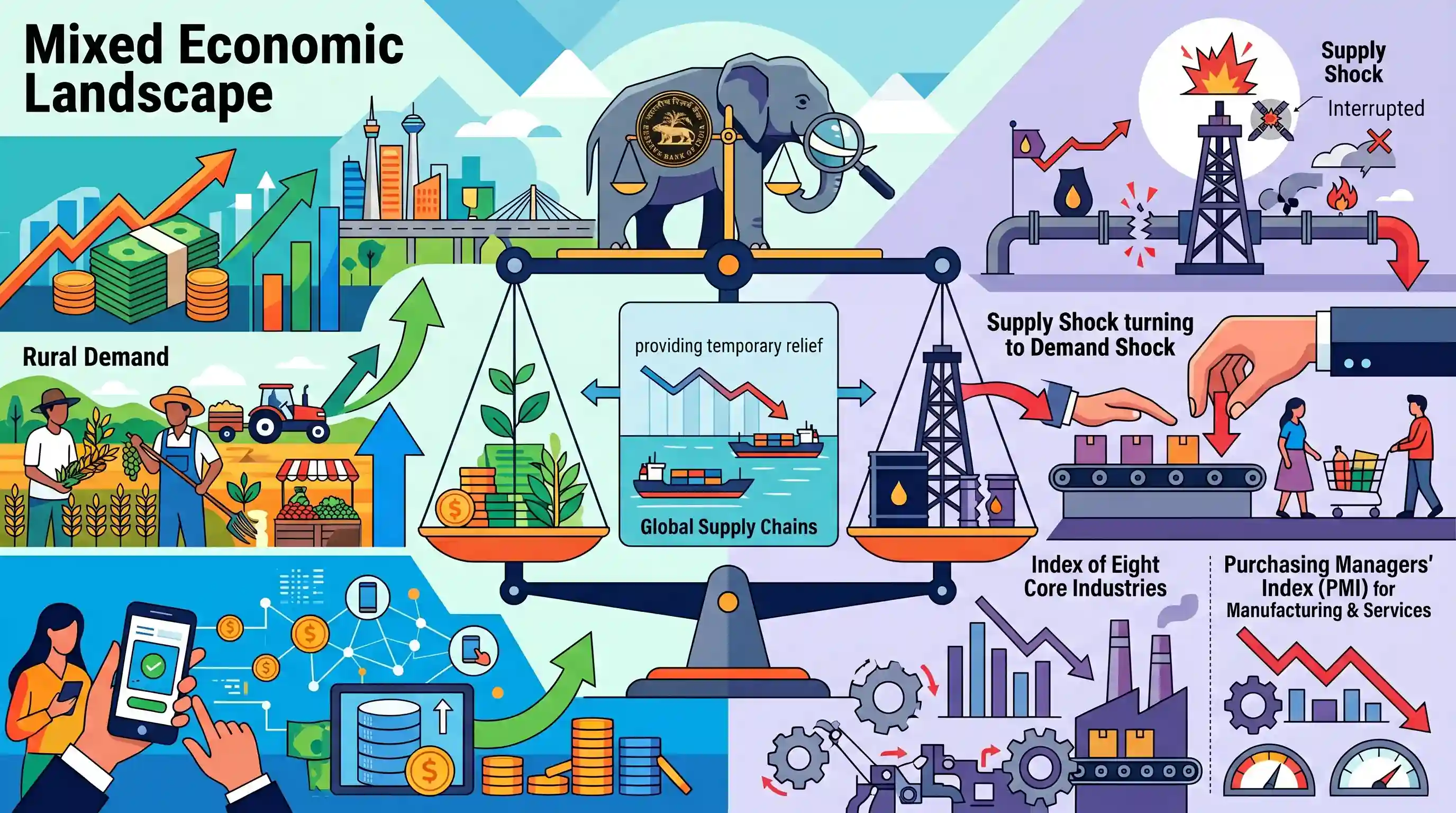
The Reserve Bank of India (RBI) has reported mixed economic trends for India stemming from the geopolitical crisis in West Asia, warning that an initial supply shock could gradually turn into a demand shock. While India's core macroeconomic fundamentals remain strong—supported by solid GST collections, rural demand, and digital payments—there are emerging signs of deceleration. Key metrics like the Index of Eight Core Industries and the Purchasing Managers' Index (PMI) for both manufacturing and services have hit multi-month lows. The RBI stressed the importance of continuously monitoring these second-round effects, even as a recent US-Iran ceasefire provides temporary relief to global supply chains and oil prices.
Key Points
- The RBI's State of the Economy report highlights mixed economic signals in India due to geopolitical tensions in West Asia.
- A primary concern is the potential for the current supply shock (disrupted global supply chains and oil prices) to translate into a domestic demand shock.
- Despite external pressures, India shows resilience through robust GST revenues, high e-way bill generation, and strong digital payment growth.
- Early signs of economic deceleration are evident in a 19-month low for the Index of Eight Core Industries and a drop in both manufacturing and services PMIs.
- A recent ceasefire between the US and Iran has offered a temporary breather, allowing India's strong macroeconomic fundamentals to cushion the immediate impact.
Important Terms
Reserve Bank of India (RBI)

India's central bank and monetary authority established in 1935. It regulates the banking system, manages foreign exchange, and formulates monetary policy to maintain price stability while supporting economic growth.
UPSC context
Essential for GS Paper III (Economy). Tests understanding of monetary policy, inflation targeting, and the central bank's role in financial stability.
Goods and Services Tax (GST)
A destination-based indirect tax on the supply of goods and services, implemented in 2017 to create a unified national market. It replaced multiple central and state taxes to reduce cascading effects.
UPSC context
Key topic for GS Paper III (Fiscal Policy). Tests knowledge of cooperative federalism, tax reforms, and revenue mobilization.
Index of Eight Core Industries
An index tracking the production performance of eight fundamental sectors—Coal, Crude Oil, Natural Gas, Refinery Products, Fertilizers, Steel, Cement, and Electricity—which constitute 40.27% of the total industrial output.
UPSC context
Common in Prelims and GS Paper III. Tests ability to analyze industrial health and infrastructure performance as a precursor to IIP.
Purchasing Managers' Index (PMI)
A survey-based economic indicator that measures the health of manufacturing and services sectors. A reading above 50 indicates expansion, while below 50 indicates contraction.
UPSC context
Important for GS Paper III. Tests understanding of high-frequency indicators used to gauge business sentiment and future economic activity.
Supply Shock
A sudden event that shifts the aggregate supply curve, often caused by disruptions in raw materials or energy (e.g., oil prices), leading to changes in prices and output.
UPSC context
GS Paper III (Macroeconomics). Tests comprehension of external vulnerabilities and their impact on stagflation and price levels.
Demand Shock
An unexpected event that causes a significant change in the total demand for goods and services, affecting output and inflation (e.g., loss of consumer confidence).
UPSC context
GS Paper III. Tests knowledge of business cycles and the shift from supply-side constraints to broader economic slowdowns.
Prelims Trap
"A supply shock turning into a demand shock implies an aggregate increase in consumer purchasing."
This is false. A negative supply shock (high prices) erodes real incomes and savings, which eventually depresses consumption, turning into a negative demand shock (reduced purchasing power).
Static Concepts Connected
What are the key features of the Index of Eight Core Industries (ICI)?
- Publisher: It is compiled and released by the Office of the Economic Adviser (DPIIT), Ministry of Commerce and Industry.
- IIP Weightage: It comprises nearly 40.27% of the weight of items included in the broader Index of Industrial Production (IIP).
- Sectoral Dominance: Refinery products carry the highest weight in the index, followed by electricity, steel, and coal.
How does the Purchasing Managers' Index (PMI) track economic health?
- Survey-Based: It is a survey-based indicator assessing business activity and sentiment for both manufacturing and services sectors.
- The 50 Threshold: A reading above 50 signifies economic expansion relative to the previous month, while a score below 50 indicates contraction.
- Private Publisher: Unlike the IIP, which is released by the NSO, the PMI is compiled by private agencies like S&P Global.
Cross-Topic Patterns
West Asia & Imported Inflation
Disruptions in West Asian maritime chokepoints directly transmit into India's CPI via imported inflation, complicating the RBI's inflation-targeting mandate even when domestic macroeconomic fundamentals remain stable.
PMI vs. IIP Data Divergence
PMI (sentiment/survey-based) and IIP/Core Industries (actual physical output) can diverge in the short term. UPSC frequently tests the conceptual differences between these high-frequency indicators.

Expect a multi-statement prelims question in 2026 linking imported cost-push inflation to wage-price spirals (second-round effects).
Linked PYQs · 4
Linked PYQs · 4
- 2021PrelimsGS1
With reference to Indian economy, demand-pull inflation can be caused/ increased by which of the following? 1. Expansionary policies 2. Fiscal stimulus 3. Inflation-indexing wages 4. Higher purchasing power 5. Rising interest rates Select the correct answer using the code given below.
- 2013PrelimsGS1
A rise in general level of prices may be caused by
- 2018MainsGS3
How would the recent phenomena of protectionism and currency manipulations in world trade affect macroeconomic stability of India?
- 2025MainsGS3
What are the challenges before the Indian economy when the world is moving away from free trade and multilateralism to protectionism and bilateralism? How can these challenges be met?
