Port environmental clearance validity doubled under EIA rules
Source:Indian Express ↗
কেন এটি গুরুত্বপূর্ণ
It directly touches upon India's regulatory frameworks balancing ease of doing business in infrastructure (ports, logistics) with environmental sustainability and EIA oversight.
সারসংক্ষেপ
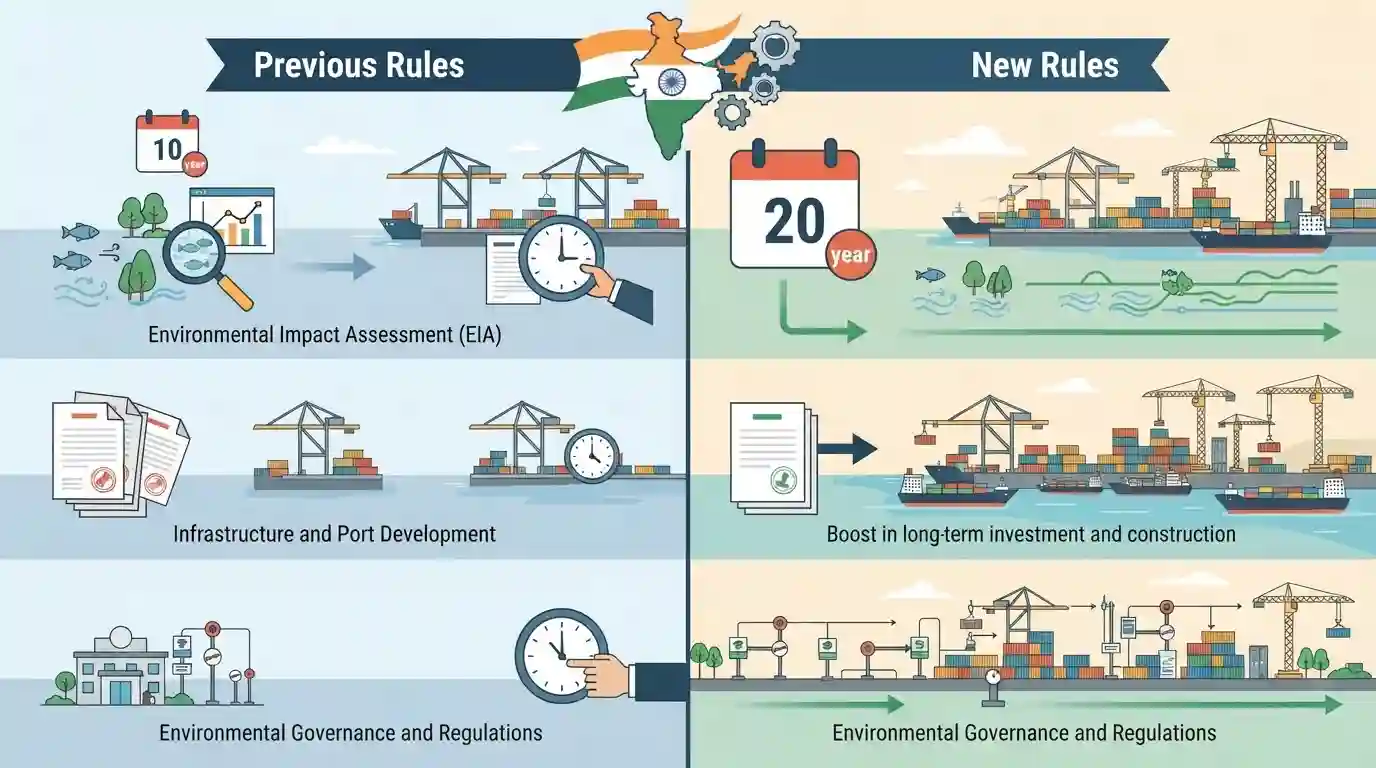
The Indian government has doubled the validity period of environmental clearances (EC) for port projects to 20 years under revised Environmental Impact Assessment (EIA) rules. This policy shift is intended to facilitate long-term maritime infrastructure development, reduce recurring procedural hurdles, and boost investment, though it sparks debate regarding environmental safeguarding and oversight over extended timelines.
মূল বিষয়
- The validity of environmental clearance (EC) for port projects has been doubled to 20 years under updated EIA rules.
- This regulatory change aims to streamline bureaucratic procedures, reduce compliance burdens, and enhance the ease of doing business for large-scale maritime infrastructure projects.
- Critics and environmental experts raise concerns about balancing long-term project viability with environmental safety and evolving ecological risks over a 20-year horizon.
গুরুত্বপূর্ণ শব্দ
Environment Impact Assessment (EIA) Rules

The regulatory framework under the Environment Protection Act, 1986, which mandates prior environmental clearance for specified developmental projects based on their potential environmental impacts.
UPSC context
UPSC GS Paper III: Environment, biodiversity, and environmental governance. Tests understanding of project clearances and regulatory compliance mechanisms.
Environment Protection Act, 1986
An umbrella legislation enacted in 1986 empowering the Central Government to coordinate actions, set standards, and frame rules for protecting and improving environmental quality across India.
UPSC context
UPSC GS Paper III: Environmental legislation and statutory bodies. Tests core environmental laws and executive powers.
প্রিলিমস ফাঁদ
The 20-year environmental clearance for port projects is final and requires no subsequent review or extension evaluation.
Aspirants often assume 20-year validity is absolute and final, overlooking that extensions require mandatory Expert Appraisal Committee (EAC) review.
সংযুক্ত স্থির ধারণা
What are the key stages and statutory backing of the EIA process in India?
- Statutory Root: Statutory backing derived under Section 3 of the Environment Protection Act, 1986, through the EIA Notification of 2006.
- Key Stages: Four mandatory stages include Screening, Scoping, Public Consultation, and Appraisal by the EAC or SEAC.
- Project Categories: Categories A and B projects require central and state-level clearance respectively, based on spatial extent and potential environmental impacts.
আন্তঃবিষয় প্যাটার্ন
Port Development + Coastal Regulation Zone (CRZ)
Maritime infrastructure expansion intersects with international shipping decarbonization targets and coastal zone regulation violations under CRZ notifications.
EIA Notification Amendments + Public Consultation Norms
EIA notification amendments bypassing robust public consultation mimic controversies seen in recent forest conservation act amendments.

EIA notification validity extensions for ports/mining + EAC review mechanism likely to appear as a statement-based prelims question.
সংযুক্ত PYQ · 2
সংযুক্ত PYQ · 2
- 2020MainsGS3
How does the draft Environment Impact Assessment (EIA) Notification, 2020 differ from the existing EIA Notification, 2006?
- 2019PrelimsGS1
Consider the following statements : The Environment Protection Act, 1986 empowers the Government of India to 1. state the requirement of public participation in the process of environmental protection, and the procedure and manner in which it is sought 2. lay down the standards for emission or discharge of environmental pollutants from various sources Which of the statements given above is/are correct?
