Managing Regional Demographic Transitions and Ageing Challenges
Source:Indian Express ↗
Why It Matters
It reorients the policy discourse on India's population from alarmist growth narratives to managing complex demographic divergence, ageing, and human capital productivity across different states.
Summary
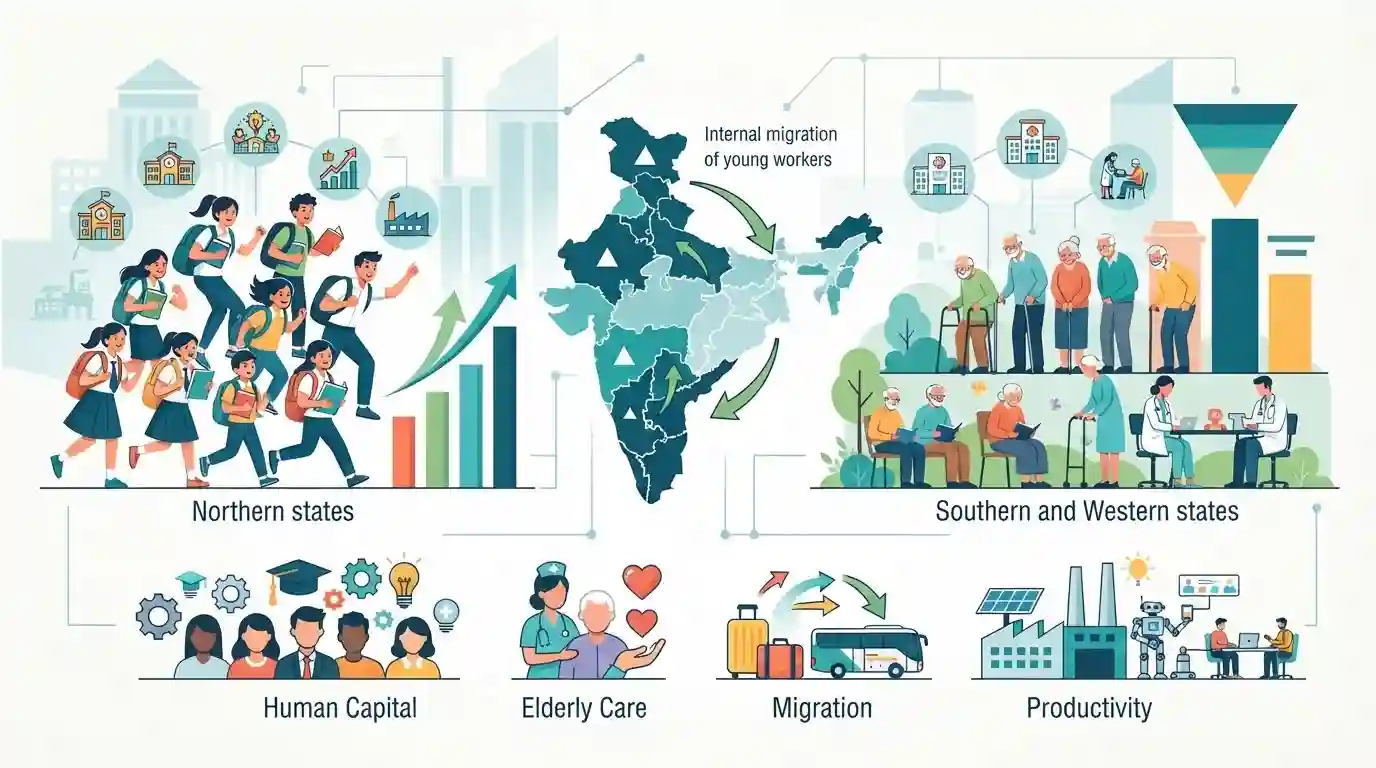
The article argues against alarmist population narratives, highlighting that India's core demographic challenge is managing asymmetric demographic transitions across states rather than curbing population growth. With southern and western states facing rapid ageing and low fertility, and northern states retaining younger profiles, policies must focus on human capital, elderly care, migration, and productivity.
Key Points
- Alarmist population narratives overlook regional divergences and shifting demographic realities in India.
- While northern states still experience younger populations, southern and western states are witnessing rapid population ageing and fertility rates falling well below the replacement level.
- The challenge is no longer about checking population growth overall, but actively managing asymmetric demographic changes, skilling, and workforce integration.
- Policy focus must pivot towards healthcare for the elderly, internal migration management, and boosting human capital productivity rather than coercive population control measures.
Prelims Trap
India's homogenous population explosion requires uniform national population control measures.
Aspirants assume India's entire population is growing rapidly and uniformly; in reality, several southern and western states have fertility rates well below replacement level (TFR < 2.1) and face rapid ageing.
Static Concepts Connected
What are the key demographic indicators used to measure population transitions and structural shifts in India?
- TFR metrics: Total Fertility Rate (TFR): The average number of children that would be born to a woman over her lifetime; replacement level stands at approximately 2.1.
- Dependency ratio: Dependency Ratio: The ratio of dependents (people younger than 15 or older than 64) to the working-age population (15-64 years).
- Dividend window: Demographic Dividend: A period of economic growth potential resulting from shifting population age structures, specifically when the share of the working-age population is larger than the non-working-age share.
Cross-Topic Patterns
Demographics vs. Finance Commission Devolution
Regional fertility divergence directly threatens the formula used by the Finance Commission for horizontal tax devolution, pitting younger northern states against ageing southern contributors.
Internal Migration and Cooperative Federalism
Ageing states with surplus capital face severe labor shortages, requiring regulated internal migration corridors from labor-surplus northern states, testing cooperative federalism.

Regional demographic divergence + Finance Commission devolution + federal tensions is a prime multi-statement UPSC Prelims trap.
Linked PYQs · 3
Linked PYQs · 3
- 2016MainsGS2
Demographic Dividend in India will remain only theoretical unless our manpower becomes more educated, aware, skilled and creative." What measures have been taken by the government to enhance the capacity of our population to be more productive and employable?
- 2023MainsGS2
The crucial aspect of development process has been the inadequate attention paid to Human Resource Development in India. Suggest measures that can address this inadequacy.
- 2023MainsGS2
Skill development programmes have succeeded in increasing human resources supply to various sectors. In the context of the statement analyse the linkages between education, skill and employment.
