Vatican mediation offer and global conflict zones in diplomacy
Source:The Hindu ↗
Why It Matters
The Vatican operates as a sovereign entity with immense global soft power, making its mediation offers significant in international diplomacy. Additionally, the specific regions mentioned by the Pope (Tigray, Caucasus, Syria, Ukraine) are recurrently tested in UPSC Prelims as 'Places in News' and in GS2 IR for geopolitical dynamics.
Summary
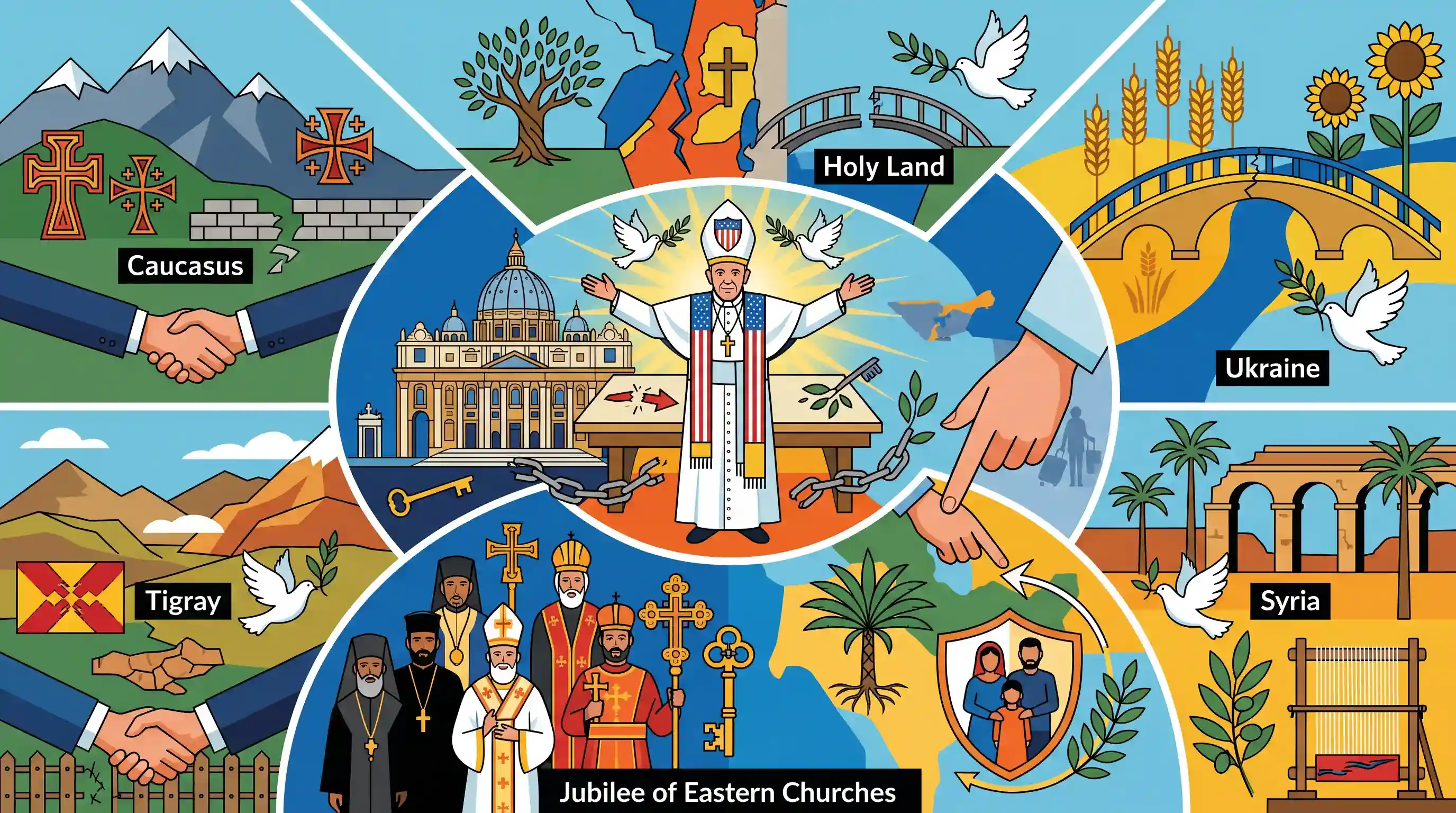
Pope Leo XIV, the newly elected and first U.S. pontiff, has offered the Vatican's mediation to end global wars. Speaking at the Jubilee of Eastern Churches, he emphasized the Holy See's readiness to host diplomatic talks for conflicting parties. Highlighting major conflict zones such as the Holy Land, Ukraine, Syria, Tigray, and the Caucasus, he also urged Christian minorities in the Middle East to remain in their homelands.
Key Points
- Newly elected Pope Leo XIV, the first U.S. pontiff, addressed the Jubilee of Eastern Churches, appealing for an end to ongoing global conflicts.
- The pontiff formally offered the Holy See's services as a mediator to bring warring world leaders to the negotiating table.
- He specifically highlighted active conflict zones, including the Holy Land, Ukraine, Lebanon, Syria, Tigray, and the Caucasus region.
- The Pope also made a strong appeal to Christian minorities in the Middle East, urging them not to abandon their historical homelands despite the violence.
Important Terms
Holy See

The central governing body of the Catholic Church; a sovereign legal entity distinct from Vatican City that conducts global diplomacy and holds UN observer status.
UPSC context
GS Paper II: International Relations. Tests knowledge of 'sui generis' sovereign entities and their role in global mediation and diplomacy.
Vatican City State
The world's smallest sovereign city-state, established by the 1929 Lateran Treaty to provide a territorial base and ensure the independence of the Holy See.
UPSC context
GS Paper II: International Relations. Relevant for territorial sovereignty, micro-states, and the legal history of international treaties.
Eastern Catholic Churches
23 autonomous particular churches in full communion with the Pope, retaining unique Eastern liturgical rites and traditions; significant in the Middle East and India.
UPSC context
GS Paper I/II: Culture and IR. Important for understanding Christian minorities in the Middle East and India's Syro-Malabar/Syro-Malankara churches.
Soft Power
A country's or entity's ability to influence others through appeal and attraction—such as moral authority, culture, or values—rather than through military or economic coercion.
UPSC context
GS Paper II: International Relations. Tests the concept of diplomatic influence exercised by religious leaders and non-military sovereign entities.
Non-State Actor
An entity with significant international influence that is not a state, such as an NGO or a religious body, often playing key roles in mediation.
UPSC context
GS Paper II: International Relations. Analyzes the impact of non-traditional actors on global peace, security, and humanitarian efforts.
Prelims Trap
The Holy See is a full member state of the United Nations General Assembly.
The Holy See is a 'Permanent Observer State' at the UN, not a full member. Additionally, the Holy See (not Vatican City) conducts diplomacy.
Static Concepts Connected
Where are Tigray and the Caucasus located geopolitically?
- Tigray region: Northernmost region of Ethiopia bordering Eritrea; site of a severe humanitarian crisis due to the federal government vs. TPLF conflict.
- Caucasus region: Mountainous transcontinental region between the Black and Caspian Seas; it houses the volatile Armenia-Azerbaijan (Nagorno-Karabakh) territorial dispute.
What distinguishes Track I, Track 1.5, and Track II diplomacy?
- Track I: Official, formal government-to-government diplomatic interactions, treaties, and negotiations.
- Track 1.5: Mixed negotiations involving both official state actors and influential non-governmental experts or mediators.
- Track II: Unofficial, non-governmental dialogue by private citizens, NGOs, or spiritual leaders (like the Pope) to build trust.
Cross-Topic Patterns
Places in News map-matching
UPSC frequently tests matching regions (Tigray, Nagorno-Karabakh) with their countries, often paired with questions on adjacent water bodies like the Black and Caspian Seas.
Non-State Actors in Global Peacebuilding
As UN Security Council vetoes create gridlock, the mediation role of non-state or spiritual actors links IR soft-power concepts directly with current geopolitics.

Expect a 'Places in News' match-the-following pairing Tigray, Caucasus, and Nagorno-Karabakh with their respective countries in 2026.
Linked PYQs · 3
Linked PYQs · 3
- 2023PrelimsGS1
Consider the following pairs: Area of conflict mentioned in news Country where it is located 1. Donbas : Syria 2. Kachin : Ethiopia 3. Tigray : North Yemen How many of the above pairs are correctly matched?
- 2023PrelimsGS1
Consider the following pairs: Regions often mentioned in news Reason for being in news 1. North Kivu and Ituri : War between Armenia and Azerbaijan 2. Nagorno-Karabakh : Insurgency in Mozambique 3. Kherson and Zaporizhzhia : Dispute between Israel and Lebanon How many of the above pairs are correctly matched?
- 2015MainsGS2
Terrorist activities and mutual distrust have clouded India-Pakistan relations. To what extent the use of soft power like sports and cultural exchanges could help generate goodwill between the two countries? Discuss with suitable examples.
