Ethical Challenges of Artificial Intelligence in Modern Society
Source:The Hindu ↗
Why It Matters
As AI transforms the global economy and society, ethical frameworks and international regulations are becoming critical. The intervention of global religious leaders highlights the intersection of technology, morality, and human rights, which is highly relevant for GS Paper 4 (Ethics and Human Values) and GS Paper 3 (Science and Technology).
Summary
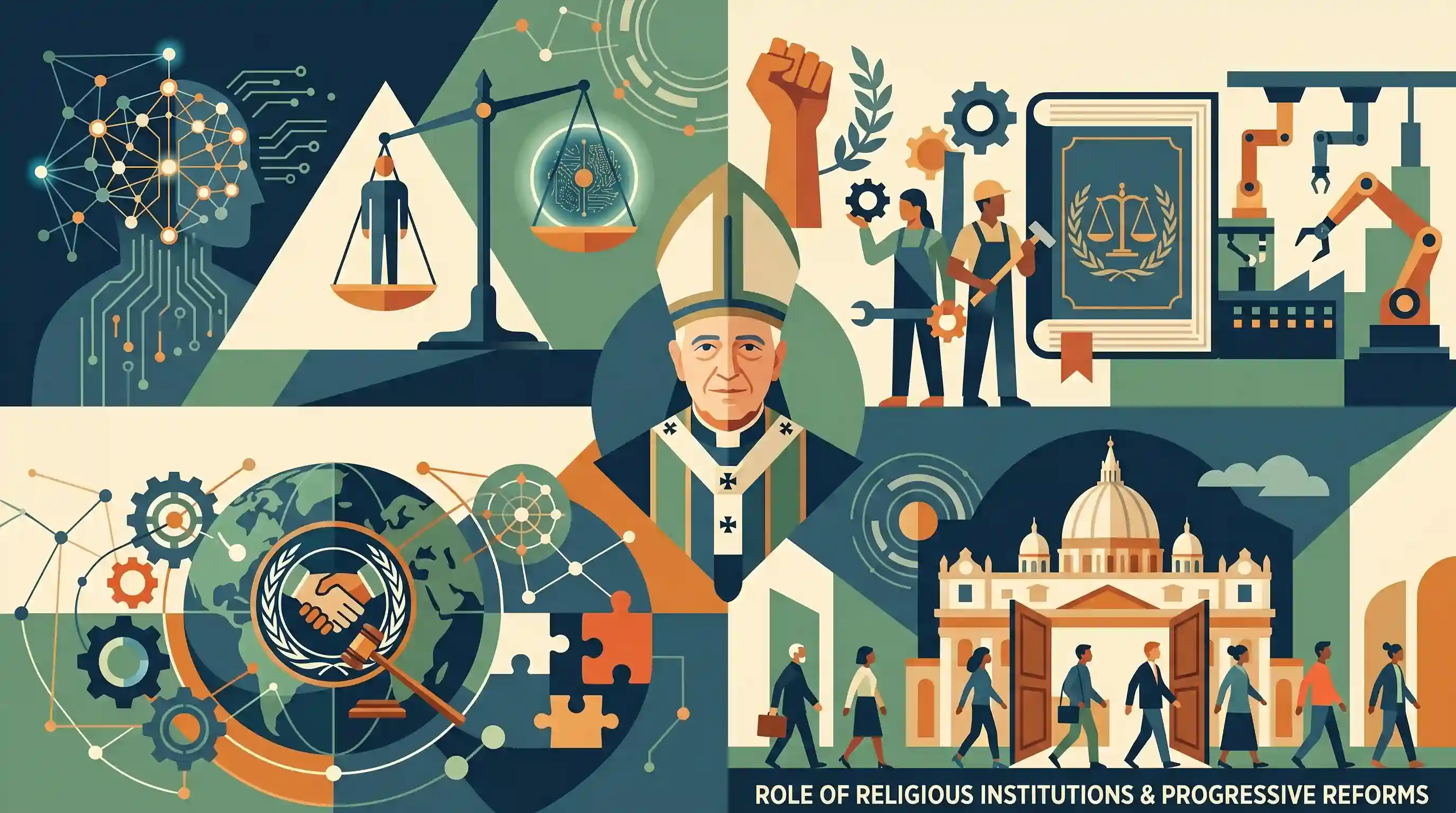
Pope Leo XIV (formerly Robert Francis Prevost) has laid out his vision for the Catholic Church, prominently identifying Artificial Intelligence as one of the most pressing challenges facing modern humanity. In his remarks, he expressed profound concern over AI's potential to undermine human dignity, equitable justice, and labor rights. Drawing historical parallels, he compared the AI boom to the Industrial Revolution, referencing Pope Leo XIII's seminal 1891 encyclical 'Rerum Novarum' on workers' rights. Furthermore, Pope Leo XIV pledged to champion the late Pope Francis's call for a global, binding ethical treaty on AI and committed to continuing the progressive, inclusive reforms of the Second Vatican Council.
Key Points
- Pope Leo XIV, in his inaugural vision, singled out Artificial Intelligence (AI) as a paramount challenge for humanity, warning of its risks to human dignity, justice, and the future of labor.
- He drew a parallel between the rapid advancement of AI and the Industrial Revolution, invoking Pope Leo XIII's 1891 encyclical 'Rerum Novarum' which championed workers' rights.
- The Pope reiterated the urgent need for a binding international treaty to regulate AI ethically, carrying forward the agenda of his predecessor, Pope Francis, who had raised the issue at the G7 summit.
- He also pledged to continue the inclusive, synodal church reforms initiated by the Second Vatican Council.
Important Terms
Rerum Novarum

An 1891 encyclical by Pope Leo XIII that established modern Catholic Social Teaching, advocating for workers' rights, fair wages, and human dignity during the Industrial Revolution.
UPSC context
GS Paper I (History) & GS Paper IV (Ethics); relevant for social justice, labor rights, and the Church's role in modern issues.
Second Vatican Council
The 1962–1965 assembly that modernized the Catholic Church, emphasizing 'aggiornamento' (updating) and promoting dialogue with the secular world, human rights, and religious freedom.
UPSC context
GS Paper I (Modern History/World History); tests understanding of 20th-century social reform and modernization movements in global institutions.
G7 Hiroshima AI Process
A 2023 initiative by G7 leaders to regulate Generative AI and establish global standards for 'trustworthy AI,' emphasizing human rights, safety, and international interoperability.
UPSC context
GS Paper II (International Relations); critical for topics on global governance of technology and international groupings (G7) setting digital norms.
Proposed International Treaty on AI
The Council of Europe's 2024 'Framework Convention on AI,' the first legally binding international agreement designed to ensure AI systems respect human rights, democracy, and the rule of law.
UPSC context
GS Paper II (Governance/IR) & GS Paper IV (Ethics); relevant for legal-ethical frameworks for emerging technologies and international cooperation.
Ethics of Artificial Intelligence
The application of ethical principles (transparency, accountability, fairness) to the design and use of AI to prevent harm, bias, and the erosion of human rights.
UPSC context
GS Paper IV (Ethics & Human Interface); tests the ability to evaluate the moral implications of disruptive technology on human dignity and labor.
Prelims Trap
"The 'Rome Call for AI Ethics' is a legally binding UN treaty regulating artificial intelligence."
The Rome Call is a non-binding ethical framework pioneered by the Vatican, not a UN treaty. Currently, the Council of Europe Framework is the primary legally binding international AI pact.
Static Concepts Connected
What are the different types of unemployment relevant to technological disruption?
- Structural unemployment: Driven by a permanent mismatch between existing workforce skills and new market needs, typically accelerated by automation and AI.
- Frictional unemployment: Temporary joblessness occurring naturally when individuals are transitioning between jobs, searching for new roles, or newly entering the labor market.
- Cyclical unemployment: Job losses linked directly to economic recessions and fluctuations in the macroeconomic business cycle.
What are the core components of AI ethics (Algor-ethics)?
- Algor-ethics: A framework ensuring artificial intelligence development remains human-centric, respects fundamental human rights, and prioritizes human dignity over pure computational efficiency.
- Explainable AI (XAI): The ethical requirement that AI decision-making processes be transparent and understandable to human operators, ensuring accountability for automated biases.
- Algorithmic fairness: The principle that AI systems should be designed to benefit all segments of society equitably, mitigating discrimination against marginalized communities.
Cross-Topic Patterns
Non-state actors in global tech governance
The Vatican's active role in shaping AI treaties via the G7 highlights the growing influence of civil society and non-state religious actors in international relations and global technology governance.
IR 1.0 vs. IR 4.0 labor disruptions
Just as the First Industrial Revolution birthed early labor rights movements, AI (IR 4.0) is forcing a modern re-evaluation of structural unemployment and universal basic income.

Expect a GS4 question on 'algor-ethics' or a Prelims pair matching international AI declarations (Bletchley, Rome Call, CoE Convention).
Linked PYQs · 3
Linked PYQs · 3
- 2024MainsGS4
The application of Artificial Intelligence as a dependable source of input for administrative rational decision-making is a debatable issue. Critically examine the statement from the ethical point of view.
- 2023MainsGS3
Introduce the concept of Artificial Intelligence (AI). How does Al help clinical diagnosis? Do you perceive any threat to privacy of the individual in the use of Al in healthcare?
- 2015MainsGS3
What are the areas of prohibitive labour that can be sustainably managed by robots ? Discuss the initiatives that can propel research in premier research institutes for substantive and gainful innovation.
