Pope Spain visit addresses migration policies and abuse accountability
Source:The Hindu ↗
Why It Matters
The article is highly relevant for GS-2 (International Relations and Social Justice) due to its focus on European migration policies, the refugee crisis, and the resulting political polarization. It is also directly relevant to GS-4 (Ethics) regarding institutional accountability, moral responsibility, and ethical leadership in the context of the Catholic Church addressing historical abuses.
Summary
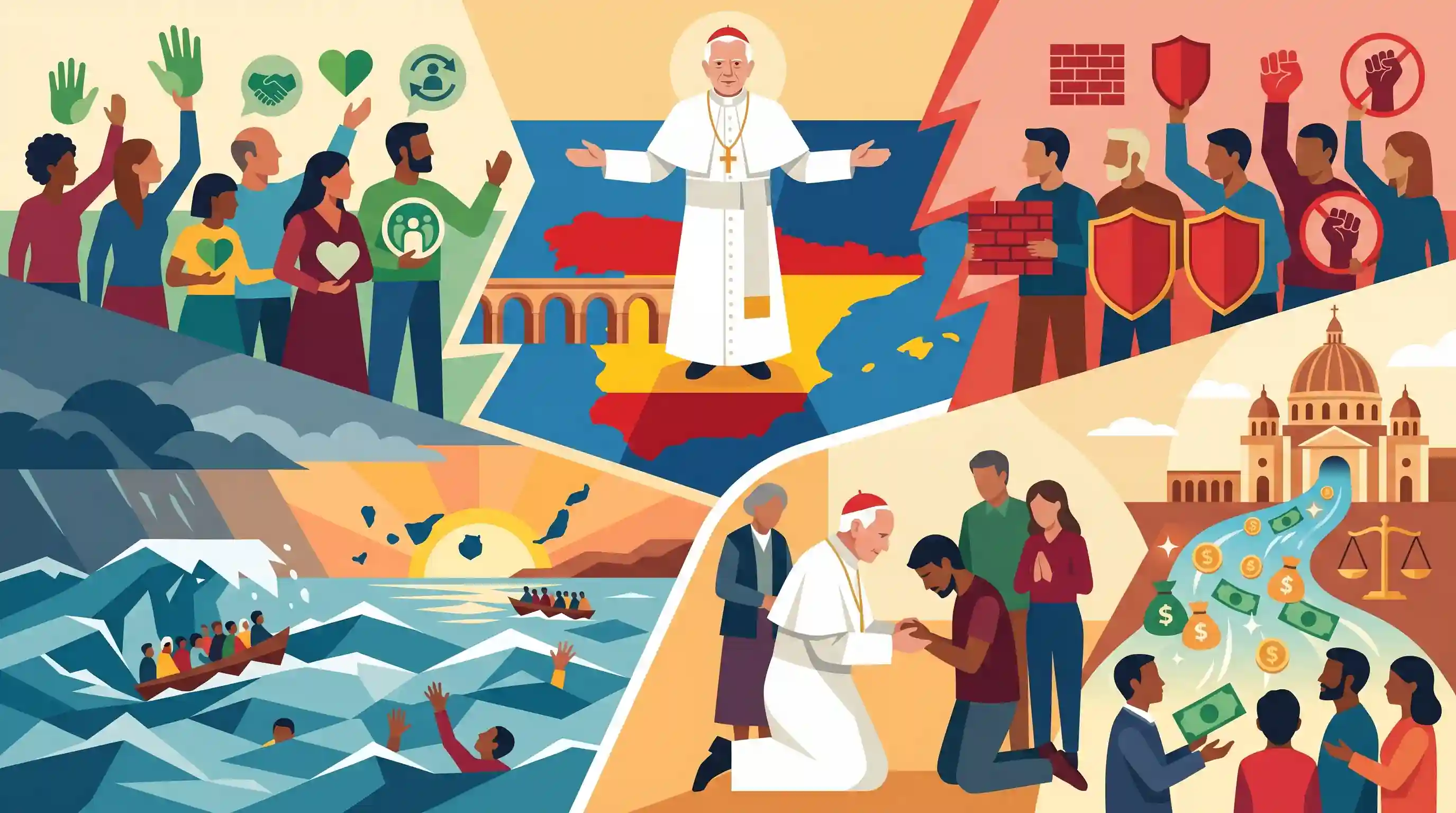
During his visit to Spain, Pope Leo XIV addressed critical social and ethical issues by calling for an end to polarising political narratives, particularly surrounding immigration. Set against the backdrop of Spain's liberal immigration policies and right-wing opposition, the Pope emphasized the humanitarian crisis on the Canary Islands route. Furthermore, in a significant act of institutional accountability, the Pope met with victims of clerical sexual abuse and instituted a compensation fund, highlighting themes of moral responsibility and ethical leadership.
Key Points
- Pope Leo XIV visited Spain to address the nation's political divides and advocate for an end to polarising narratives, particularly concerning immigration.
- The visit highlighted the perilous Atlantic migration route to the Canary Islands, where thousands of migrants from West Africa perish annually, as recognized by the UN IOM.
- The Pope addressed historical ethical failures within the Catholic Church by meeting with victims of clerical sexual abuse and formally establishing a compensation fund for them.
- The political backdrop of the visit included tensions between PM Pedro Sanchez's liberal immigration policies and the conservative and far-right opposition, notably the Vox party.
Important Terms
Catholic Church

The global religious institution headed by the Pope; currently emphasizing humanitarian advocacy for migrants and institutional accountability through collaborative state-church compensation funds for historical clerical abuse.
UPSC context
GS Paper IV (Ethics): Institutional accountability and moral responsibility; GS Paper II: Social Justice and religious influence in global politics.
Vox Party
A Spanish far-right, national-conservative political party advocating for ultranationalism and strict anti-immigration policies, often opposing liberal migration amnesties and clashing with the Church’s pro-migrant stance.
UPSC context
GS Paper II (International Relations/Comparative Politics): Impact of right-wing populism on national policy and regional cooperation in the EU.
International Organization for Migration (IOM)
The leading UN-related intergovernmental organization tracking global migration trends and fatalities, providing data to support evidence-based policies and the protection of migrants along irregular routes.
UPSC context
GS Paper II (International Institutions): Role of UN-affiliated bodies in managing global migration and humanitarian crises.
Western African Atlantic Route
A perilous migration corridor from the West African coast to Spain’s Canary Islands, identified by the IOM as one of the world’s deadliest irregular maritime paths.
UPSC context
GS Paper II: Global migration challenges and humanitarian disasters; GS Paper I (Geography): Key international migration corridors.
Clerical Sexual Abuse Reparations
A comprehensive 2026 agreement between the Spanish government and the Church to provide financial and symbolic redress to victims of historical clerical abuse, including cases outside statutes of limitations.
UPSC context
GS Paper IV (Ethics): Accountability of non-state actors and restorative justice for historical institutional failures.
Prelims Trap
The Canary Current is a warm ocean current facilitating easy maritime navigation for migrants to the Canary Islands.
The Canary Current is actually a cold ocean current. Its cooling effect stabilizes the air, preventing rain (driving Sahara's aridity), and creates treacherous maritime conditions, making this migration route highly fatal.
Static Concepts Connected
How do cold ocean currents like the Canary Current influence coastal desert formation?
- Stable air masses: Cold currents cool the lower atmosphere, causing temperature inversions that prevent the vertical air ascent required for rainfall.
- Moisture depletion: Winds blowing over cold water hold less moisture, ensuring they arrive on land dry, which drives aridity in regions like the western Sahara.
- Coastal fog: While rain is suppressed, the cooling of moist sea air often produces advection fog, providing only marginal moisture to coastal environments.
What are the core elements of institutional accountability in governance and ethics?
- Systemic ownership: Acknowledging that institutional cultures and systemic hierarchies enabled misconduct, rather than solely blaming individual bad actors.
- Tangible restitution: Moving beyond mere apologies to structural and financial remedies, such as establishing formal compensation funds for victims.
- Restoring credibility: Publicly addressing historical moral failures to demonstrate genuine ethical leadership and to rebuild eroded public trust.
Cross-Topic Patterns
Oceanography dictating human migration perils
The treacherous Atlantic route to the Canary Islands links physical geography (cold currents, wind systems) directly to international humanitarian crises and the geopolitics of global migration.
Non-state actors exerting moral diplomacy
The Pope's intervention in Spain’s immigration politics exemplifies how non-state religious institutions leverage soft power and moral capital to influence domestic policies and global governance.

Mapping questions pairing West African physical geography (Canary Current) with geopolitical or migration crises are highly probable in 2026.
Linked PYQs · 2
Linked PYQs · 2
- 2024MainsGS4
“Ethics encompasses several key dimensions that are crucial in guiding individuals and organizations towards morally responsible behaviour.” Explain the key dimensions of ethics that influence human actions. Discuss how these dimensions shape ethical decision-making in the professional context.
- 2022PrelimsGS1
The term "Levant" often heard in the news roughly corresponds to which of the following regions?
