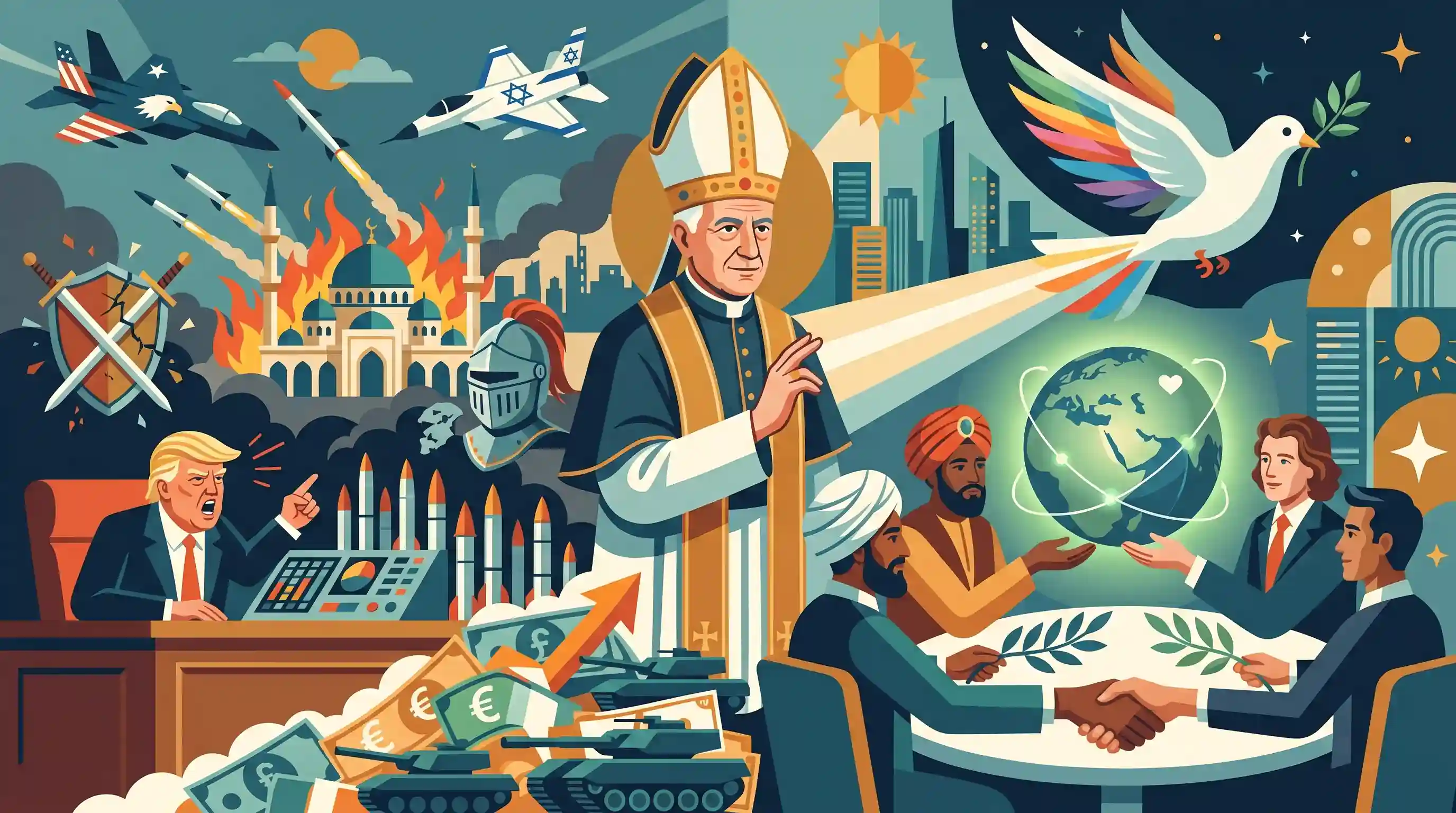
Pope Francis Declares US Just War Theory Outdated in First Encyclical
Source:The Hindu ↗
Why It Matters
The debate over the 'just war' theory touches upon core concepts of ethics in international relations (GS Paper 4). The Pope's moral stance against the use of force by superpowers like the U.S. provides a classic case study for evaluating the ethical responsibilities of powerful nations and the effectiveness of diplomacy versus military intervention in contemporary geopolitical conflicts.
Summary
Pope Leo XIV's first encyclical, 'Magnifica humanitas', strongly criticizes the U.S. and Israeli military strikes on Iran, declaring the concept of a 'just war' as 'outdated'. The Pope advocates for diplomacy, dialogue, and forgiveness as the primary tools for modern conflict resolution, challenging the Trump administration's aggressive rhetoric and justification for preventive attacks. He also condemned the rise in European military spending. The document underscores a significant moral and ethical stance on international relations, rejecting the use of military force as a means to achieve peace or prevent nuclear proliferation.
Key Points
- Pope Leo XIV released his first encyclical, 'Magnifica humanitas,' which primarily focuses on anti-war messaging while also addressing the rise of AI.
- The Pope explicitly termed the concept of a 'just war' as 'outdated', a direct counter to U.S. Vice President JD Vance's use of the theory to justify recent air strikes on Iran.
- The encyclical serves as a sharp rebuke to the military actions of the U.S. and Israel, particularly their February air strikes on Iranian nuclear facilities.
- Pope Leo XIV emphasized that modern humanity has effective tools for conflict resolution, such as diplomacy, dialogue, and forgiveness, rendering war unnecessary.
- He also condemned the escalation of military spending in Europe and rejected the justification of preventive attacks to thwart nuclear weapons proliferation.
Important Terms
Papal Encyclical

A circular letter sent by the Pope to the world's bishops. It provides authoritative teaching on matters of faith, morals, or social issues to guide the Catholic faithful.
UPSC context
GS Paper IV (Ethics); examples of teachings from great leaders and reformers influencing global moral discourse.
Just War Theory
A moral framework used to determine when a war is ethically justifiable (jus ad bellum) and how it should be conducted (jus in bello) to minimize human suffering.
UPSC context
GS Paper IV (Ethics); central to 'Ethics in International Relations' for evaluating conflicts and military intervention.
Ethics in International Relations
A subfield of ethics exploring moral dilemmas in global affairs. It examines the tension between national sovereignty, strategic interests, and universal human rights or moral duties.
UPSC context
GS Paper IV direct syllabus topic; tests a candidate's ability to apply moral reasoning to global crises.
Magnifica humanitas
The first encyclical of Pope Leo XIV (2026). It advocates for 'magnificent humanity,' challenging aggressive military policies and calling for diplomacy over the traditional 'just war' framework.
UPSC context
Current Affairs (International); highlights modern ethical shifts and the role of religious leadership in global peace-building.
Preventive Strike
A military action launched to destroy a potential threat before the enemy can strike. Such strikes are often controversial under international law and traditional ethical frameworks.
UPSC context
GS Paper II (International Relations) and GS Paper IV; concerns the legality and morality of preemptive self-defense.
Prelims Trap
Preventive military strikes against nuclear facilities are legally recognized under the UN Charter's right to self-defense.
UN Charter Art 51 permits self-defense against an *actual* armed attack. Customary law recognizes *pre-emptive* strikes (imminent threat), but broadly rejects *preventive* attacks against distant/future threats like nuclear development.
Static Concepts Connected
What are the core ethical components of the traditional 'Just War' (Bellum Justum) theory?
- Jus ad bellum: Conditions for going to war: must have a just cause, legitimate authority, right intention, be a last resort, and have a reasonable probability of success.
- Jus in bello: Ethical conduct during war, heavily relying on the principles of proportionality and discrimination (protecting non-combatants).
- Jus post bellum: Ethical transition from war to peace, ensuring fair treaties, reconstruction, and avoiding vindictive retribution against the defeated state.
Under the UN Charter, what are the recognized exceptions to the prohibition on the use of force?
- Self-Defense (Article 51): A state retains the inherent right to individual or collective self-defense if an armed attack occurs, until the Security Council takes necessary measures.
- UNSC Authorization: Under Chapter VII, the UN Security Council can explicitly authorize the use of military force to maintain or restore international peace and security.
Cross-Topic Patterns
Ethics of Deterrence vs. Disarmament
The moral rejection of nuclear preventive strikes links GS-4 ethics to GS-2 global nuclear architecture topics, contrasting Western pre-emptive doctrines with global disarmament advocacy like the Treaty on the Prohibition of Nuclear Weapons.
Unilateralism in West Asia
The military strikes on Iran's nuclear sites reflect a growing trend of unilateral interventions by the US and Israel, bypassing UNSC frameworks and exacerbating the West Asian security dilemma.

Expect a GS-4 Mains question evaluating the 'Just War' theory's relevance amid modern pre-emptive strikes, AI warfare & nuclear deterrence.
Linked PYQs · 3
Linked PYQs · 3
- 2025MainsGS4
Carl von Clausewitz once said, "War is a diplomacy by other means." Critically analyse the above statement in the present context of contemporary geo-political conflict.
- 2020MainsGS4
‘The will to power exists, but it can be tamed and be guided by rationality and principles of moral duty.’ Examine this statement in the context of international relations.
- 2024MainsGS4
“It is not enough to talk about peace, one must believe in it; and it is not enough to believe in it, one must act upon it.” In the present context, the major weapon industries of the developed nations are adversely influencing continuation of number of wars for their own self-interest, all around the world. What are the ethical considerations of the powerful nations in today's international arena to stop continuation of ongoing conflicts?
