विधिक सहायता तंत्र और कमजोर वर्गों के लिए न्याय तक पहुंच
स्रोत:द हिंदू ↗
क्यों मायने रखता है
The article touches directly upon core GS2 syllabus themes such as the role of NALSA, Lok Adalats, alternative dispute resolution, judicial reforms, and access to justice for vulnerable sections (DPSP Article 39A). It provides valuable examples (Jan Vishwas Act, regional language translations) for Mains answers.
सारांश
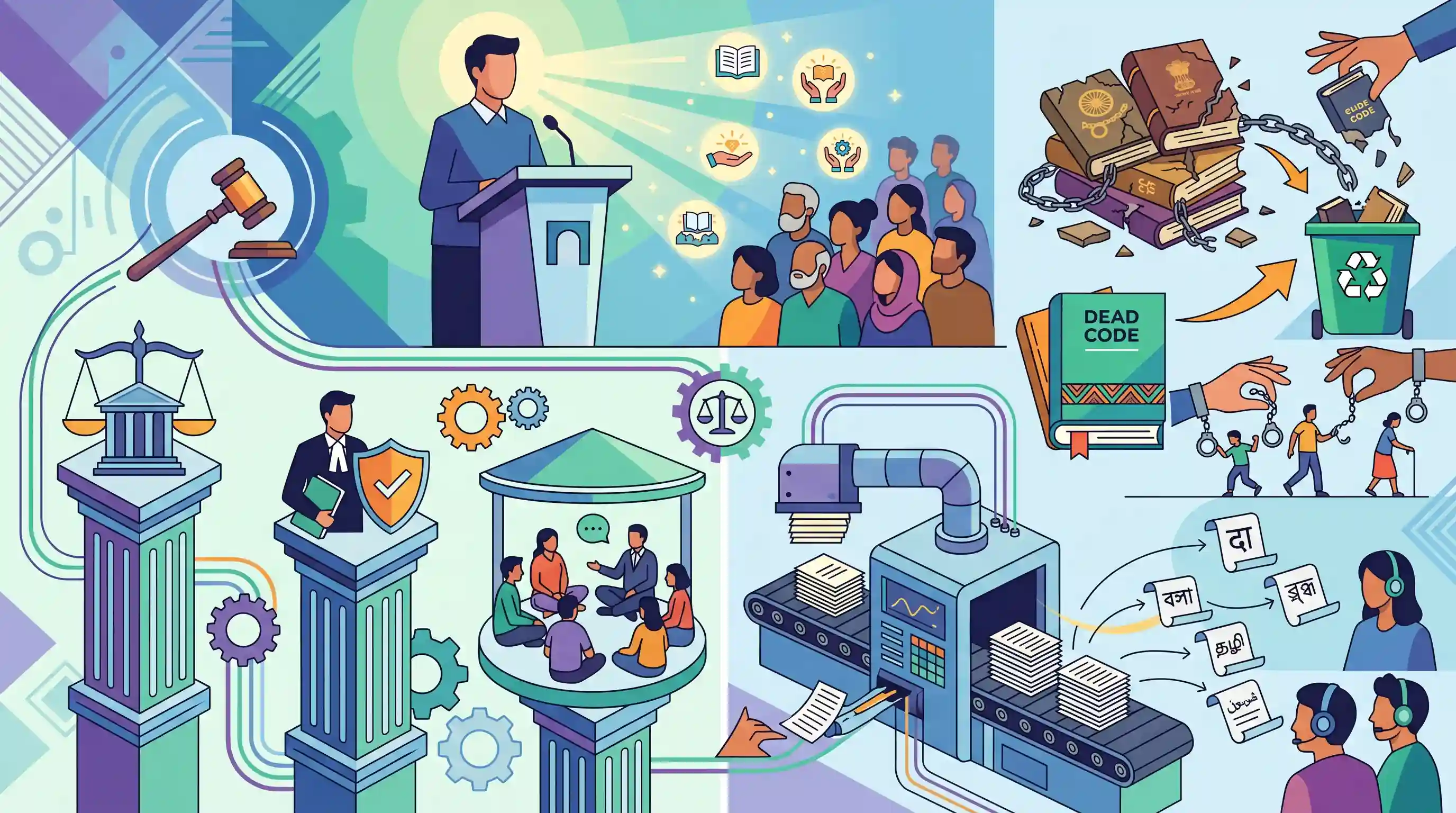
Prime Minister Narendra Modi addressed the National Conference on 'Strengthening Legal Aid Delivery Mechanisms', emphasizing that awareness of legal rights is the first step towards ensuring justice for the poor. He highlighted the government's initiatives for 'ease of justice', including the decriminalization of 3,400 provisions via the Jan Vishwas Act, repealing 1,500 obsolete colonial laws, and replacing the IPC with the Bharatiya Nyaya Sanhita (BNS). The PM and Supreme Court Judges also stressed the need to remove language barriers, noting the translation of 80,000 SC judgments into 18 Indian languages. The crucial roles of NALSA, the Legal Aid Defence Counsel System, and Lok Adalats were underscored as key pillars for delivering accessible, swift, and humane justice.
मुख्य बिंदु
- PM Modi inaugurated the National Conference on 'Strengthening Legal Aid Delivery Mechanisms' at the Supreme Court.
- He stressed that true access to justice requires poor citizens to be aware of their rights and overcome the fear of the legal system.
- The Jan Vishwas Act helped decriminalize 3,400 provisions and the government repealed 1,500 obsolete laws to improve the 'ease of justice'.
- The Supreme Court has translated over 80,000 judgments into 18 regional languages to eliminate language barriers in accessing justice.
- Legal Aid Defence Counsel System has been expanded, resolving around eight lakh cases in three years, and alternative dispute resolution through Lok Adalats is playing a vital role.
महत्वपूर्ण शब्द
Bharatiya Nyaya Sanhita (BNS)

The main criminal code of India, replacing the colonial-era Indian Penal Code (IPC) to modernize definitions of crimes like terrorism and mob lynching.
UPSC context
GS Paper II: Criminal Justice Reforms. Tests understanding of legal modernization and replacing colonial legacies.
National Legal Services Authority (NALSA)
A statutory body under the Legal Services Authorities Act, 1987, providing free legal aid to weaker sections and organizing Lok Adalats.
UPSC context
GS Paper II: Judiciary & Governance. Crucial for topics on access to justice and Article 39A.
Jan Vishwas Act
A legislative reform aimed at 'ease of doing business' by decriminalizing minor procedural offences and replacing imprisonment with civil penalties.
UPSC context
GS Paper II & III: Governance & Economy. Tests knowledge of regulatory reforms and administrative simplification.
Legal Services Authorities Act, 1987
The parent legislation establishing the framework for free legal aid, NALSA, and the statutory status of Lok Adalats in India.
UPSC context
GS Paper II: Statutory Bodies. Fundamental to understanding the legal aid ecosystem in India.
Legal Aid Defence Counsel System (LADCS)
A NALSA scheme providing full-time, salaried lawyers to defend the poor in criminal cases, moving away from case-based honorariums.
UPSC context
GS Paper II: Social Justice. Tests specific mechanisms for delivering justice to marginalized sections.
Lok Adalat
An alternative dispute resolution forum that settles pending or pre-litigation cases amicably; its awards have the weight of a civil court decree.
UPSC context
GS Paper II: Alternative Dispute Resolution (ADR). Key for reducing judicial pendency and grassroots justice.
प्रारंभिक ट्रैप
लोक अदालत द्वारा दिया गया निर्णय (award) उच्च न्यायालय में अपील के अधीन है।
Lok Adalat awards are deemed decrees of a civil court. They are final, binding on all parties, and no appeal lies against them.
संबंधित अवधारणाएँ
विधिक सेवा प्राधिकरण अधिनियम के तहत निःशुल्क कानूनी सहायता के लिए कौन पात्र है?
- Vulnerable demographics: Women, children, members of SC/ST communities, and persons with disabilities are universally eligible, regardless of their income level.
- Workforce & victims: Industrial workmen, victims of human trafficking (begar), and victims of mass disasters, ethnic violence, floods, or earthquakes qualify for free aid.
- Income & custody: General citizens earning below a specific statutory threshold (which varies by state, generally ₹1-5 lakh) are eligible. Persons in custody are also covered.
What are the core jurisdictional features of a Lok Adalat?
- Final and binding: Awards are deemed civil court decrees. They are final, binding, and cannot be appealed, though constitutional writ jurisdiction (Articles 226/32) remains open.
- Scope of cases: Handles civil cases and compoundable criminal offenses. It can take up pending court cases as well as pre-litigation disputes.
- Fee structure: No court fee is payable. If a pending case is settled via Lok Adalat, the fee already paid in the regular court is fully refunded.
अंतर-विषय पैटर्न
AI in Judiciary: SUVAS & DPI
Translating 80,000 SC judgments relies on AI tools like SUVAS, connecting constitutional language rights (Eighth Schedule) with India's emerging Digital Public Infrastructure.
Jan Vishwas & Ease of Doing Business
Decriminalizing minor offenses bridges the gap between judicial pendency and economic policy, shifting India from a punitive to a trust-based regulatory environment.

Expect a multi-statement prelims question on NALSA's Legal Aid Defense Counsel System (LADCS) and the finality of Lok Adalat awards.
संबद्ध PYQ · 5
संबद्ध PYQ · 5
- 2023MainsGS2
Who are entitled to receive free legal aid? Assess the role of the National Legal Services Authority (NALSA) in rendering free legal aid in India.
- 2024MainsGS2
Explain and distinguish between Lok Adalats and Arbitration Tribunals. Whether they entertain civil as well as criminal cases ?
- 2013PrelimsGS1
With reference to National Legal Services Authority, consider the following statements : 1. Its objective is to provide free and competent legal services to the weaker sections of the society on the basis of equal opportunity. 2. It issues guidelines for the State Legal Services Authorities to implement the legal programmes and schemes throughout the country. Which of the statements given above is/are correct?
- 2010PrelimsGS1
With reference to Lok Adalats, which of the following statements is correct?
- 2020PrelimsGS1
In India, Legal Services Authorities provide free legal services to which of the following type of citizens? 1. Person with an annual income of less than ₹ 1,00,000 2. Transgender with an annual income of less than ₹ 2,00,000 3. Member of Other Backward Classes (OBC) with an annual income of less than ₹ 3,00,000 4. All Senior Citizens Select the correct answer using the code given below:
