Application of Public Trust Doctrine in Environmental Jurisprudence
Source:Indian Express ↗
Why It Matters
This article is significant for UPSC GS-3 (Environment and Ecology) and GS-2 (Governance/Judiciary) as it highlights the evolution of environmental jurisprudence in India, specifically how judicial bodies like the NGT utilize ancient common law and global legal principles like the Public Trust Doctrine to enforce environmental accountability and address climate/pollution crises.
Summary
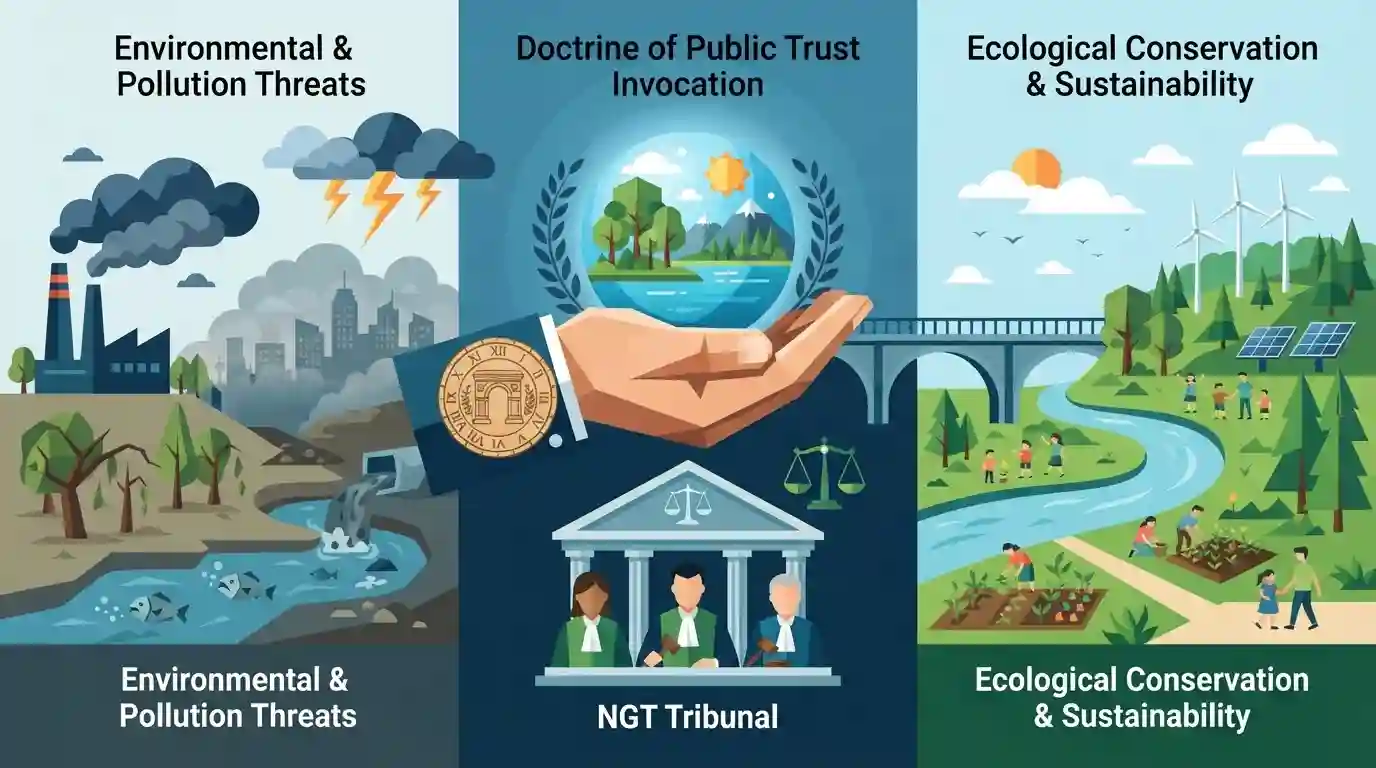
The article discusses the National Green Tribunal invoking the ancient Roman-era 'Doctrine of Public Trust' in response to growing environmental and pollution threats to the planet. The doctrine dictates that the state holds vital natural resources in trust for the public, establishing state accountability and legal foundations for ecological conservation and sustainability in India.
Key Points
- The National Green Tribunal (NGT) recently invoked the Roman-era 'Doctrine of Public Trust' while dealing with severe environmental pollution threats, emphasizing that certain natural resources like air, water, and forests are preserved for public use and cannot be privatized or destroyed.
- The Public Trust Doctrine places an affirmative duty on the government and its instrumentalities as trustees to protect and manage public natural resources for the common good rather than private convenience or commercial exploitation.
- Indian courts, including the Supreme Court and NGT, have progressively integrated international and historical legal doctrines into environmental jurisprudence to protect ecological balance and fulfill intergenerational equity under Article 21.
Important Terms
National Green Tribunal

A specialized statutory judicial body established under the NGT Act, 2010, for effective and expeditious disposal of cases relating to environmental protection, forest conservation, and natural resources.
UPSC context
GS Paper III (Environment & Ecology) & GS Paper II (Polity/Statutory Bodies). Tests institutional mechanisms for environmental governance.
National Green Tribunal Act, 2010
Legislation enacted by Parliament in 2010 to establish a dedicated environmental tribunal, providing a legal framework for speedy resolution of environmental disputes and enforcement of conservation rights.
UPSC context
GS Paper III (Environmental Laws & Statutory Framework). Tests understanding of specialized judicial remedies in environmental jurisprudence.
Environment (Protection) Act, 1986
India's umbrella legislation enacted in 1986 following the Bhopal disaster, empowering the Central Government to take measures to protect and improve the environment and prevent pollution.
UPSC context
GS Paper III (Environment & Ecology/Pollution Control). Frequently tested for its scope, central powers, and implementation of international commitments.
Prelims Trap
the National Green Tribunal Act, 2010 introduced the Roman-era Doctrine of Public Trust into Indian jurisprudence
The Public Trust Doctrine originates from Roman law and ancient legal philosophy, not from the National Green Tribunal Act, 2010 or British colonial statutes.
Static Concepts Connected
What are the key judicial milestones and constitutional bases of the Public Trust Doctrine in India?
- Roman roots: Roman Origins: Originates from Justinian Institutes, establishing that air, running water, the sea, and shores are common to all citizens.
- M.C. Mehta case: Landmark Case: Cemented in India by Supreme Court in M.C. Mehta v. Kamal Nath (1997), holding state as trustee of natural resources.
- Constitutional basis: Constitutional Link: Tied directly to Right to Life under Article 21, DPSP Article 48A, and Fundamental Duty Article 51A(g).
Cross-Topic Patterns
DPSP + Fundamental Rights + Environmental Jurisprudence
The Public Trust Doctrine transforms Directive Principles (Article 48A) into judicially enforceable affirmative duties, bridging non-justiciable DPSP with the enforceable Right to Life (Article 21).
Judicial Activism + Specialized Tribunals + Statutory Limits
NGT's invocation of Roman-era doctrines highlights how specialized tribunals import international common law principles to bypass legislative gaps in environmental governance.

Public Trust Doctrine + M.C. Mehta v. Kamal Nath case + NGT powers likely to be tested in a matching or statement-based prelims question.
Linked PYQs · 2
Linked PYQs · 2
- 2018PrelimsGS1
How is the National Green Tribunal (NGT) different from the Central Pollution Control Board (CPCB)? 1. The NGT has been established by an Act whereas the CPCB has been created by an executive order of the Government. 2. The NGT provides environmental justice and helps reduce the burden of litigation in the higher courts whereas the CPCB promotes cleanliness of streams and wells, and aims to improve the quality of air in the country. Which of the statements given above is/are correct?
- 2012PrelimsGS1
The National Green Tribunal Act, 2010 was enacted in consonance with which of the following provisions of the Constitution of India? 1. Right to healthy environment, construed as a part of Right to life under Article 21 2. Provision of grants for raising the level of administration in the Scheduled Areas for the welfare of Scheduled Tribes under Article 275(1) 3. Powers and functions of Gram Sabha as mentioned under Article 243(A) Select the correct answer using the codes given below:
