Dehradun Launches Campaign to Clean Rispana and Bindal Rivers
Source:prashant-news ↗
Why It Matters
Understanding the geography of Uttarakhand's local river systems (specifically the Rispana and Bindal rivers, which feed into the Song River and ultimately the Ganga) as well as the implementation of administrative and environmental schemes like Namami Gange is highly relevant for UKPSC PCS Prelims.
Summary
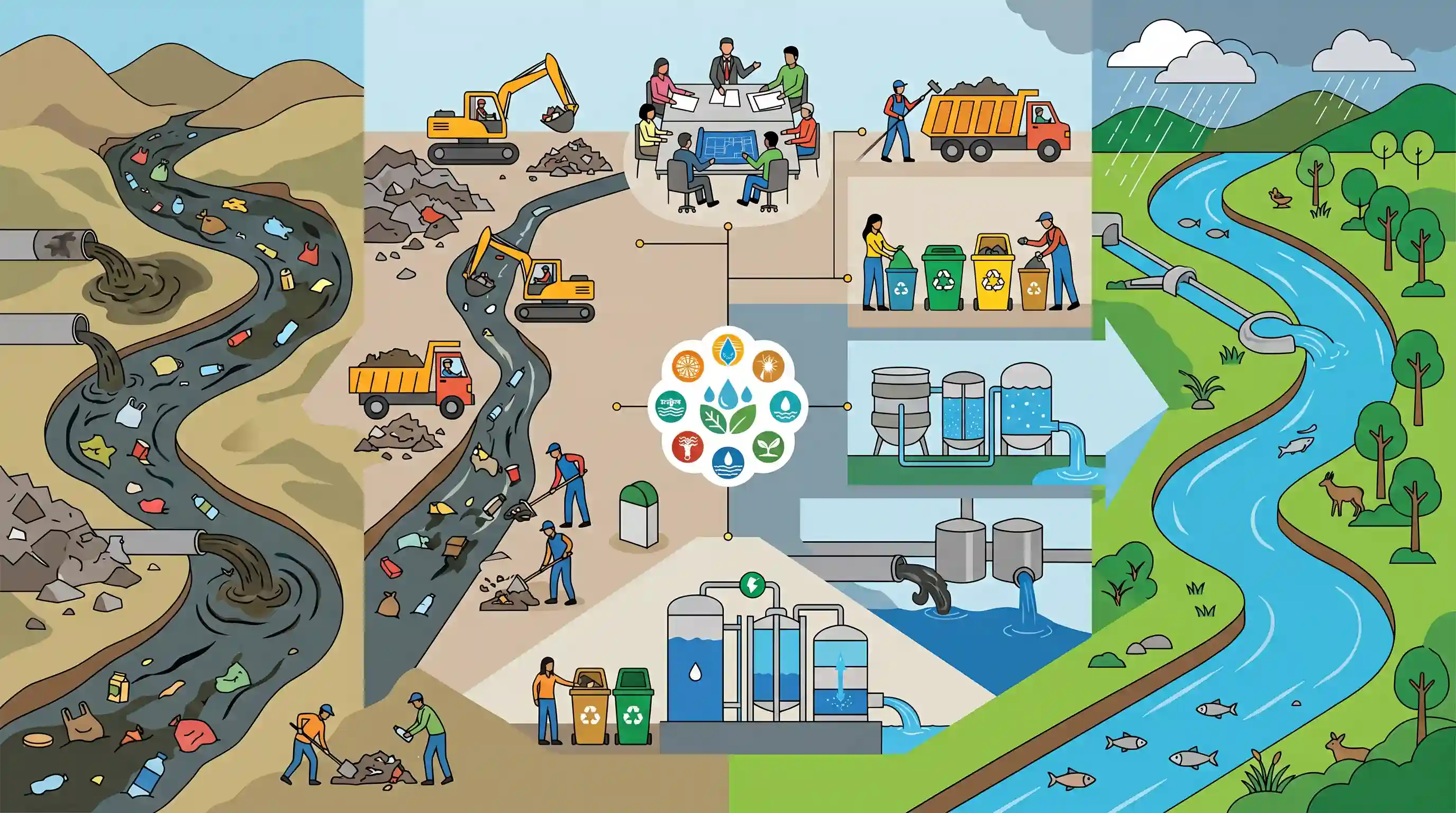
The Uttarakhand government has launched a dedicated cleaning and restoration drive targeting Dehradun's highly polluted Rispana and Bindal rivers. Aimed at preparing the city’s drainage network for the upcoming monsoon, the initiative involves removing massive debris and trash from a 12-km stretch of the Rispana and an 8-km stretch of the Bindal. Additionally, the district administration is preparing a phased action plan under the federal Namami Gange Programme and the District Sanitation Committee to curb solid waste dumping and treat raw sewage entering these critical watercourses.
Key Points
- The Uttarakhand government has initiated a cleaning and rejuvenation drive in Dehradun for the heavily polluted Rispana River, ahead of the monsoon season.
- A 12-km stretch of the Rispana River and an 8-km stretch of the Bindal River are currently undergoing cleanup operations, including desilting and waste removal.
- The initiative is being executed via coordinated efforts between the Dehradun district administration, Dehradun Municipal Corporation (DMC), and other state departments.
- A phased, comprehensive action plan is being drafted under the Namami Gange Programme and the District Sanitation Committee to resolve solid waste dumping and treat untreated domestic sewage flowing into the rivers.
- Since March, DMC has reportedly cleared nearly 17,000 metric tonnes of waste across the city through its special sanitation drive.
Important Terms
Namami Gange Programme

A flagship, centrally-funded Integrated Conservation Mission launched in June 2014 to accomplish the twin objectives of effective abatement of pollution, conservation, and rejuvenation of the National River Ganga and its tributaries.
UPSC context
GS Paper III: Environmental Conservation. Tests knowledge of flagship central schemes for river rejuvenation and basin management.
Rispana River
A perennial tributary of the Song River (which feeds into the Ganga) originating in Mussoorie and flowing through Dehradun, serving as a critical regional water source and groundwater recharge channel.
UPSC context
GS Paper I: Indian Geography. Tests understanding of regional drainage networks, river basins, and urban environmental degradation.
Bindal River
A seasonal river in Dehradun, Uttarakhand, that acts as a natural drainage channel preventing urban flooding. It merges with the Rispana River and is part of the broader Ganga River basin system.
UPSC context
GS Paper I: Physical Geography. Tests familiarity with Himalayan river tributaries, seasonal streams, and urban flood risk mitigation.
District Sanitation Committee
A district-level administrative body, typically headed by the District Magistrate, responsible for planning, implementing, and monitoring sanitation programs, waste management initiatives, and open-defecation-free targets.
UPSC context
GS Paper II: Local Governance. Tests insight into decentralized institutional frameworks for implementing public health and sanitation policies.
Dehradun Municipal Corporation (DMC)
The largest urban local self-governing body (Nagar Nigam) in Uttarakhand, responsible for municipal administration, sanitation, and waste management in Dehradun under the 74th Constitutional Amendment.
UPSC context
GS Paper II: Local Self-Government. Tests understanding of the role, performance, and fiscal challenges of Urban Local Bodies.
Prelims Trap
The Rispana River is a glacier-fed, perennial tributary that drains directly into the Ganga River.
The Rispana and Bindal are spring-fed (not glacier-fed) seasonal streams. They do not drain directly into the Ganga; they merge to form the Suswa, which joins the Song River, which then meets the Ganga.
Static Concepts Connected
What are District Ganga Committees (DGCs) and their role in river governance?
- Administrative head: Chaired by the District Magistrate of the respective district to ensure localized community participation and decentralized monitoring.
- Legal basis: Created under the River Ganga Authorities Order, 2016, giving them statutory backing for river basin management.
- Key mandate: Prevent local municipal pollution, stop solid waste dumping, and monitor sewage treatment plants (STPs) at the grassroots level.
What was the Rajpur Canal system and its significance in Indian traditional irrigation?
- Historical origin: Constructed in the 17th century during the pre-colonial Garhwal Kingdom to divert water from the Rispana River.
- Gravity-fed engineering: Utilized natural mountain slopes (contours) to transport potable and irrigation water to Dehradun without mechanical pumps.
- Socio-cultural link: Terminated at religious and community sites like the Guru Ram Rai Darbar Sahib, integrating public utility with conservation.
Cross-Topic Patterns
Urban effluents and wildlife sanctuaries
Untreated municipal waste from Dehradun's Rispana/Bindal forms the Suswa River, carrying heavy toxicity directly into the Rajaji Tiger Reserve, endangering Asiatic elephant corridors and aquatic fauna.
Ancient gravity canals for climate resilience
Integrating historical infrastructure like the 350-year-old Rajpur Canal into modern urban planning offers low-energy, gravity-based water security solutions for water-stressed Himalayan smart cities.

Mapping of minor Ganga tributaries (Song/Suswa) and historic gravity-fed canals (Rajpur) likely to appear in geography/history segments.
Linked PYQs · 2
Linked PYQs · 2
- 2012UKPSC_PRELIMSGS1
In the Union Budget, 2014 the Integrated Ganga Conservation Mission has been called as:
- 2025UKPSC_PRELIMSGS1
Which of the following is the correct order of rivers from west to east in Uttarakhand?
