Bengaluru traffic police launch vehicle engine off campaign
Source:The Hindu ↗
Why It Matters
Highlights a practical, localized administrative intervention for urban pollution control and energy conservation. It serves as a strong case study for GS4 (role of public servants as facilitators of positive change) and GS3 (mitigating vehicular pollution in metropolitan cities).
Summary
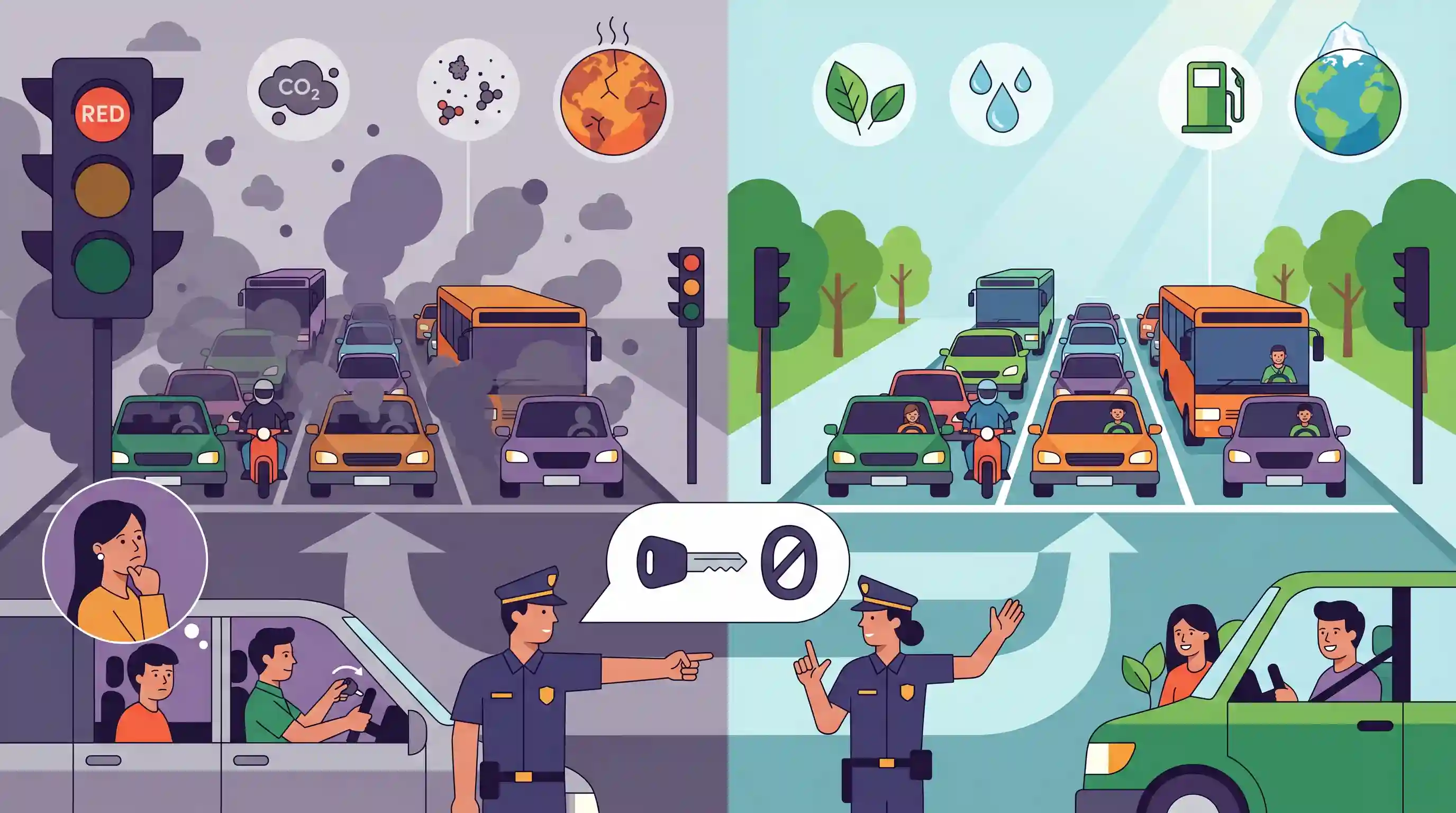
The Bengaluru Traffic Police have initiated an awareness campaign at traffic signals to educate commuters on the importance of switching off vehicle engines while waiting. The campaign seeks to foster behavioral change among motorists to conserve fuel, reduce vehicular emissions, and mitigate urban air pollution and global warming.
Key Points
- Bengaluru Traffic Police have launched an awareness campaign at traffic signals to urge motorists to turn off engines while waiting.
- The initiative aims to curb vehicular emissions, which are a major contributor to urban air pollution and global warming.
- Commuters are being educated on the economic and environmental costs of fuel wastage caused by vehicle idling.
- Currently operational at the Rajarajeshwari Nagar signal, the campaign exemplifies the use of administrative authority and police presence to drive civic education and sustainable behavioral change.
Important Terms
Urban Air Pollution

Contamination of the atmosphere in cities by harmful substances like Particulate Matter (PM) and Nitrogen Oxides, primarily from vehicles, industries, and construction.
UPSC context
GS Paper 3: Environment. Essential for understanding urban degradation and health impacts in Indian metropolitan cities.
Vehicular Emissions
Harmful gases and particles (like CO2, NOx, and PM2.5) released into the air from vehicle exhausts due to fuel combustion.
UPSC context
GS Paper 3: Environment/Pollution. Critical for discussing BS-VI norms, electric vehicles, and urban smog mitigation.
Behavioral Change
The process of altering individual habits and societal norms—such as switching off engines at traffic signals—through persuasion, awareness, and social influence.
UPSC context
GS Paper 4: Ethics. Relevant to persuasion, social influence, and non-punitive governance strategies (Nudge Theory).
Global Warming
The long-term increase in Earth’s average surface temperature caused by the accumulation of greenhouse gases like carbon dioxide and methane in the atmosphere.
UPSC context
GS Paper 3: Environment/Climate Change. Foundational concept for international climate negotiations and sustainable development goals.
Energy Conservation
The effort made to reduce energy consumption by using less energy or eliminating waste, such as idling engines, to ensure resource sustainability.
UPSC context
GS Paper 3: Economy/Infrastructure. Key for resource efficiency and reducing India's dependence on fuel imports.
Bengaluru Traffic Police
A specialized unit of the Karnataka State Police responsible for traffic regulation, enforcement of road safety laws, and public awareness in Bengaluru.
UPSC context
GS Paper 2: Governance. Illustrates the role of executive agencies in implementing environmental and civic awareness campaigns.
Prelims Trap
Idling engine campaigns like 'Red Light On, Gaadi Off' are statutory mandates penalized under the Motor Vehicles Act.
These are behavioral nudge campaigns, not legally enforceable mandates with fines. They rely on persuasion and civic sense, aligning with Mission LiFE principles.
Static Concepts Connected
What are the primary criteria pollutants emitted by vehicular exhaust?
- Nitrogen Oxides (NOx): Major contributor to ground-level ozone and photochemical smog; formed at high engine temperatures during combustion.
- Carbon Monoxide (CO): Product of incomplete combustion; highly toxic as it binds to hemoglobin and reduces the blood's oxygen-carrying capacity.
- Particulate Matter (PM): Fine particles (PM2.5 and PM10), particularly high in diesel vehicle exhaust, which penetrate deep into the lungs.
How does 'Nudge Theory' apply to environmental public policy?
- Behavioral Economics: Influencing public choices through positive reinforcement and indirect suggestions rather than forced compliance, bans, or heavy taxation.
- Mission LiFE: India's global initiative utilizing nudges to replace a 'use-and-dispose' economy with a circular, pro-planet behavioral model at the citizen level.
- Administrative Role: Shifting the role of civil servants and police from mere punitive regulators to enablers of sustainable civic behavior.
Cross-Topic Patterns
Mission LiFE + Urban Governance
Local traffic campaigns operationalize Mission LiFE's goal of fostering pro-planet behaviors at the individual level through administrative nudges rather than statutory penalties.
Photochemical Smog + Vehicular Idling
Idling engines release high levels of NOx and VOCs, which react in the presence of sunlight to form ground-level ozone and urban photochemical smog.

Expect GS4 case studies or GS2 governance questions on using Nudge Theory and Mission LiFE to tackle urban air pollution in 2026.
Linked PYQs · 2
Linked PYQs · 2
- 2023MainsGS3
The adoption of electric vehicles is rapidly growing worldwide. How do electric vehicles contribute to reducing carbon emissions and what are the key benefits they offer compared to traditional combustion engine vehicles?
- 2025MainsGS4
To achieve holistic development goal, a civil servant acts as an enabler and active facilitator of growth rather than a regulator. What specific measures will you suggest to achieve this goal ?
