Fiscal Implications of Pre Poll Welfare Spending by States
Source:Indian Express ↗
Why It Matters
The tension between electoral populism and fiscal prudence is a core UPSC theme across both GS2 (governance and electoral reforms) and GS3 (economy and state finances). Aspirants must understand the implications of off-budget borrowings, the crowding out of capital expenditure, and the regulatory roles of the RBI, Finance Commission, and Election Commission.
Summary
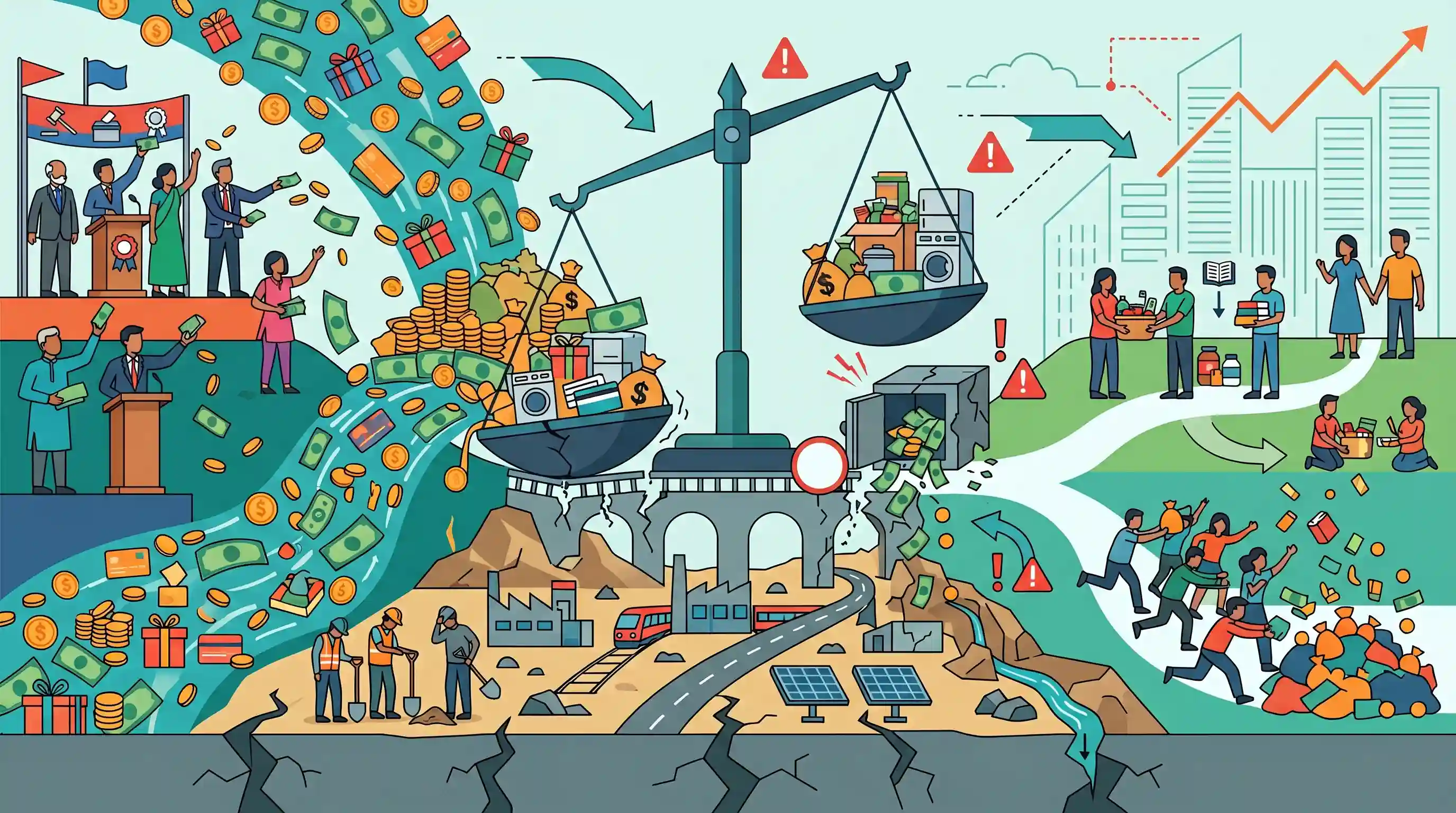
The article underscores the rising trend of competitive populism, where poll-bound states are splurging over Rs 37,000 crore on newly announced welfare schemes and direct cash transfers ahead of elections. While aimed at securing electoral gains and providing short-term relief, this massive surge in revenue expenditure poses severe risks to state exchequers. It strains the fiscal deficit, threatens adherence to the Fiscal Responsibility and Budget Management (FRBM) Act, and routinely diverts crucial funds away from capital expenditure and long-term asset creation. This dynamic has sparked a broader debate on distinguishing essential welfare for the vulnerable from unsustainable political 'freebies' that compromise India's macroeconomic stability.
Key Points
- Poll-bound states have announced major welfare schemes and direct cash transfers (often debated as 'freebies') ahead of elections, cumulatively costing over Rs 37,000 crore.
- Such aggressive pre-poll spending significantly strains state finances, leading to expanding fiscal and revenue deficits that risk breaching FRBM Act targets.
- A high proportion of revenue expenditure directed towards populist measures often crowds out capital expenditure, negatively impacting long-term infrastructure creation and economic growth.
- The trend of competitive populism highlights the urgent need to balance vulnerable section welfare with macroeconomic stability and prudent public expenditure management.
Important Terms
Fiscal Responsibility and Budget Management (FRBM) Act

A 2003 law mandating the Union and State governments to institutionalize fiscal discipline, reduce deficits, and ensure long-term macroeconomic stability through transparent public financial management.
UPSC context
GS Paper III (Economy); tests knowledge of fiscal consolidation, deficit targets, and the sustainability of government debt.
Finance Commission
A constitutional body (Article 280) that recommends the distribution of tax revenues between the Union and States and assesses the fiscal health and debt levels of state governments.
UPSC context
GS Paper II & III; core to 'Fiscal Federalism' and the equitable devolution of resources.
Reserve Bank of India (RBI)
India's central bank that regulates the banking system and monitors macroeconomic stability, frequently warning states about fiscal risks from rising subsidies through its 'State Finances' reports.
UPSC context
GS Paper III (Economy); tests understanding of monetary-fiscal policy coordination and macroeconomic risk assessment.
Election Commission of India (ECI)
A constitutional body (Article 324) responsible for conducting free and fair elections; it regulates political manifestos and 'freebies' under the Model Code of Conduct to ensure transparency.
UPSC context
GS Paper II (Polity/Governance); tests regulatory oversight of electoral practices and 'competitive populism'.
Competitive Populism
A political dynamic where parties compete for electoral support by promising increasingly generous subsidies or cash transfers, often threatening fiscal discipline and long-term economic health.
UPSC context
GS Paper II & III; tests the debate on 'Freebies vs. Welfare' and its impact on the exchequer.
Capital Expenditure (Capex)
Government spending used to create long-term assets like infrastructure and machinery, which boosts economic productivity, often squeezed by high revenue expenditure on poll-bound welfare schemes.
UPSC context
GS Paper III (Budgeting); tests the ability to distinguish between consumption-led spending and growth-oriented investment.
Prelims Trap
Promises of freebies in election manifestos amount to a 'corrupt practice' under the Representation of the People Act, 1951.
The Supreme Court ruled in 2013 (S. Subramaniam Balaji case) that manifesto promises are not 'corrupt practices' as they align with DPSPs.
Static Concepts Connected
How do the fiscal multipliers of capital and revenue expenditure differ?
- Capital Multiplier: CapEx has a high multiplier (approx. 2.45) because it creates long-term physical assets, employment, and boosts future productive capacity.
- Revenue Multiplier: RevEx has a lower multiplier (approx. 0.99) as it primarily fuels short-term consumption without yielding durable economic assets.
- Crowding Out: Massive pre-poll revenue spending 'crowds out' capital investments, dampening overall long-term economic growth.
How does the Constitution regulate the borrowing powers of State governments?
- Article 293(3): States cannot raise new market loans without the Centre's consent if they have any outstanding debt owed to the Union government.
- Net Borrowing Ceiling: The Centre uses this constitutional provision to set limits, linking borrowing approvals to FRBM targets (typically 3% of GSDP) to enforce fiscal discipline.
Cross-Topic Patterns
DPSP vs. Macroeconomic Stability
The freebie debate pits Article 38 and the provision of merit goods against the fiscal prudence mandated by the FRBM Act, raising ethical questions of inter-generational debt equity.
Finance Commission and Fiscal Prudence
The 16th Finance Commission is expected to leverage performance-based conditional grants to disincentivize states' competitive populism and non-merit subsidies, particularly in the financially strained power sector.

A 2026 Prelims question will likely combine Article 293 borrowing limits, FRBM targets, and RPA 'corrupt practices' into one multi-statement.
Linked PYQs · 5
Linked PYQs · 5
- 2025MainsGS3
Explain how the Fiscal Health Index (FHI) can be used as a tool for assessing the fiscal performance of states in India. In what way would it encourage the states to adopt prudent and sustainable fiscal policies?
- 2023MainsGS2
“Development and welfare schemes for the vulnerable, by its nature, are discriminatory in approach.” Do you agree? Give reasons for your answer.
- 2022MainsGS2
Besides the welfare schemes, India needs deft management of inflation and unemployment to serve the poor and the underprivileged sections of the society. Discuss.
- 2019MainsGS3
The public expenditure management is a challenge to the Government of India in the context of budget making during the post-liberalization period. Clarify it.
- 2006PrelimsGS1
Which one of the following statements is correct? Fiscal Responsibility and Budget Management Act (FRBMA) concerns
