Political Shifts Delay Mumbai Water Security and Infrastructure Plans
Source:Indian Express ↗
Why It Matters
The article perfectly illustrates the intersection of urban infrastructure planning, political continuity, and environmental conservation. It provides concrete examples for GS-3 answers on water security (desalination vs. dams) and the environmental costs of large projects, as well as GS-2 answers regarding the impact of political instability on policy continuity and governance.
Summary
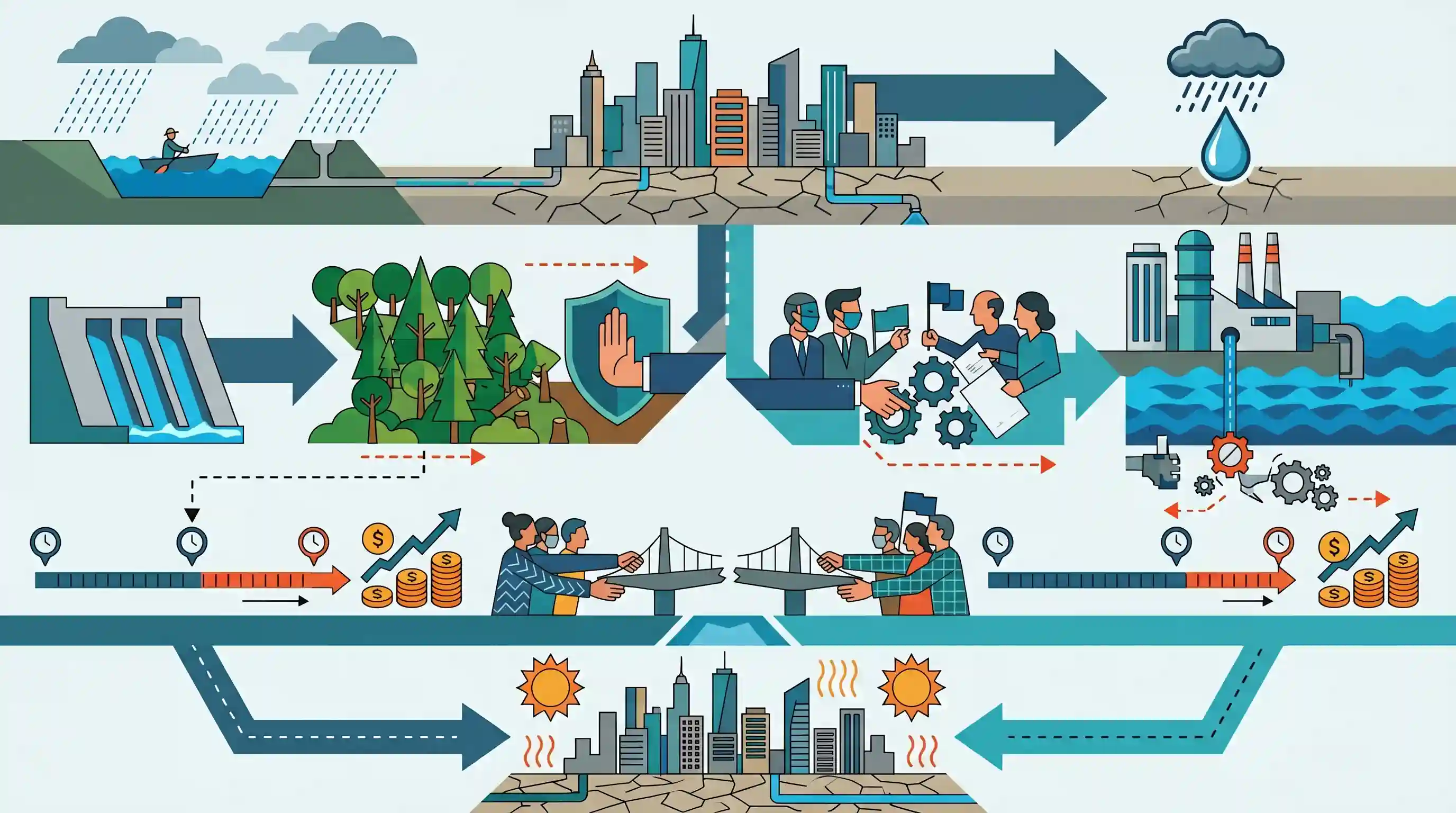
Mumbai's pressing water scarcity is a direct consequence of long delays in two major infrastructure projects—the Gargai Dam and a proposed desalination plant—which together would have added 640 MLD of water supply. The delays stem largely from political transitions and competing priorities between the Mahayuti and Maha Vikas Aghadi (MVA) alliances. While the Gargai Dam was halted due to environmental concerns involving extensive forest clearance, the desalination project suffered from political reviews and technical challenges in the tendering process. Both critical projects are now slowly progressing, but with significantly extended timelines (2029-2030) and escalated costs, leaving the city vulnerable to climate-induced water stress and heavy reliance on monsoon-fed reservoirs.
Key Points
- Mumbai is facing severe water shortage, exacerbated by delayed execution of two major projects—the Gargai Dam and a desalination plant—that were supposed to add 640 MLD to the city's supply.
- The Gargai Dam project (440 MLD) was delayed when the MVA government stalled it due to the environmental impact of diverting 845 hectares of forest and cutting 3 lakh trees; it has now been revived with an estimated completion in 2030 and a budget of Rs 3,000 crore.
- The desalination plant (200 MLD), proposed by the MVA, faced slowdowns under the current Mahayuti government and also suffered from technical complexities and tender delays. It is now projected for completion in 2029 at an escalated cost of Rs 3,200 crore.
- Frequent political shifts between different alliances in Maharashtra have resulted in changing priorities, shifting project support, and considerable delays and cost escalations in crucial urban infrastructure.
Important Terms
Gargai Dam Project

A proposed dam on the Gargai river in Palghar, Maharashtra, designed to augment Mumbai's water supply by 440 million liters per day (MLD) through a new reservoir.
UPSC context
GS Paper 3 (Infrastructure); illustrates the trade-off between urban development and environmental conservation (forest clearance in Tansa Wildlife Sanctuary).
Desalination Plant project
An infrastructure project in Manori, Mumbai, utilizing reverse osmosis to convert seawater into potable water, providing a climate-resilient source independent of monsoon-fed lakes.
UPSC context
GS Paper 3 (Science & Tech/Infrastructure); representative of innovative, drought-proof water resource management for water-stressed megacities.
Brihanmumbai Municipal Corporation (BMC)
India’s wealthiest municipal body, established under the Mumbai Municipal Corporation Act, 1888, responsible for the city’s civic infrastructure, including water treatment and distribution.
UPSC context
GS Paper 2 (Polity/Urban Governance); tests knowledge of the powers and challenges of Urban Local Bodies (ULBs) in utility management.
MLD (Million Liters per Day)
A standard volumetric unit used in India to measure the capacity of water supply systems, treatment plants, and the daily water demand of urban populations.
UPSC context
GS Paper 3 (Infrastructure); essential technical metric for quantifying urban utility performance and national water policy targets.
Governance & Policy Continuity
The principle that development projects should proceed consistently across different administrations to prevent cost escalations, technical delays, and stalled public utility services.
UPSC context
GS Paper 2 (Governance); examines how political transitions and shifting priorities affect long-term state developmental goals.
Prelims Trap
Desalination plants offer an environmentally neutral alternative to dams by avoiding deforestation.
While they avoid terrestrial deforestation, desalination plants discharge hypersaline brine that threatens marine ecosystems and are highly energy-intensive.
Static Concepts Connected
What is the constitutional distribution of powers regarding water management?
- State List: Entry 17 places water supply, irrigation, canals, drainage, and water storage under the jurisdiction of the State.
- Union List: Entry 56 grants the Union power to regulate and develop inter-state rivers and river valleys.
- Local Governance: The 12th Schedule (74th Amendment Act) delegates urban domestic and industrial water supply to Municipalities.
What are the primary ecological concerns with Reverse Osmosis desalination?
- Brine discharge: Extremely concentrated salt waste (brine) lowers dissolved oxygen and severely harms coastal benthic and marine ecosystems.
- Energy intensity: RO requires massive electricity, leading to a high carbon footprint if powered by conventional fossil fuels.
- Marine impingement: Intake pipes pull in and kill plankton, eggs, and small fish, disrupting local coastal food webs.
Cross-Topic Patterns
Policy Continuity & Cost Overruns
Political transitions halting large-scale urban infrastructure perfectly illustrate GS-3 themes on investment models, where regulatory cholesterol and policy paralysis cause massive cost escalations.
Climate-proofing urban utilities
Diversifying away from monsoon-dependent dams towards desalination connects to GS-1 urbanization and GS-3 disaster resilience in coastal megacities facing erratic monsoons.

Expect a GS-3 Mains question evaluating the ecological vs. economic trade-offs of desalination plants for coastal megacity water security.
Linked PYQs · 5
Linked PYQs · 5
- 2024MainsGS3
The world is facing an acute shortage of clean and safe freshwater. What are the alternative technologies which can solve this crisis? Briefly discuss any three such technologies citing their key merits and demerits.
- 2020MainsGS3
Suggest measures to improve water storage and irrigation system to make its judicious use under depleting scenario.
- 2014MainsGS3
Environmental Impact Assessment studies are increasingly undertaken before a project is cleared by the Government. Discuss the environmental impacts of coal-fired thermal plants located at coal pitheads.
- 2024MainsGS3
What role do environmental NGOs and activists play in influencing Environmental Impact Assessment (EIA) outcomes for major projects in India? Cite four examples with all important details.
- 2019MainsGS3
Define the concept of carrying capacity of an ecosystem as relevant to an environment. Explain how understanding this concept is vital while planning for sustainable development of a region.
