Himachal Agriculture University faces vacancy crisis and pending funds
Source:uniindia ↗
Why It Matters
This highlights the real-world implications of Centre-State financial relations, specifically how the delayed release of state-matching funds can stall centrally sanctioned educational infrastructure projects. It is relevant for HPAS questions on governance issues and educational development within Himachal Pradesh.
Summary
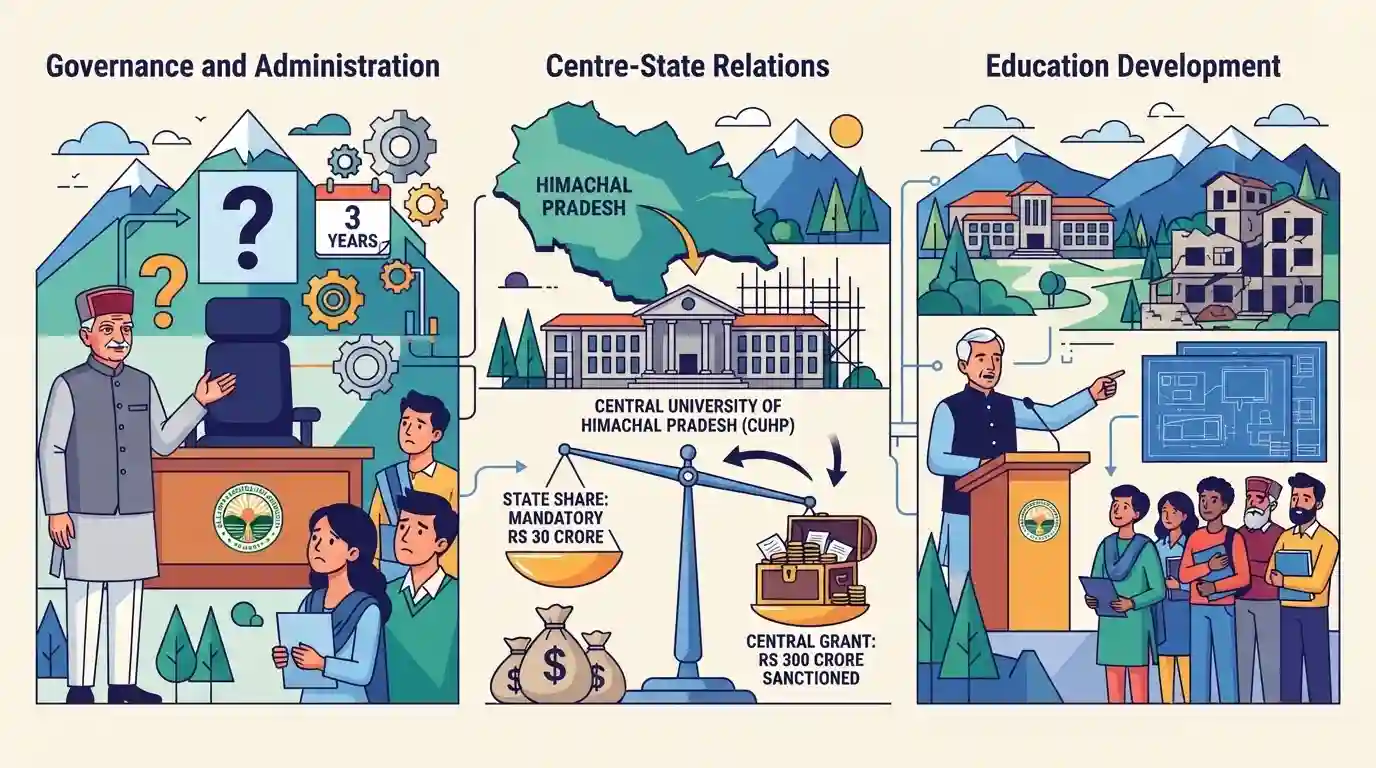
Former Himachal Pradesh Chief Minister Shanta Kumar has called on Chief Minister Sukhvinder Singh Sukhu to urgently address governance and infrastructure deficits in the state's higher education sector. He highlighted that the Agriculture University in Palampur has been functioning without a Vice-Chancellor for three years. Additionally, he urged the state government to release its mandatory Rs 30 crore contribution required to construct a permanent campus for the Central University of Himachal Pradesh (CUHP) in Dharamshala. This state contribution is necessary to secure a Rs 300 crore grant already sanctioned by the Central Government.
Key Points
- Former Himachal Pradesh Chief Minister Shanta Kumar urged the current state government to appoint a Vice-Chancellor for the Agriculture University at Palampur, a post vacant for three years.
- He also requested the state government to release its matching contribution of Rs 30 crore for the Central University of Himachal Pradesh (CUHP).
- Releasing this state share is a prerequisite to unlocking Rs 300 crore sanctioned by the Central Government for constructing CUHP's permanent campus in Dharamshala.
- The delay in administrative appointments and fund disbursement is adversely impacting the higher education infrastructure in the Kangra region.
Important Terms
Agriculture University Palampur

Officially CSK Himachal Pradesh Krishi Vishvavidyalaya, it is a key state agricultural institution. It has lacked a regular Vice-Chancellor for three years, highlighting severe administrative delays in state higher education.
UPSC context
GS Paper 2 (Education/Governance). Tests knowledge of state university administration and the impact of leadership vacuums.
Central University of Himachal Pradesh (CUHP)
An institution established under the Central Universities Act, 2009. Its permanent campus construction in Dharamshala is currently stalled because the state government has delayed releasing its mandatory ₹30 crore financial share.
UPSC context
GS Paper 2 (Education). Exemplifies Centre-State funding bottlenecks and infrastructure deficits in centrally funded higher education institutions.
Mandatory State Contribution
The required financial or resource share a state must provide—such as funds for land acquisition—to unlock larger, pre-sanctioned Central Government grants for joint institutional or infrastructure development projects.
UPSC context
GS Paper 2 & 3 (Centre-State Relations). Tests understanding of fiscal federalism, matching grants, and developmental delays.
Vice-Chancellor (VC) Appointment
The process of selecting a university's principal executive officer. Prolonged vacancies and ad-hoc arrangements in state universities reflect administrative dysfunction and degrade the quality of higher education governance.
UPSC context
GS Paper 2 (Governance). Crucial for questions on institutional autonomy, UGC regulations, and higher education reforms.
Prelims Trap
The elected State Government directly appoints the Vice-Chancellor of a State Agricultural University.
The Governor acts as the ex-officio Chancellor of state universities and holds the statutory authority to appoint the Vice-Chancellor, not the Chief Minister or state cabinet.
Static Concepts Connected
Who appoints the Vice-Chancellors in Central and State universities?
- Central Universities: The President of India acts as the Visitor and holds the power to appoint the VC under the respective parliamentary acts (e.g., Central Universities Act).
- State Universities: The Governor typically serves as the ex-officio Chancellor and appoints the VC, governed by the respective State University Act.
- Federal Friction: Conflicts between mandatory UGC regulations (Centre) and State Acts frequently lead to legal and administrative deadlocks between the Governor and the Chief Minister.
How are Union grants to states structured under the Constitution?
- Statutory Grants: Under Article 275, these are provided from the Consolidated Fund of India to states in need, based on Finance Commission recommendations.
- Discretionary Grants: Under Article 282, the Union uses these for specific public purposes, such as Centrally Sponsored Schemes (CSS) which often require a matching state contribution.
- Special Category Ratio: Himalayan and North-Eastern states enjoy a favourable 90:10 (Centre:State) funding ratio for core CSS, compared to 60:40 for general category states.
Cross-Topic Patterns
Governor vs. State Govt on VCs
Friction over VC appointments in state universities frequently tests the boundaries between the Governor's statutory Chancellor role and the elected state government's agenda, seen recently in Kerala, TN, and HP.
CSS matching grant bottlenecks
Delays in states releasing their matching shares (10% or 40%) stall large central funds, highlighting structural constraints in fiscal federalism and Centrally Sponsored Scheme implementation.

Expect a Prelims statement comparing the President's role as Visitor of Central Universities vs the Governor's role as State Chancellor.
Linked PYQs · 1
Linked PYQs · 1
- 2016HPAS_PRELIMSGS1
Which of the following statements is correct in reference to the Finance Commission of India ?
