Demographic Change Committee and Secular Policy Approach
Source:The Hindu ↗
Why It Matters
This topic is crucial for understanding the intersection of demography, national security, and secularism in India. It highlights how population data and demographic committees can influence social harmony and public policy, directly relevant to GS-1 (Population Issues) and GS-3 (Border Security).
Summary
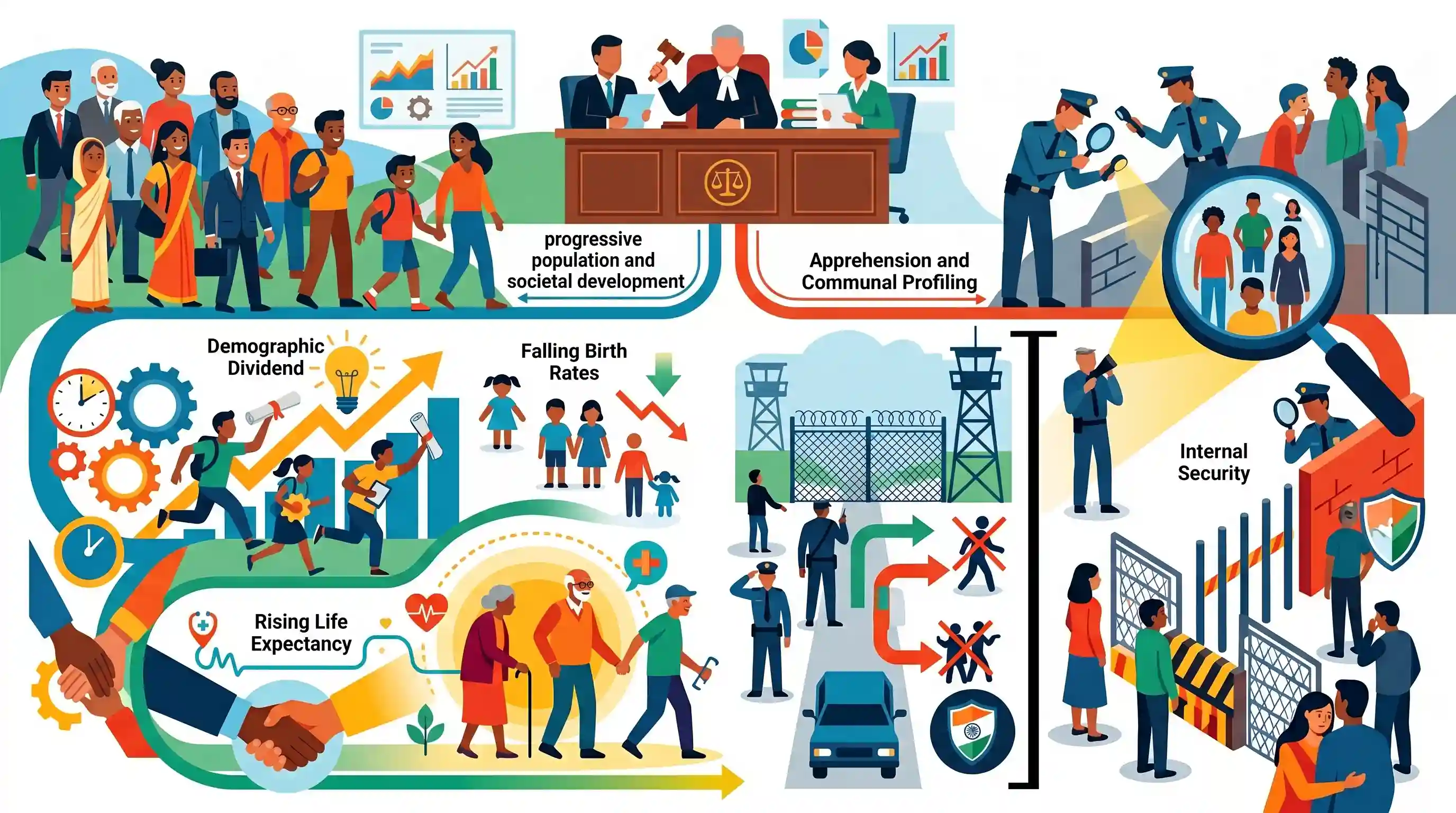
The Union government's recent constitution of a High-Level Committee on Demographic Change, chaired by Justice P.P. Naolekar, has raised apprehensions about its intent. While ostensibly formed to evaluate population shifts, cross-border infiltration, and related challenges to public service delivery, critics view its mandate as a potential tool for the communal profiling of minorities, echoing concerns raised by the Citizenship (Amendment) Act. The editorial argues that India’s primary demographic challenges—such as maximizing the demographic dividend, dealing with falling birth rates, and managing rising life expectancy—require scientific and secular policy approaches. Conflating genuine national security concerns regarding illegal migration with the religious composition of the population risks stoking polarization rather than fostering effective population management.
Key Points
- A High-Level Committee on Demographic Change has been formed under retired Supreme Court judge Justice P.P. Naolekar to study 'abnormal' population shifts and cross-border infiltration.
- Critics argue the committee's mandate may be used for communal profiling, particularly targeting the Muslim minority, rather than addressing genuine demographic challenges.
- India's actual demographic challenges are defined by rising life expectancy, falling birth rates, and the need to capitalize on the demographic dividend.
- The editorial advocates for approaching migration, illegal immigration, and population management through secular, economic, and security lenses rather than using demography as a polarizing tool.
Important Terms
High-Level Committee on Demographic Change

A Ministry of Home Affairs panel tasked with studying population shifts and illegal immigration to recommend policy solutions for national security and public service delivery.
UPSC context
Relevant for GS Paper 1 (Population Issues) and GS Paper 2 (Governance and Government Policies).
Justice P.P. Naolekar
A retired Supreme Court Judge and former Lokayukta of Madhya Pradesh, appointed to chair the High-Level Committee investigating "unnatural" demographic changes in India.
UPSC context
Significant for GS Paper 2 (Judiciary and Committees) and GS Paper 1 (Social Issues).
Citizenship (Amendment) Act (CAA)
Legislation providing an expedited path to Indian citizenship for persecuted non-Muslim minorities (Hindus, Sikhs, Buddhists, Jains, Parsis, Christians) from Afghanistan, Bangladesh, and Pakistan.
UPSC context
Crucial for GS Paper 2 (Constitution, Polity, and Citizenship) and GS Paper 3 (Internal Security).
Demographic Dividend
The economic growth potential resulting from shifts in a population's age structure, specifically when the working-age population is larger than the dependent population.
UPSC context
Key topic for GS Paper 1 (Population) and GS Paper 3 (Economic Development).
Cross-border Infiltration
The unauthorized entry of individuals or groups across international borders, often cited as a challenge to national sovereignty and social structure.
UPSC context
Essential for GS Paper 3 (Internal Security and Border Management) and GS Paper 2 (International Relations).
Prelims Trap
Rights under Article 14 and 21 are exclusive to Indian citizens, excluding illegal migrants from constitutional protection.
Articles 14 and 21 apply to all 'persons', including foreigners and undocumented migrants. Only Articles 15, 16, 19, 29, and 30 are exclusively reserved for Indian citizens.
Static Concepts Connected
What are the key markers of India's population stabilization and demographic dividend?
- Replacement Level Fertility: A Total Fertility Rate (TFR) of 2.1 is the rate at which a population exactly replaces itself from one generation to the next.
- Current TFR Trends: India's TFR has currently dropped below replacement level to 2.0 (as per NFHS-5), indicating a natural progression toward population stabilization.
- Demographic Dividend: The window where the working-age population outnumbers dependents. For India, this economic opportunity is finite, projected to last only until 2055-56.
Which Fundamental Rights differentiate between Indian Citizens and Foreigners?
- Exclusive to Citizens: Articles 15, 16, 19, 29, and 30 are strictly limited to Indian citizens.
- Available to All: Articles 14, 20, 21, 21A, 22, 23, 24, 25, 26, 27, and 28 are available to all 'persons' within Indian territory, including illegal immigrants.
- Deportation Limits: While Article 21 protects their life and liberty, the Indian state retains sovereign power to identify and deport undocumented migrants through established due process.
Cross-Topic Patterns
Border Management & Demographic Shifts
Porous borders with Bangladesh and Myanmar linking illegal migration to localized demographic changes frequently appear in GS-3 Internal Security alongside GS-1 Society questions on population.
CAA and Rights of Non-Citizens
The intersection of illegal migration, demographic profiling, and the scope of 'persons' under Article 14 and 21 is a recurring GS-2 Constitutional framework theme.

Expect a 2026 Prelims multi-statement question linking India's sub-2.1 TFR, demographic dividend window, and border security committees.
Linked PYQs · 3
Linked PYQs · 3
- 2024MainsGS1
What is the concept of a 'demographic winter'? Is the world moving towards such a situation? Elaborate.
- 2014MainsGS3
How does illegal transborder migration pose a threat to India's security? Discuss the strategies to curb this, bringing out the factors which give impetus to such migration.
- 2021MainsGS1
Discuss the main objectives of Population Education and point out the measures to achieve them in India in detail.
