Geopolitics overriding economic globalization in current world order
Source:The Hindu ↗
Why It Matters
The article provides a direct articulation of India's strategic worldview by its External Affairs Minister. It is highly relevant for GS2 Mains questions discussing the retreat of globalization, the shifting world order (US-China rivalry), and India's rationale for pursuing self-reliance (Atmanirbhar Bharat) as a geopolitical hedge.
Summary
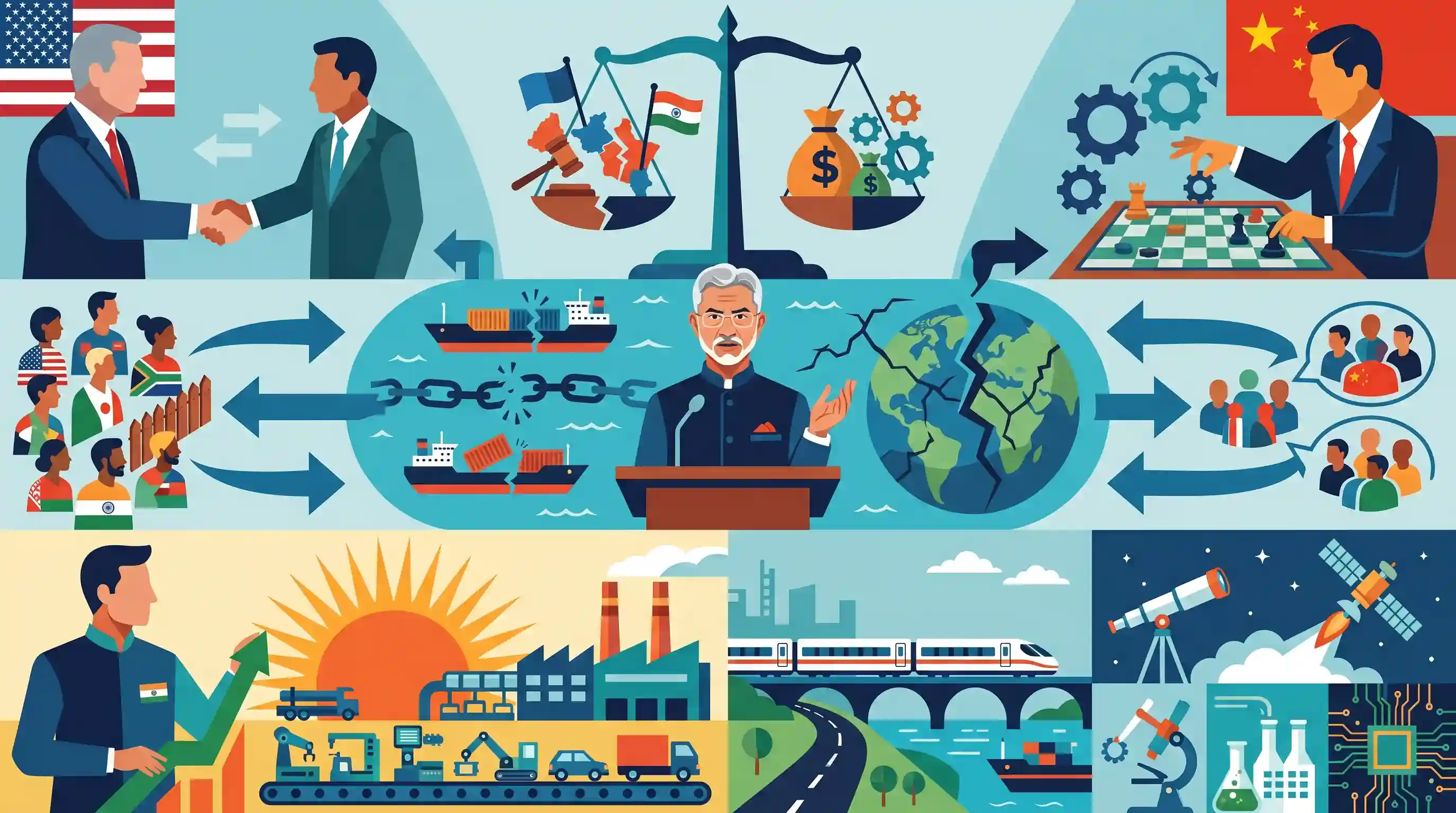
External Affairs Minister S. Jaishankar recently emphasized that in the contemporary global landscape, political calculations are increasingly overriding economic considerations. Addressing an audience at IIM-Calcutta, he highlighted how the traditional era of globalization is being disrupted by supply chain insecurities and global fragmentation. Major powers are adapting, with the US preferring bilateral engagements and China playing by its own rules. Consequently, nations are forced to hedge against geopolitical contingencies. In response to this shifting world order, India is aggressively pursuing self-reliance, aiming to establish itself as a robust manufacturing base while advancing its infrastructure and scientific capabilities.
Key Points
- Geopolitical and strategic considerations are increasingly overriding economic rationale in the current global order.
- Major powers are shifting their strategies, with the US favoring bilateral one-on-one engagements and China operating by its own rules.
- Traditional globalization is facing significant pressures due to supply chain insecurities and global fragmentation, prompting nations to hedge against future contingencies.
- To navigate these challenges, India is actively pursuing self-reliance by bolstering its manufacturing base, infrastructure, and scientific capabilities.
Important Terms
Atmanirbhar Bharat

A policy framework launched in 2020 to make India self-reliant by strengthening domestic manufacturing and reducing import dependency across five pillars: Economy, Infrastructure, System, Demography, and Demand.
UPSC context
GS Paper 3 (Economic Development); tests understanding of industrial self-sufficiency and India's response to global supply chain disruptions.
Strategic Autonomy
The ability of a state to make sovereign foreign policy and defense decisions independent of external pressures, prioritizing national interest over rigid bloc alignments.
UPSC context
GS Paper 2 (International Relations); core to Indian diplomacy, testing the transition from Non-Alignment to interest-based multi-alignment.
De-globalization
The trend of diminishing global interdependence, marked by rising protectionism, reshoring of industries, and a shift toward national economic security over global integration.
UPSC context
GS Paper 2 and 3; tests analysis of shifting global orders and their impact on India’s trade and economic growth.
Supply Chain Resilience Initiative (SCRI)
A trilateral initiative by India, Japan, and Australia aimed at diversifying supply sources and reducing dependence on single nations to ensure economic security during crises.
UPSC context
GS Paper 2 (Global Groupings); tests knowledge of Indo-Pacific dynamics and strategic economic partnerships.
Multi-alignment
A pragmatic foreign policy approach where a nation engages with multiple, often competing, major powers simultaneously to maximize strategic interests without joining exclusive blocs.
UPSC context
GS Paper 2 (International Relations); tests nuances of India's role as a "shaper" in a multipolar world.
Bilateralism
The conduct of political or economic relations between two sovereign states, often used as an alternative to multilateralism for more focused or rapid strategic outcomes.
UPSC context
GS Paper 2 (IR); tests understanding of diplomatic tools and India's specific engagements with key partners.
Prelims Trap
"Western de-risking strategies imply a complete economic decoupling and severance of trade ties with China."
De-risking focuses on reducing vulnerabilities in critical supply chains (like tech or pharma), whereas de-coupling implies complete economic severance, which isn't happening.
Static Concepts Connected
How does the WTO address trade restrictions imposed under 'national security'?
- GATT Article XXI: Allows member nations to breach standard WTO obligations if necessary to protect their essential security interests.
- Growing weaponization: Increasingly invoked by major powers to justify tariffs (e.g., steel/aluminum) and tech export controls.
- Dispute panel review: Historically seen as entirely self-judging, but recent WTO dispute panels have asserted authority to review such claims.
What is the Supply Chain Resilience Initiative (SCRI) in the Indo-Pacific?
- Founding members: A trilateral supply chain initiative formally launched by India, Japan, and Australia in 2021.
- Core objective: Aimed at reducing dependency on a single nation (China) by building diversified, resilient supply networks.
- Operational focus: Focuses on sharing best practices, enhancing FDI, and organizing buyer-seller matching events across the region.
Cross-Topic Patterns
Geopolitics driving domestic industrial policy
The shift from globalization to 'friend-shoring' connects directly to India’s PLI scheme, blending external security strategies with internal economic self-reliance.
Mineral security as the new geopolitics
'Politics trumping economics' is highly visible in critical minerals, linking India's entry into the Minerals Security Partnership (MSP) to countering China's supply-chain dominance.

2026 Mains will likely feature a question linking the 'weaponization of trade' (tariffs/sanctions) to India's push for Atmanirbhar Bharat.
Linked PYQs · 3
Linked PYQs · 3
- 2025MainsGS2
"With the waning of globalization, post-Cold War world is becoming a site of sovereign nationalism.” Elucidate.
- 2024MainsGS2
‘The West is fostering India as an alternative to reduce dependence on China's supply chain and as a strategic ally to counter China's political and economic dominance.’ Explain this statement with examples.
- 2021MainsGS2
“The USA is facing an existential threat in the form of a China, that is much more challenging than the erstwhile Soviet Union.” Explain.
