Political Polarization and Violence in Mature Democracies
Source:Indian Express ↗
Why It Matters
Provides a crucial comparative case study on how political polarization, extreme rhetoric, and social media can destabilize even mature democracies, offering important lessons for India's internal security and democratic resilience.
Summary
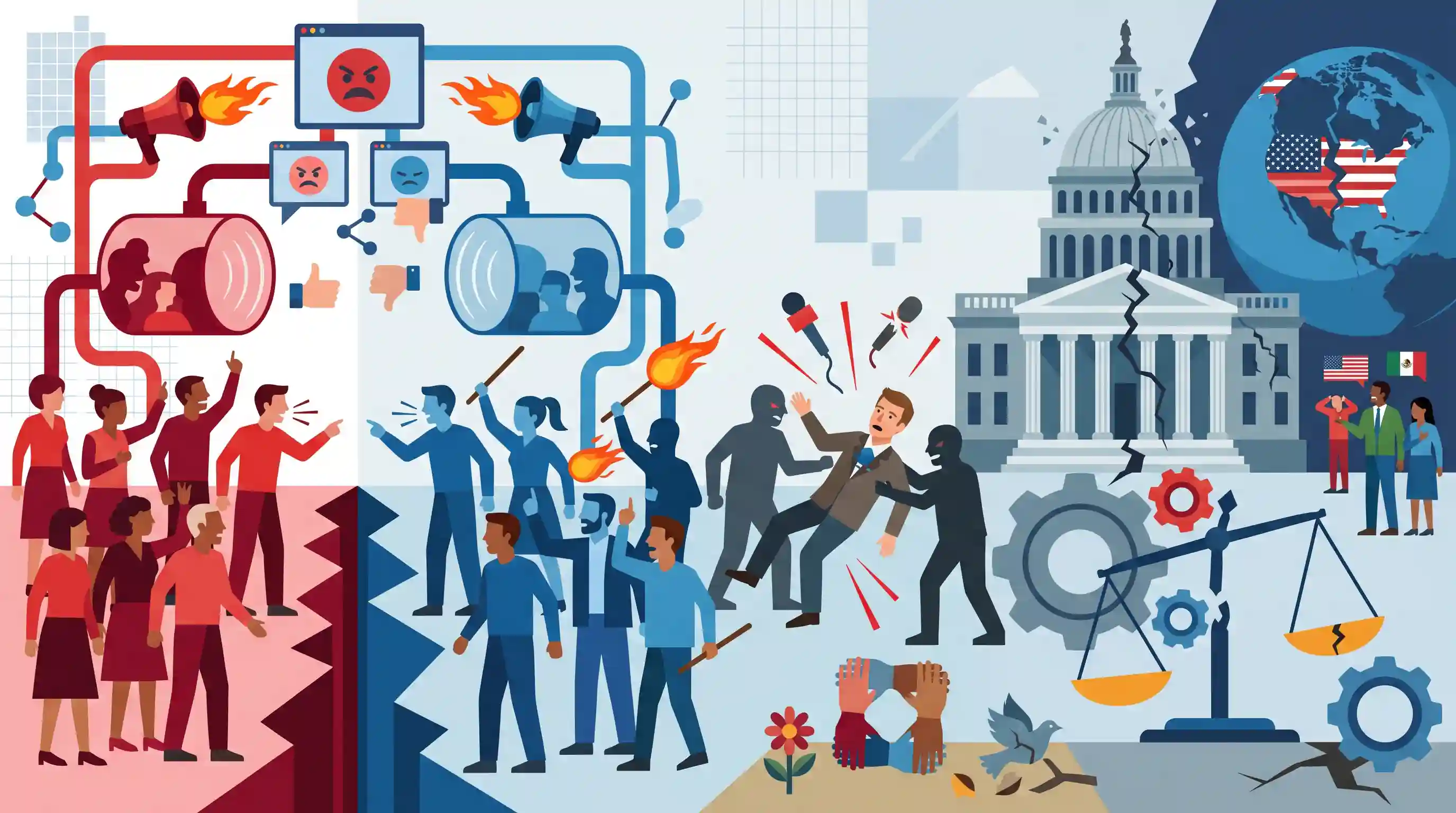
The article examines the murder of American conservative activist Charlie Kirk, analyzing it as a stark manifestation of the extreme political polarization and radicalization currently gripping the United States. It highlights how deep partisan divides, amplified by social media echo chambers and incendiary rhetoric, have progressively normalized political violence. The incident raises critical questions about the resilience of democratic institutions in mature democracies and the broader implications of internal instability in the US.
Key Points
- Charlie Kirk, a prominent US conservative activist and founder of Turning Point USA, was murdered in a shocking act of political violence.
- The incident is viewed not as an isolated anomaly but as the tragic culmination of escalating political polarization and radicalization in the US.
- Social media echo chambers and extreme political rhetoric are identified as key drivers that normalize violence and deepen partisan divides.
- The growing acceptance of political violence poses a severe threat to the stability of mature democracies and carries global implications.
Important Terms
Turning Point USA

An American conservative non-profit founded by Charlie Kirk to mobilize students for free markets and limited government on campuses.
UPSC context
GS Paper II: Role of non-state actors and interest groups in influencing democratic politics and youth mobilization.
Political Polarization
The divergence of political attitudes toward ideological extremes, often resulting in partisan hostility and the breakdown of cross-party cooperation.
UPSC context
GS Paper II: Functioning of democracies; tests understanding of factors causing institutional gridlock and social disharmony.
Political Violence
The use of force by state or non-state actors to achieve political goals, frequently triggered by extreme partisan divides.
UPSC context
GS Paper II & III: Threats to internal security and the rule of law in mature democracies.
Online Radicalization
The process where individuals adopt extremist beliefs via social media echo chambers and incendiary online rhetoric.
UPSC context
GS Paper III: Role of social media in internal security challenges and the spread of extremism.
Democratic Backsliding
The erosion of democratic norms and institutional quality, often characterized by rising authoritarianism and the weakening of the rule of law.
UPSC context
GS Paper II: Comparative politics; tests the resilience and challenges of global democratic systems.
Prelims Trap
Freedom of speech in the US allows state restrictions on hate speech similar to India's Article 19(2).
The US First Amendment provides near-absolute protection, permitting hate speech unless it incites 'imminent lawless action'. India explicitly allows 'reasonable restrictions'.
Static Concepts Connected
How does Free Speech in India differ from the US Constitution?
- US First Amendment: Protects nearly all expression, including hate speech, unless it meets the strict standard of inciting 'imminent lawless action'.
- India's Article 19(2): Subjects freedom of speech to 'reasonable restrictions' on grounds like sovereignty, security, public order, and decency.
- Hate speech laws: India actively uses penal provisions (e.g., BNS/IPC 153A) to curb hate speech; the US lacks broad federal hate speech bans.
What drives online radicalisation and algorithmic echo chambers?
- Confirmation bias: Algorithms continuously feed users content aligning with their pre-existing beliefs, effectively isolating them from dissenting perspectives.
- Outrage mechanics: Platforms prioritize highly emotional or polarizing content to maximize user watch-time, engagement, and ad revenue.
- Lone wolf extremism: Continuous online exposure to extremist rhetoric often bypasses organizational structures, prompting self-radicalized individuals to commit political violence.
Cross-Topic Patterns
Comparative Polity: Free Speech models
UPSC frequently tests GS-2 Comparative Polity. The US 'absolute free speech' model sharply contrasts with India's 'reasonable restrictions' regarding online radicalisation and hate speech.
Social Media & Internal Security
The US incident mirrors India's own challenges with algorithmic radicalisation, making this a prime GS-3 case study for tech regulation and non-state extremism.

Expect a GS-2/GS-3 mains question linking comparative free speech models to algorithmic radicalisation and democratic resilience.
Linked PYQs · 4
Linked PYQs · 4
- 2024MainsGS3
Social media and encrypting messaging services pose a serious security challenge. What measures have been adopted at various levels to address the security implications of social media? Also suggest any other remedies to address the problem.
- 2016MainsGS3
Use of Internet and social media by non-state actors for subversive activities is a major security concern. How have these been misused in the recent past? Suggest effective guidelines to curb the above threat.
- 2022MainsGS1
Are tolerance, assimilation and pluralism the key elements in the making of an Indian form of secularism? Justify your answer.
- 2020MainsGS4
Discuss the role of ethics and values in enhancing the following three major components of Comprehensive National Power (CNP) viz. human capital, soft power (culture and policies) and social harmony.
