Protests in Jammu and Kashmir Demanding Restoration of Statehood
Source:The Hindu ↗
Why It Matters
The ongoing political discourse around the abrogation of Article 370 is central to understanding Indian federalism, the transition of States to Union Territories, and internal security dynamics in Jammu and Kashmir. It highlights the tension between regional autonomy demands and the Union's integration strategies.
Summary
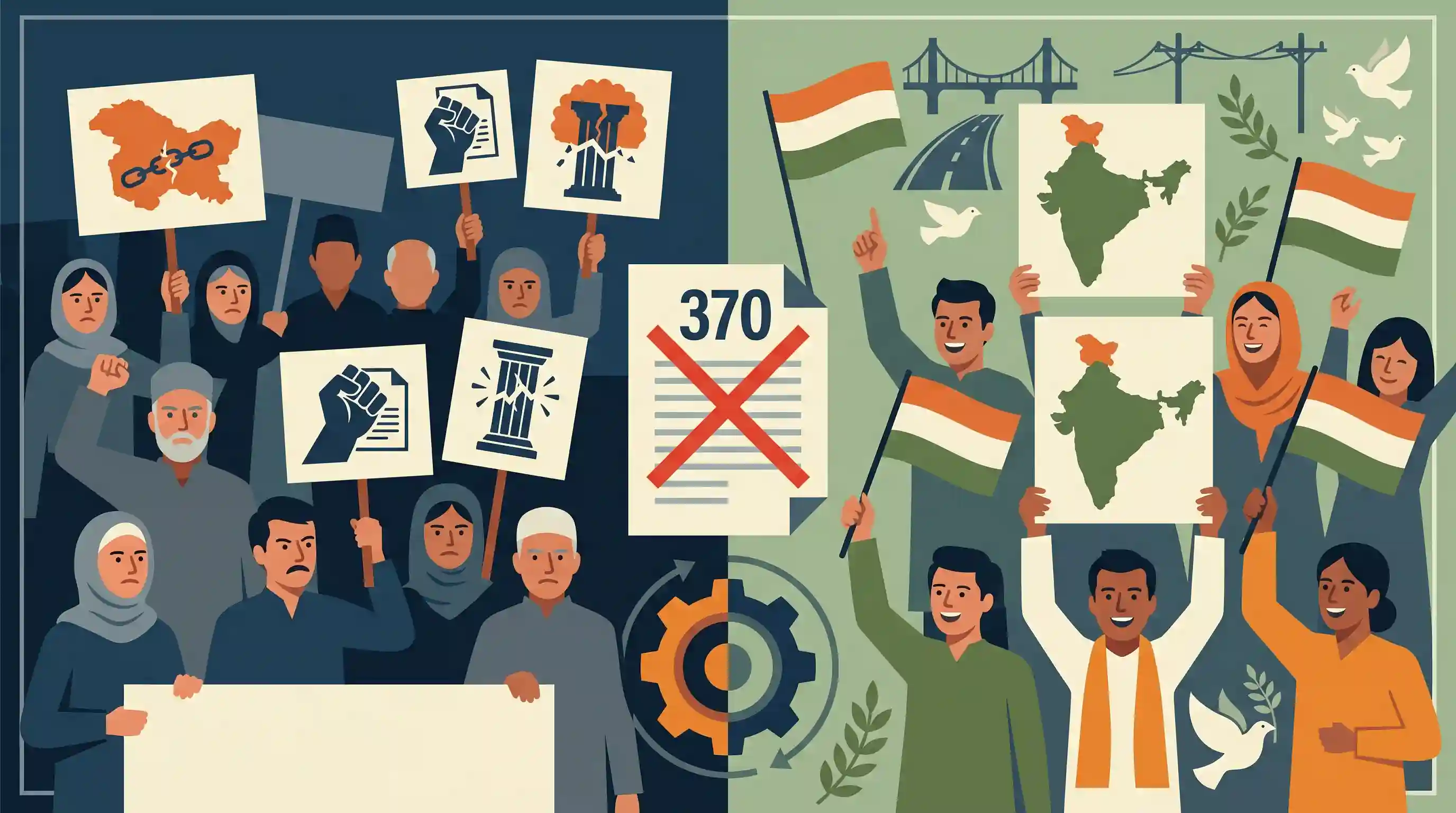
The sixth anniversary of the abrogation of Article 370 in Jammu and Kashmir was marked by contrasting political activities. Regional parties, including the National Conference, PDP, and Congress, staged protests demanding the restoration of statehood and special status, describing the 2019 move as an assault on democracy and constitutional values. They raised concerns over demographic manipulation and political disempowerment. Conversely, the BJP celebrated the day with rallies, crediting the abrogation for integrating the region constitutionally, ending violence, and bringing peace and development to marginalized communities.
Key Points
- Regional parties in Jammu and Kashmir held protests on the sixth anniversary of the abrogation of Article 370, demanding the restoration of statehood and special status.
- Opposition leaders labeled the abrogation a subversion of the Constitution, alleging demographic manipulation and electoral distortion under the Union Territory framework.
- The BJP celebrated the anniversary by holding 'Tiranga Yatras', asserting that the abrogation has brought peace, constitutional unity, and equal rights to the region.
- Opposition parties accused the administration of selective targeting, claiming they were barred from peaceful protests while the ruling party received state patronage for celebrations.
Important Terms
Article 370

A temporary constitutional provision that granted special autonomous status to Jammu and Kashmir, allowing it a separate constitution. It was effectively abrogated by the Union Government on August 5, 2019.
UPSC context
GS Paper II (Indian Constitution); tests special provisions, federalism, and the legal implications of the 2023 Supreme Court judgment.
Bharatiya Janata Party (BJP)
India's ruling party that spearheaded the 2019 abrogation of Article 370 and the bifurcation of Jammu and Kashmir into two Union Territories, emphasizing national integration, security, and development.
UPSC context
GS Paper II (Governance); relevant to Union-State relations, internal security, and the executive's role in constitutional reorganization.
National Conference (NC)
One of the oldest regional parties in Jammu and Kashmir, founded by Sheikh Abdullah. It historically championed regional autonomy and remains a primary advocate for restoring the state's special status.
UPSC context
GS Paper II (Indian Polity); relevant to the study of regional political parties and J&K’s historical integration with India.
Peoples Democratic Party (PDP)
A regional political party in Jammu and Kashmir established by Mufti Mohammad Sayeed. It advocates for "Self-Rule" and a dialogue-centered resolution to the conflict in the Kashmir region.
UPSC context
GS Paper II (Indian Polity); concerns regional dynamics, coalition politics, and the "Gupkar Declaration" seeking restoration of statehood.
CPI(M)
A national Left-wing party that opposes the 2019 reorganization of Jammu and Kashmir, arguing it violated constitutional norms of federalism and bypassed mandatory democratic consultation with the state.
UPSC context
GS Paper II (Federalism); tests the role of national parties in defending state rights and constitutional processes of reorganization.
J&K Peoples Conference (JKPC)
A regional party led by Sajad Lone that transitioned from separatist leanings to mainstream politics, focusing on regional empowerment and challenging the traditional dominance of the NC and PDP.
UPSC context
GS Paper II (Polity); explores political plurality in the Kashmir Valley and the evolution of mainstream regional voices.
Prelims Trap
The Supreme Court set a binding deadline for the Union to restore J&K’s statehood.
The Supreme Court mandated assembly elections by September 2024 but explicitly declined to set a timeline for statehood restoration, accepting the Union's assurance instead.
Static Concepts Connected
How does J&K's UT legislative framework differ from other Union Territories?
- Legislative restrictions: Like Delhi, the J&K Assembly cannot legislate on 'Police' and 'Public Order', which remain under Union control. Puducherry lacks these specific explicit constitutional restrictions.
- Executive control: The Lieutenant Governor holds exclusive direct administrative control over anti-corruption bureaus, police, and All India Services, severely limiting the elected government's executive reach.
On what grounds did the Supreme Court uphold Article 370's abrogation?
- Temporary nature: Article 370 was placed in Part XXI as a temporary, transitional provision, meant to facilitate J&K's full integration, not to grant permanent internal sovereignty.
- Presidential authority: The Court validated the President's power under Article 370(3) to unilaterally declare the provision inoperative even after the dissolution of the J&K Constituent Assembly.
Cross-Topic Patterns
Asymmetric federalism: J&K vs Article 371
While J&K lost its special autonomy, states in the Northeast and elsewhere retain targeted asymmetric protections under Article 371 to safeguard tribal rights, lands, and customary laws.
Delimitation and federal friction
J&K's post-abrogation delimitation concerns mirror the broader national anxiety among Southern states regarding the upcoming 2026 freeze-lift, fearing demographic shifts will reduce their political representation.

Expect a comparative Prelims question contrasting the legislative powers of UTs (Delhi, J&K, Puducherry) over Police, Public Order & Land.
Linked PYQs · 4
Linked PYQs · 4
- 2016MainsGS2
To what extent is Article 370 of the Indian Constitution, bearing marginal note "Temporary provision with respect to the State of Jammu and Kashmir", temporary? Discuss the future prospects of this provision in the context of Indian polity.
- 2025MainsGS2
Discuss the nature of Jammu and Kashmir Legislative Assembly after the Jammu and Kashmir Reorganization Act, 2019. Briefly describe the powers and functions of the Assembly of the Union Territory of Jammu and Kashmir.
- 2023MainsGS3
Winning of 'Hearts and Minds' in terrorism-affected areas is an essential step in restoring the trust of the population. Discuss the measures adopted by the Government in this respect as part of the conflict resolution in Jammu and Kashmir.
- 2024MainsGS2
What changes has the Union Government recently introduced in the domain of Centre-State relations ? Suggest measures to be adopted to build the trust between the Centre and the States and for strengthening federalism.
