Tribal Rights and Constitutional Safeguards in India
Source:The Hindu ↗
Why It Matters
It addresses core concerns regarding the welfare, legal protection, and empowerment of Scheduled Tribes, which is a recurring theme in both GS Paper 1 (society/tribal issues) and GS Paper 2 (vulnerable sections/polity).
Summary
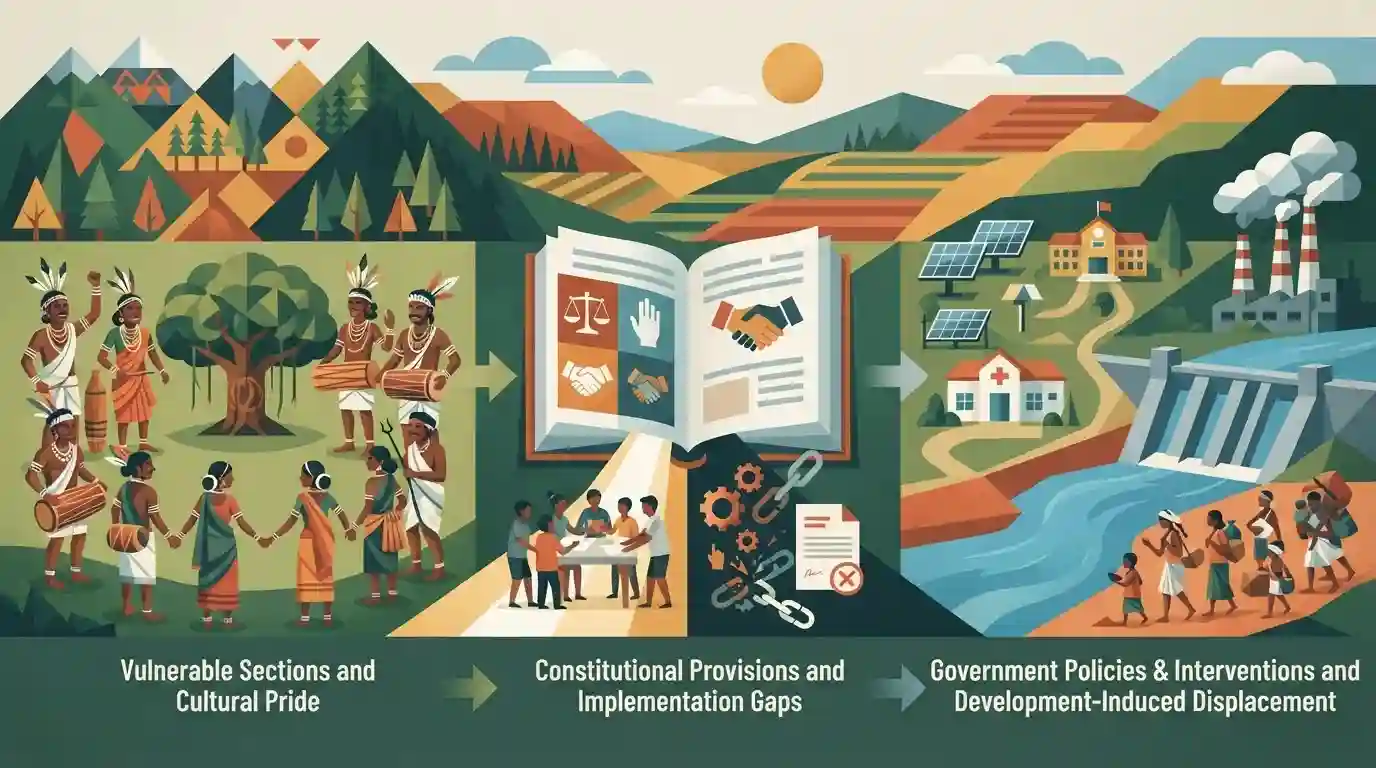
The article examines the multifaceted issues surrounding tribal rights, cultural pride, and constitutional safeguards in India, highlighting the gaps in the implementation of protective legislations like the PESA Act and Forest Rights Act while addressing the challenges of development-induced displacement.
Key Points
- Tribal rights, cultural pride, and constitutional safeguards remain critical pillars for the protection of indigenous communities in India.
- Implementation gaps in legislative protections such as PESA and the Forest Rights Act continue to challenge tribal autonomy and livelihood security.
- Balancing infrastructure development with the preservation of tribal land rights and cultural identity requires active grassroots participation and legal empowerment.
Prelims Trap
PESA extends Part IX of the Constitution to all tribal-majority regions across India.
Aspirants often assume PESA automatically applies to all tribal-majority areas in India, missing that it specifically applies only to Fifth Schedule areas across ten states, whereas Northeast states operate under the Sixth Schedule.
Static Concepts Connected
What are the key constitutional differences between the Fifth and Sixth Schedules of the Indian Constitution?
- Scope & States: Geographical scope: Fifth Schedule covers tribal areas in 10 mainland states, whereas Sixth Schedule covers tribal-majority areas in Assam, Meghalaya, Tripura, and Mizoram.
- Administrative Bodies: Administrative setup: Fifth Schedule provides for Tribal Advisory Councils (TACs); Sixth Schedule establishes autonomous district councils (ADCs) with legislative and judicial powers.
- Governor Powers: Governor's role: Fifth Schedule Governors have broad discretionary powers to make regulations for peace and good governance; Sixth Schedule focuses powers within ADCs.
Cross-Topic Patterns
Tribal Land Rights vs. Mineral Economics
Tribal land displacement in mineral-rich Fifth Schedule areas intersects directly with the Economics syllabus on land acquisition, mining leasing, and compensation frameworks under the LARR Act 2013.
Community Forest Rights & Climate Governance
Implementation of CFR rights under the FRA links forest governance directly with the Environment syllabus on biodiversity conservation, carbon credits, and local community-led REDD+ initiatives.

PESA and FRA implementation gaps combined with Fifth Schedule Governor powers are perennial favorites for UPSC Mains GS-2 and Prelims.
Linked PYQs · 3
Linked PYQs · 3
- 2025MainsGS1
Does tribal development in India centre around two axes, those of displacement and of rehabilitation? Give your opinion.
- 2023MainsGS1
How did the colonial rule affect the tribals in India and what was the tribal response to the colonial oppression?
- 2023MainsGS2
“Development and welfare schemes for the vulnerable, by its nature, are discriminatory in approach.” Do you agree? Give reasons for your answer.
