Supreme Court on constitutional morality and public speech
Source:The Hindu ↗
Why It Matters
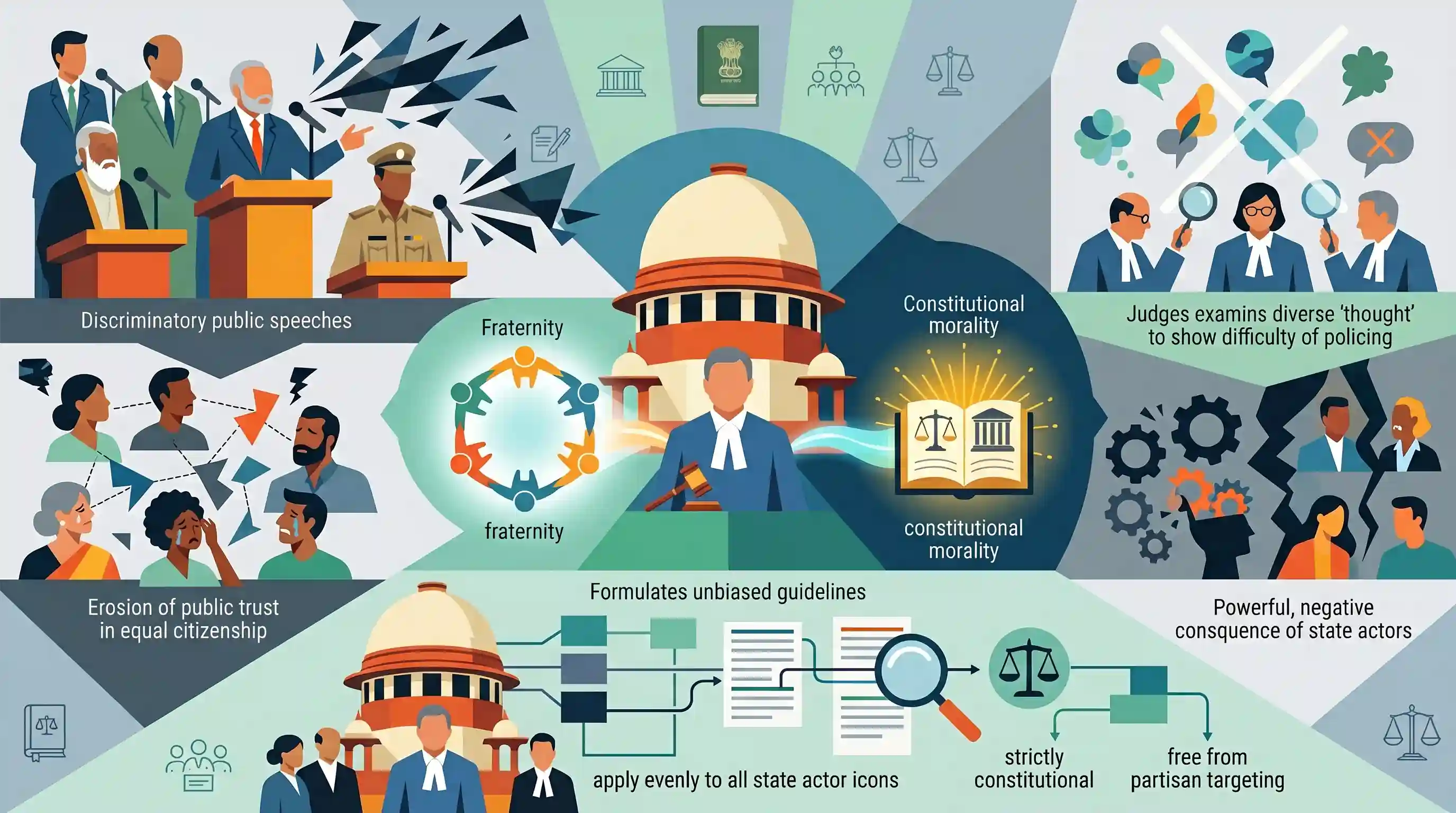
The article highlights the tension between freedom of speech and constitutional morality. Derogatory speech by high constitutional functionaries breaches the foundational value of fraternity and equal citizenship, making it a critical issue for governance, administrative ethics, and judicial oversight.
Summary
The Supreme Court heard a petition addressing the rise of discriminatory public speeches by political leaders, senior bureaucrats, and police officers, noting that such statements erode public trust in equal citizenship. A bench led by Chief Justice Surya Kant underscored the critical need for constitutional functionaries to uphold constitutional morality and foster fraternity. While acknowledging the difficulty of policing 'thought,' the Court recognized the serious administrative and societal consequences of hate speech when delivered by state actors. The Court agreed to objectively examine the formulation of guidelines to check such behavior, emphasizing that the exercise must remain strictly constitutional and free from partisan targeting.
Key Points
- The Supreme Court emphasized that political leaders and public office-holders must practice constitutional morality, foster fraternity, and demonstrate mutual respect.
- A petition highlighted the normalisation of toxic, discriminatory speeches by Chief Ministers, senior bureaucrats, and police officers, arguing it legitimises exclusionary governance.
- The petitioner sought guidelines to regulate the consequences of derogatory public speech by constitutional functionaries without imposing prior censorship.
- The Court acknowledged that such speech carries the 'imprimatur of the State' and can negatively shape public perception and law enforcement action.
- The bench stated that formulating guidelines must be an objective, 'contemplative and constitutional exercise' rather than a populist one targeting specific political parties.
Important Terms
Constitutional Morality

Adherence to the core values, spirit, and ethical norms of the Constitution, rather than just its literal text, ensuring governance remains democratic and inclusive.
UPSC context
GS II & GS IV: Tested under 'Salient Features of Constitution' and 'Ethics in Public Administration' as a check on arbitrary power.
Fraternity
A sense of common brotherhood and sisterhood among all citizens that ensures the dignity of the individual and the unity and integrity of the nation.
UPSC context
GS II: A foundational Preamble value frequently explored in the context of social harmony and secularism.
Hate Speech
Communication in speech, writing, or behavior that attacks, threatens, or insults a person or group based on identity factors like religion, caste, or ethnicity.
UPSC context
GS II: Linked to Article 19(2) 'reasonable restrictions' on free speech and the maintenance of public order.
Constitutional Functionaries
Individuals holding high offices established directly by the Constitution, such as the President, Ministers, and Judges, who are bound by oath to uphold its values.
UPSC context
GS II: Related to 'Functions and Responsibilities of Union/States' and the ethical standards expected of high public officials.
Equal Citizenship
The principle that every citizen, regardless of status or identity, holds the same political and civil rights and a shared claim to the state's protection.
UPSC context
GS II: Fundamental to Indian Secularism and the 'Basic Structure' of the Constitution regarding non-discrimination.
Representation of the People Act, 1951
The primary legislation governing the conduct of elections in India, including provisions for disqualifying candidates for corrupt practices or promoting enmity between groups.
UPSC context
GS II: A core syllabus topic (Salient features of RPA) concerning electoral integrity and political accountability.
Prelims Trap
"The Supreme Court can impose additional restrictions on the free speech of Ministers beyond Article 19(2)."
In Kaushal Kishor (2023), the SC ruled that NO additional restrictions can be imposed on a Minister's free speech beyond Article 19(2).
Static Concepts Connected
How does the Constitution and law regulate hate speech and uphold fraternity?
- Article 19(2): Allows reasonable restrictions on freedom of speech and expression in the interests of public order, decency, or morality.
- Article 51A(e): Mandates a Fundamental Duty for citizens to promote harmony and the spirit of common brotherhood, upholding fraternity.
- RPA 1951: Section 123(3A) makes the promotion of enmity between classes during elections a 'corrupt practice' that can void an election.
What is 'Constitutional Morality' in Indian jurisprudence?
- Core Philosophy: It means adherence to the core constitutional principles like liberty, equality, and fraternity, rather than just popular or societal morality.
- Ambedkar's View: B.R. Ambedkar viewed it as a cultivated sentiment to ensure the peaceful resolution of conflicts without resorting to revolution.
- Judicial Tool: The Supreme Court frequently uses it to strike down majoritarian laws or practices that violate fundamental rights (e.g., Navtej Singh Johar case).
Cross-Topic Patterns
Hate speech vs. Civil Service Conduct Rules
Toxic speech by bureaucrats directly breaches the Central Civil Services (Conduct) Rules, 1964, making this an applied case study for GS4 foundational values of impartiality and non-partisanship.
Freedom of Speech + BNS hate speech provisions
Regulating hate speech involves Sections 196 and 299 of the Bharatiya Nyaya Sanhita (BNS), testing the balance between criminalizing provocative speech and upholding Article 19(1)(a).

Expect a GS2 or GS4 question linking constitutional morality, fraternity, and the ethical conduct of public functionaries in 2026.
Linked PYQs · 3
Linked PYQs · 3
- 2025MainsGS2
"Constitutional morality is the fulcrum which acts as an essential check upon the high functionaries and citizens alike...." In view of the above observation of the Supreme Court, explain the concept of constitutional morality and its application to ensure balance between judicial independence and judicial accountability in India.
- 2021MainsGS2
‘Constitutional Morality’ is rooted in the Constitution itself and is founded on its essential facets. Explain the doctrine of ‘Constitutional Morality’ with the help of relevant judicial decisions.
- 2025MainsGS4
"Constitutional morality is not a natural sentiment but a product of civil education and adherance of the rule of law." Examine the significance of constitutional morality for public servant highlighting the role in promoting good governance and ensuring accountability in public administration.
